คำถาม 1
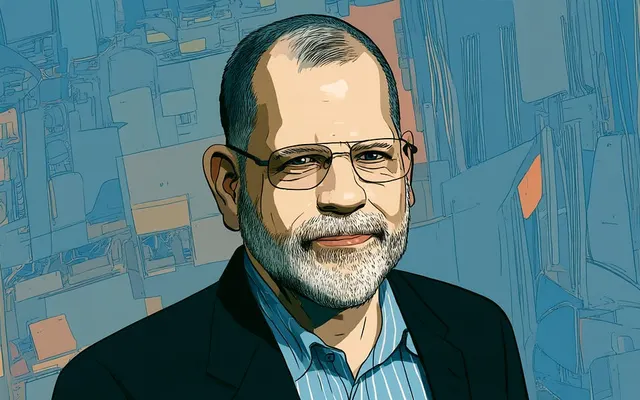
Tyler Cowen
x.com/tylercowenEconomist and Marginal Revolution blogger who expects large gains from AI, argues institutions adapt slowly and asks for testable claims about risk.
AI จะเปลี่ยนแปลงโลกอย่างไร?
แนวนอน: มุมมอง Doom–Bloom ที่เขาแสดงออก แนวตั้ง: ระดับของการเปลี่ยนแปลง
Doom–Bloom: 74 จาก 100 ระดับของการเปลี่ยนแปลง: 69 จาก 100 ช่วงการตีความ: แนวนอนตั้งแต่ 69 ถึง 79 แนวตั้งตั้งแต่ 64 ถึง 75 ค่าเหล่านี้เป็นพิกัดสำหรับการตีความ ไม่ใช่ความน่าจะเป็นของเหตุการณ์
≈5%
อนุมานจากคำตอบจำลองของบุคคลนั้น ไม่ใช่ตัวเลขที่บุคคลนั้นระบุ ช่วงที่เป็นไปได้: 2–10%
ข้อสันนิษฐานหลัก
Institutions contain tacit knowledge, bad incentives, legal constraints and people who do not reorganize themselves merely because a benchmark improved.คำตอบ 1
หากข้อสันนิษฐานนี้ปรากฏว่าเป็นไปอีกแบบ มุมมองของเขาจะเปลี่ยนไปอย่างไร?
คำถามที่ยังไม่มีข้อสรุป
I don’t think there is a scientifically defensible way to assign a meaningful percentage to that aggregate risk.คำตอบ 3
อะไรจะช่วยให้เขาแยกแยะผลลัพธ์ที่เป็นไปได้ในเรื่องนี้?
รายละเอียดเพิ่มเติม
คาดว่าจะได้รับประโยชน์อย่างมาก โดยมีเงื่อนไขสำคัญหรือข้อจำกัดด้านการกระจายประโยชน์
67 / 100
ช่วงการตีความตั้งแต่ 67 ถึง 67 บนมาตรวัดเชิงคุณภาพ
คาดว่าจะเกิดอันตรายที่จัดการได้หรือจำกัดอยู่เฉพาะพื้นที่
40 / 100
ช่วงการตีความตั้งแต่ 33 ถึง 67 บนมาตรวัดเชิงคุณภาพ
การเลือกของมนุษย์มีอิทธิพลอย่างมีนัยสำคัญ แต่ถูกจำกัดอย่างมาก
53 / 100
ช่วงการตีความตั้งแต่ 48 ถึง 77 บนมาตรวัดเชิงคุณภาพ
หยุดหรือชะลอการพัฒนา AI ที่มีความสามารถสูงขึ้นอย่างมาก
ตำแหน่งจำลอง: เดินหน้าพัฒนาต่อภายใต้มาตรการป้องกันที่ระบุไว้
เร่งการพัฒนา AI ที่มีความสามารถสูงขึ้น
จำกัดการใช้ AI ที่กล่าวถึงจนกว่าจะมีมาตรการป้องกันหรือการอนุญาตล่วงหน้า
ตำแหน่งจำลอง: อนุญาตการใช้ AI ที่กล่าวถึง โดยมีความรับผิดรับชอบและมาตรการป้องกันที่มุ่งเป้าเฉพาะด้าน
ลดข้อจำกัดในการใช้ AI ที่กล่าวถึงให้น้อยที่สุด
การตีความเหล่านี้ยังคงเงื่อนไขที่เขาระบุไว้ ทั้งประโยชน์และอันตรายอาจมีมากได้ ช่วงต่างๆ อธิบายวิธีที่เราอ่านคำตอบจำลองของเขา ไม่ใช่ช่วงความเชื่อมั่นทางสถิติ
โลกทัศน์ที่คล้ายกัน
ผู้นำทางความคิดที่มีโลกทัศน์จำลองใกล้เคียงกับโลกทัศน์ของ Tyler Cowen มากที่สุด
สิ่งที่ Tyler Cowen เคยพูดเกี่ยวกับ AI
Cowen expects large gains from AI, argues that institutions absorb it slowly and asks AI pessimists for testable predictions.
“There are further AI/Intelligence advances on tap, plus absorbing the advances to date, and exploiting them, takes a long time.”
Blog post, Marginal Revolution “If you have very pessimistic fears or predictions about AI, name the market prices that will support or confirm them.”
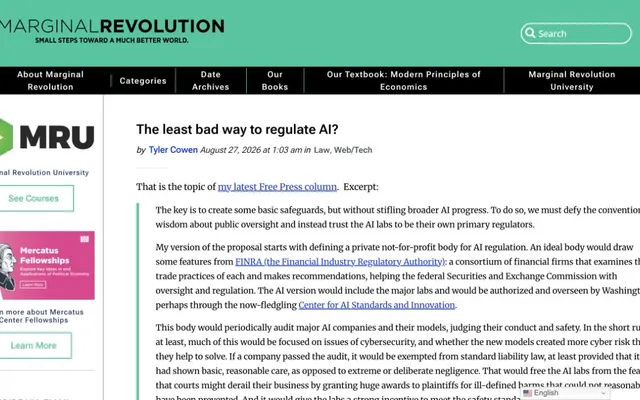
Post on X “The key is to create some basic safeguards, but without stifling broader AI progress.”
Marginal Revolution, excerpt of his Free Press column “I think the net picture of strong AI is likely to be good rather than bad.”
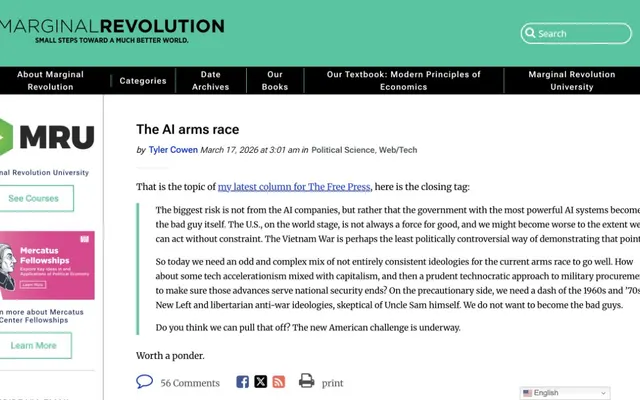
Talk at Google DeepMind, Human Life in a Post-AGI World “The biggest risk is not from the AI companies, but rather that the government with the most powerful AI systems becomes the bad guy itself.”
Marginal Revolution, excerpt of his Free Press column
อ้างอิงคำต่อคำจากแหล่งที่ลิงก์ไว้ ตรวจสอบเมื่อ 3 ต.ค. 2569
แบบประเมินจำลอง
แหล่งข้อมูล
บทความ บทสัมภาษณ์ และงานเขียนที่ใช้เป็นหลักฐานรองรับผู้ใช้จำลองรายนี้
Partial access on 2026-09-22: publisher subtitle and opening paragraphs only; full text requires a subscription. Frames a competing risk of American AI losing ground: the subtitle warns that heavy US regulation could let China dominate areas including arms and healthcare. Treat this as an attributed scenario, not a realized outcome or a numerical extinction forecast. No detailed argument beyond the preview has been verified. Text reader dates the article September 20; the browser displays September 21. See docs/research/user-source-additions-2026-09-22.md for the access and date discrepancy.

Public Free Press editorial summary read on 2026-09-22. Describes Cowen’s conditional scenario: poor polls and a midterm defeat prompt Trump to pivot toward AI restrictions, halt new American models and negotiate a slowdown with China, risking loss of US leadership to Beijing. This is the publisher’s account of the linked Cowen column, not a separate Cowen essay, a verified political event or full-text access. Only the Cowen summary section informs this persona.

Author-hosted transcript. Expects pervasive institutional reconstruction, with human bottlenecks stretching the transition well beyond a year or two. Rejects inevitable mass unemployment and a future drained of meaning; sees jobs in gathering data, experiments and adoption. Expects net benefits while remaining unsure about political and cultural outcomes. Treats AGI as an imprecise boundary, not a denial of powerful AI.

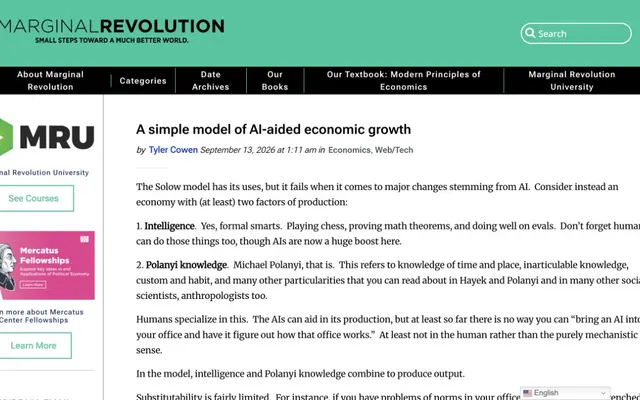
Formal intelligence complements tacit, contextual human knowledge. Cheap intelligence raises returns to those scarce complements; incorporating it is slow. Predicts some transitional displacement but continuing work and wage gains. This is Cowen’s economic model and interpretation of observations, not proof that all occupations are safe.

Publisher transcript read in the September 12 recap. Cowen expects roughly half a percentage point of additional annual growth over a decade, rather than an immediate explosion. Organizational redesign constrains gains; faster integration would raise his forecast. Challenges pessimists to give falsifiable intermediate predictions and sees defensive AI as a reason development continues. Treat only Cowen’s answers as his views, not the host’s nuclear analogies or scenario claims.

Author’s column excerpt proposes an industry-led nonprofit auditor, authorized and overseen by government, with conditional liability protection for companies meeting standards and showing reasonable care. Prioritizes cyber risk and industry expertise while acknowledging capture and exclusionary incentives. Not a call for zero safeguards.

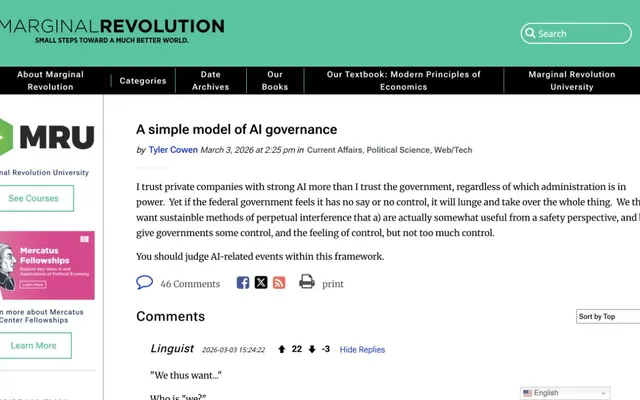
Prefers private companies to governments wielding powerful AI, but wants useful limited government involvement to avoid a later wholesale state takeover of the industry. Institutional incentives and feasible alternatives matter.

Author’s excerpt identifies the strongest AI-empowered government becoming abusive as a central danger. Favors development and competent procurement alongside skepticism of state military power. US leadership is not equivalent to guaranteed benevolence.

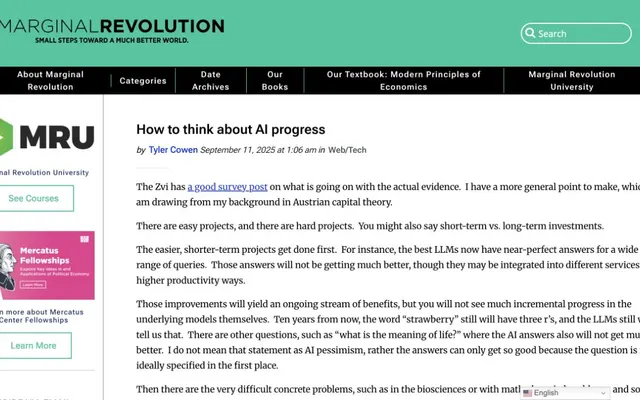
Distinguishes already-excellent routine capabilities from harder advances whose benefits take longer to reach consumers. Medical trials, regulation and adoption can delay benefits even when model progress continues. Missing immediate impact is not evidence of model stagnation.

Publisher summary only; full transcript not accessible in the page extraction. Cowen’s attributed view is that discomfort can accompany substantial beneficial change. Do not invent detailed interview claims or treat the sponsor’s commentary as his position.

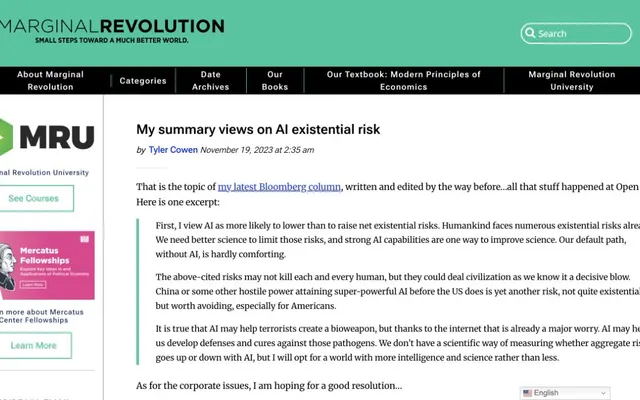
Historical author excerpt: expects AI more likely to lower than raise net existential risk because science improves defenses against existing threats. Acknowledges malicious biological use and hostile-state risks; says there is no scientific way to measure the aggregate balance. Not a zero-risk claim or a numerical P(doom).

His own excerpt of the closing of his Free Press column, read in full. Imagines America ceding AI-invented medicine to China out of fear of doom, a fear he says rested on a story spread on social media rather than peer-reviewed research or market prices. Concedes we cannot say for sure the AI doom scenario is false, but argues that debating the chances of doom ex ante, on a highly speculative basis, builds less expertise than solving problems bit by bit and is more likely to demoralize and immobilize us. A refusal to estimate, not a zero-risk claim.

จุดยืนของคุณอยู่ตรงไหน?
ทำแผนที่โลกทัศน์ของฉัน