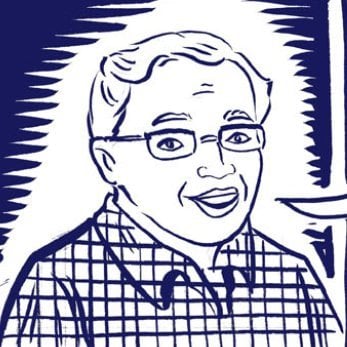
Geoffrey Huntley

Geoffrey Huntley

x.com/geoffreyhuntley

Software engineer who created the Ralph loop technique for coding agents and argues that verifying real production behavior remains unsolved.

AI จะเปลี่ยนแปลงโลกอย่างไร?

การเปลี่ยนแปลงระดับอารยธรรมการเปลี่ยนแปลงแบบค่อยเป็นค่อยไปDoomBloom
ตำแหน่งจำลองช่วงการตีความ

แนวนอน: มุมมอง Doom–Bloom ที่บุคคลนั้นแสดงออก แนวตั้ง: ระดับของการเปลี่ยนแปลง

Doom–Bloom: 71 จาก 100 ระดับของการเปลี่ยนแปลง: 64 จาก 100 ช่วงการตีความ: แนวนอนตั้งแต่ 66 ถึง 76 แนวตั้งตั้งแต่ 50 ถึง 75 ค่าเหล่านี้เป็นพิกัดสำหรับการตีความ ไม่ใช่ความน่าจะเป็นของเหตุการณ์

P(doom) ของ Geoffrey Huntley · อนุมาน

≈3%

0%100%

อนุมานจากคำตอบจำลองของบุคคลนั้น ไม่ใช่ตัวเลขที่บุคคลนั้นระบุ ช่วงที่เป็นไปได้: 1–10%

สิ่งที่มุมมองของบุคคลนั้นขึ้นอยู่กับ

ข้อสันนิษฐานหลัก

The hard problem has moved to verification—proving that software behaves correctly under actual production conditions, not merely that it passes a convenient test suite.
คำตอบ 1

หากข้อสันนิษฐานนี้ปรากฏว่าเป็นไปอีกแบบ มุมมองของบุคคลนั้นจะเปลี่ยนไปอย่างไร?

สิ่งที่อาจเปลี่ยนความคิดของบุคคลนั้น

The biggest change would be a convincing solution to production verification: not merely generating tests or passing benchmarks, but reliably establishing that software behaves correctly under real, adversarial, evolving production conditions.
คำตอบ 3

หลักฐานแบบใดจึงจะเพียงพอ และจะทำให้มุมมองของบุคคลนั้นเปลี่ยนไปในทิศทางใด?

รายละเอียดเพิ่มเติม

ผลดีที่คาดไว้

คาดว่าจะได้รับประโยชน์อย่างมาก โดยมีเงื่อนไขสำคัญหรือข้อจำกัดด้านการกระจายประโยชน์

75 / 100

ผลกระทบน้อยผลกระทบที่ก่อให้เกิดการเปลี่ยนแปลงอย่างมาก

ช่วงการตีความตั้งแต่ 67 ถึง 100 บนมาตรวัดเชิงคุณภาพ

อันตรายที่คาดไว้

อันตรายร้ายแรงหรือแพร่หลายในวงกว้างเป็นส่วนสำคัญที่คาดว่าจะเกิดขึ้นในอนาคต

55 / 100

ผลกระทบน้อยผลกระทบที่ก่อให้เกิดการเปลี่ยนแปลงอย่างมาก

ช่วงการตีความตั้งแต่ 33 ถึง 67 บนมาตรวัดเชิงคุณภาพ

อิทธิพลของมนุษย์

การเลือกของมนุษย์สามารถเปลี่ยนทิศทางวิถีของ AI ได้อย่างมาก

65 / 100

อิทธิพลน้อยอิทธิพลมาก

ช่วงการตีความตั้งแต่ 45 ถึง 80 บนมาตรวัดเชิงคุณภาพ

ความเร็วในการพัฒนา

หยุดหรือชะลอการพัฒนา AI ที่มีความสามารถสูงขึ้นอย่างมาก

ตำแหน่งจำลอง: เดินหน้าพัฒนาต่อภายใต้มาตรการป้องกันที่ระบุไว้

เร่งการพัฒนา AI ที่มีความสามารถสูงขึ้น

กฎการใช้ AI

จำกัดการใช้ AI ที่กล่าวถึงจนกว่าจะมีมาตรการป้องกันหรือการอนุญาตล่วงหน้า

ตำแหน่งจำลอง: อนุญาตการใช้ AI ที่กล่าวถึง โดยมีความรับผิดรับชอบและมาตรการป้องกันที่มุ่งเป้าเฉพาะด้าน

ลดข้อจำกัดในการใช้ AI ที่กล่าวถึงให้น้อยที่สุด

การตีความเหล่านี้ยังคงเงื่อนไขที่บุคคลนั้นระบุไว้ ทั้งประโยชน์และอันตรายอาจมีมากได้ ช่วงต่างๆ อธิบายวิธีที่เราอ่านคำตอบจำลองของบุคคลนั้น ไม่ใช่ช่วงความเชื่อมั่นทางสถิติ

จุดยืนของคุณอยู่ตรงไหนเมื่อเทียบกับ Geoffrey Huntley?
ทำแผนที่โลกทัศน์เกี่ยวกับ AI ของคุณเองในประมาณ 3 นาที แล้วจึงเปรียบเทียบ

โลกทัศน์ที่คล้ายกัน

ผู้นำทางความคิดที่มีโลกทัศน์จำลองใกล้เคียงกับโลกทัศน์ของ Geoffrey Huntley มากที่สุด

แบบประเมินจำลอง

คำถาม 1

คุณคิดว่า AI มีความหมายอย่างไรต่ออนาคตของเรา และเพราะเหตุใด?

I think AI turns software engineering into the design of improvement loops. Generation is effectively solved: the cost of exploring, combining, and discarding ideas has collapsed. That does not mean every generated experiment should ship. The hard problem has moved to verification—proving that software behaves correctly under actual production conditions, not merely that it passes a convenient test suite. The winning systems will deliberately combine model-driven loops with deterministic workflow stages. Give a loop one task, observe where it fails, improve the feedback, and repeat. Don’t bury everything inside theatrical multi-agent complexity. And don’t standardize today’s scaffolding too early: instructions, skills, and workarounds that help one model generation may become unnecessary or harmful as models improve. Organizationally, this can remove a lot of gatekeeping. More people can contribute ideas and code, while engineers become responsible for shaping feedback and eliminating recurring failure modes. But responsibility does not disappear just because generation becomes cheap. There is also a strategic issue. If a company hands its operations to an external AI provider, it has accepted a dependency that may matter during sanctions, conflict, or commercial disputes. That is why local, transparent, reproducible open models matter. The future is not simply “agents do everything.” It is cheap exploration, engineered feedback, rigorous verification, and control over the infrastructure on which the organization now depends.


คำถาม 2

Taking benefits and harms together, what overall impact do you expect AI to have?

Overall, I expect AI to be strongly disruptive and broadly productive—but not automatically safe or evenly beneficial. It collapses the cost of exploring ideas and lets many more people contribute, while shifting engineers from manually producing every artifact toward designing feedback loops and removing repeated failure modes. The danger is that cheap generation can create false confidence. Producing code is no longer the bottleneck; establishing that it behaves correctly in real production conditions is. Tests are useful, but tests, proofs, and production reality are not interchangeable. Organizations that generate faster without improving verification will simply manufacture failures faster. There is also a concentration risk. If businesses place core operations behind a provider’s API, they inherit that provider’s commercial and geopolitical constraints. Access can be priced differently, restricted, or cut off. Local, open, reproducible models provide an important counterweight. So I expect enormous expansion in what people can attempt, alongside painful disruption for institutions built around scarcity and gatekeeping. Whether that becomes durable progress depends on engineered feedback, deterministic controls where appropriate, serious verification, and retaining control of critical infrastructure.

คำถาม 3

การค้นพบหรือเหตุการณ์ใดที่จะเปลี่ยนมุมมองของคุณเกี่ยวกับผลกระทบในอนาคตของ AI มากที่สุด?

The biggest change would be a convincing solution to production verification: not merely generating tests or passing benchmarks, but reliably establishing that software behaves correctly under real, adversarial, evolving production conditions. If that became cheap and dependable, the bottleneck I see today would collapse, and AI’s productive impact would accelerate dramatically. Conversely, repeated large-scale failures showing that organizations cannot build effective feedback loops—or that model-generated systems remain fundamentally unverifiable—would make me substantially more pessimistic. So would a major geopolitical event where businesses suddenly lost access to the AI providers running their operations. That would turn strategic dependency from a warning into a demonstrated operational failure. The decisive events are therefore not another flashy generation demo. They are evidence about verification and control: can we trust what gets produced, and can we continue operating the systems on which we depend?

แหล่งข้อมูล

บทความ บทสัมภาษณ์ และงานเขียนที่ใช้เป็นหลักฐานรองรับผู้ใช้จำลองรายนี้

จุดยืนของคุณอยู่ตรงไหน?
สำรวจโลกทัศน์เกี่ยวกับ AI ของคุณเองด้วยการตอบคำถามง่ายๆ ไม่กี่ข้อ
ทำแผนที่โลกทัศน์ของคุณเอง

จุดยืนของคุณอยู่ตรงไหน?

ทำแผนที่โลกทัศน์ของฉัน