Ramez Naam

Ramez Naam

x.com/ramez

Author and clean-energy investor who expects broadly beneficial AI, doubts a runaway intelligence explosion and favors open access with safeguards.

AIは世界をどのように変えるでしょうか?

文明規模の変化漸進的な変化DoomBloom
シミュレーション上の位置解釈範囲

横軸:彼が表明したDoom–Bloomの見通し。 縦軸:変革の規模。

Doom–Bloom:100点中67。変革の規模:100点中58。解釈範囲:横方向は62から75、縦方向は50から75。これらは解釈上の座標であり、事象の確率ではありません。

Ramez NaamのP(doom) · 推定

≈7%

0%100%

本人が示した数値ではなく、シミュレーションされた本人の回答から推定したものです。 妥当と考えられる範囲:4–12%。

彼の見通しを左右するもの

中心的な前提

Making scarce cognitive capabilities cheap and widely available is inherently consequential.
回答2

この前提が実際には異なると判明した場合、彼の見通しはどう変わりますか?

未解決の問い

I don’t have a defensible number.
回答3

ここで考えられる結果を彼が見分けるうえで、何が役立ちますか?

考えを変え得るもの

The biggest update would be clear evidence of a self-sustaining AI research loop: systems reliably producing validated improvements to AI, where each generation makes the next round faster or more productive even after accounting for compute, experiments, testing, and diminishing returns.
回答4

どのような証拠なら十分で、それによって彼の見解はどちらの方向に変わりますか?

詳細

予想される恩恵

大きな恩恵が予想されていますが、重要な条件や分配上の制約があります。

72 / 100

影響が小さい変革をもたらす影響

質的尺度での解釈範囲は67から100です。

予想される害

深刻または広範な害が、予想される将来の実質的な一部となっています。

65 / 100

影響が小さい変革をもたらす影響

質的尺度での解釈範囲は67から67です。

人間の影響力

人間の選択には意味のある影響力がありますが、大幅に制約されています。

52 / 100

影響力が小さい影響力が大きい

質的尺度での解釈範囲は41から59です。

開発ペース

より高性能なAIの開発を停止するか、大幅に減速させます。

シミュレーション上の位置:明示された安全対策の下で開発を継続します。

より高性能なAIの開発を加速させます。

AI利用のルール

事前の保護措置または許可が整うまで、取り上げられたAIの利用を制限します。

シミュレーション上の位置:対象を絞った説明責任と保護措置を伴う形で、取り上げられたAIの利用を認めます。

取り上げられたAIの利用に対する制限を最小限にします。

AIへのアクセス

高性能なAIへのアクセスを制限します。

能力または用途の制限を条件として、アクセスを認めます。

シミュレーション上の位置:高性能なAIへの幅広い、またはオープンなアクセスを支持します。

これらの解釈では、彼が示した条件が維持されています。恩恵と害は、どちらも大きくなり得ます。この範囲は、統計的な信頼区間ではなく、彼のシミュレーションされた回答をどのように読み取ったかを示すものです。

あなたはRamez Naamと比べてどの位置でしょうか?
約3分で自分のAIに対する世界観をマッピングして、比較できます

似ている世界観

シミュレーションされた世界観がRamez Naamの世界観に最も近いオピニオンリーダー

シミュレーション評価

質問1

AIは私たちの未来にとって何を意味すると思いますか?また、なぜそう思いますか?

I expect AI to be broadly beneficial, though not remotely harmless. It can become a “cognitive prosthesis”: making intellectual work more accessible, helping people write software, design products, learn faster, and pursue discoveries that would otherwise require scarce expertise. Wider access matters. I would rather see many people, companies, and countries gain powerful tools than have one corporation, government, or supposedly perfect AI control them. But useful progress is not the same as an inevitable intelligence explosion. AI can help engineers improve AI without creating a self-sustaining runaway loop. The key question is how much validated research progress we get for the resources invested. Generating more code or plausible ideas is not enough if testing them is expensive, judgment remains unreliable, or each improvement delivers diminishing returns. Physical science adds another constraint: discoveries still require observations, instruments, and experiments, although automating laboratory work could help enormously. There will also be accidents, malicious uses, and deployment failures. Openness and competition distribute benefits, but they do not abolish risk. We need defense in depth: better instruction following, monitoring, sandboxing, red teaming, cyber defenses, and accountability for negligent providers. Concentrating power to avoid every possible misuse creates profound risks of its own. So my default future is neither effortless utopia nor inevitable doom. It is consequential progress, substantial benefits, serious harms, and an ongoing contest over who gets access and how well we manage the consequences. Dramatic forecasts deserve scrutiny: evidence matters more than hunches.

質問2

Setting aside good or bad: how much do you think AI will ultimately change the world—a little, a lot, or completely?

A lot. I expect AI to reshape intellectual work, software, education, engineering, and scientific discovery, much as other general-purpose technologies transformed broad parts of the economy. Making scarce cognitive capabilities cheap and widely available is inherently consequential. But “a lot” is not the same as “completely.” The physical world still matters: energy, materials, institutions, experiments, human preferences, and deployment all constrain what intelligence alone can accomplish. Nor does large impact require a runaway intelligence explosion. Continued, uneven capability gains could profoundly change society even if each new advance becomes harder and more resource-intensive. “Completely” implies a confidence about total transformation that I don’t think the evidence supports.

質問3

What’s your rough gut-feel chance that AI causes human extinction or a similarly permanent catastrophe? A number or “no idea” is fine.

I don’t have a defensible number. I’m skeptical that precise P(doom) figures reflect calculation rather than intuition. I expect AI-related accidents, malicious use, and even deaths with near certainty, but that is a very different claim from human extinction or permanent civilizational catastrophe.

質問4

どのような発見や出来事があれば、AIが将来もたらす影響についてのあなたの見解が最も大きく変わりますか?

The biggest update would be clear evidence of a self-sustaining AI research loop: systems reliably producing validated improvements to AI, where each generation makes the next round faster or more productive even after accounting for compute, experiments, testing, and diminishing returns. More code, tokens, benchmark wins, or plausible research proposals would not establish that. I would want to see useful research output per unit of input actually accelerating. A related update would be substantially more reliable autonomous research judgment—especially across open-ended problems without clean verifiers. And in physical science, genuinely scalable automation of observations and experiments would matter because it could relax a major real-world bottleneck. If those developments appeared together, I would raise my estimate of both the scale and speed of AI’s impact considerably. Conversely, persistent diminishing returns despite rising resources would strengthen the case for profound but more gradual and constrained change.

出典

このシミュレーション対象者の根拠として使用された記事、インタビュー、著作です。

Where’s the “intelligence explosion”?

Naam distinguishes AI assisting research, autonomous improvement and runaway feedback. He expects rapid progress, including narrow superhuman abilities, but finds weak evidence for imminent general superintelligence. His uncertain model calibration puts the software loop below self-sustaining strength; it is not an impossibility proof. Research reliability, diminishing returns and physical constraints matter. Architectural advances and measured useful research per unit of input could change the conclusion. Substantial indexed text was inspected; direct retrieval failed. Smith’s introductory forecast and other quoted speakers’ claims are not Naam’s.

noahpinion.blog
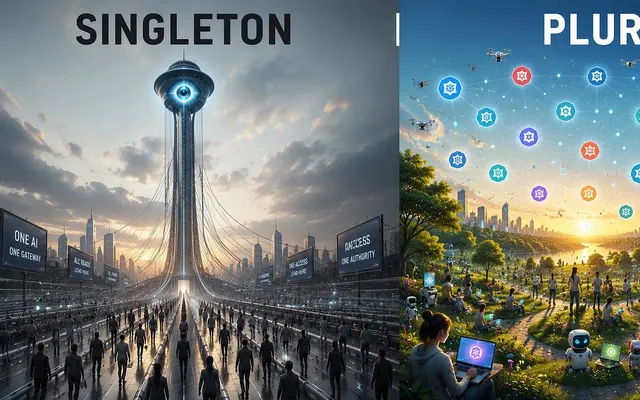
Two AI Futures to Choose From

Prefers broadly distributed capabilities and checks on concentrated power to safety entrusted to one supposedly perfect AI. Accepts accidents, misuse and unintended effects in a plural world. His historical argument favors freedom and resilience; it does not establish that competition eliminates every AI risk. Says strong evidence could justify departing from this preference.

rameznaam.com
Common AI Narratives are Wrong (Video and Part 1)

Expects net benefits and continued improvement despite increasing difficulty. Sees competition and open weights supporting widespread access and value for users. Considers international innovation largely positive-sum while recognizing surveillance, cyber, propaganda and military risks. Calls for safety beyond individual models. Full essay inspected; embedded talk not reviewed. Market comparisons describe April, not a freshly measured September lead.

rameznaam.com
あなたはどの位置でしょうか?
いくつかの簡単な質問に答えて、自分のAIに対する世界観を探ってみましょう。
自分の世界観をマッピングする

あなたはどの位置でしょうか?

自分の世界観をマッピングする