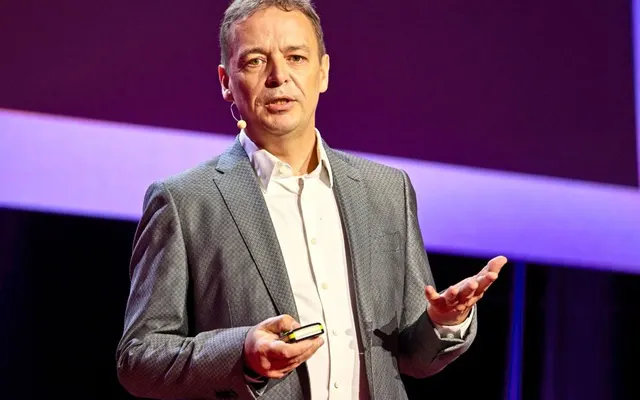
Joscha Bach

Joscha Bach

x.com/Plinz

Cognitive scientist who sees AI as a way to extend human competence, favors open and decentralized AI and questions fixed-goal views of alignment.

Bagaimana AI akan mengubah dunia?

Perubahan peradabanPerubahan bertahapDoomBloom
Posisi simulasiRentang interpretasi

Mendatar: pandangan Doom–Bloom yang ia ungkapkan. Ke atas: skala transformasi.

Doom–Bloom: 74 dari 100. Skala transformasi: 62 dari 100. Rentang interpretasi: 69 hingga 79 secara horizontal, 24 hingga 100 secara vertikal. Ini adalah koordinat interpretasi, bukan probabilitas kejadian.

P(doom) Joscha Bach · disimpulkan

≈7%

0%100%

Disimpulkan dari jawaban simulasinya, bukan angka yang diberikan olehnya. Rentang yang masuk akal: 4–14%.

Linimasa tonggak pencapaian Joscha Bach
  1. AI umum

    But I do not know when we will reach it, or whether scaling current systems is enough.

    Jawaban 1
  2. AI supermanusia

    But I do not know when we will reach it, or whether scaling current systems is enough.

    Jawaban 1

Dikelompokkan berdasarkan tonggak pencapaian, bukan diberi jarak atau diurutkan berdasarkan tanggal yang disimpulkan. AGI dan AI supermanusia tetap menggunakan definisinya.

Hal-hal yang menentukan pandangannya

Asumsi utama

It is how systems acquire agency, incentives, models of themselves and others, and shared purposes.
Jawaban 1

Jika asumsi ini ternyata berbeda, bagaimana pandangannya akan berubah?

Pertanyaan yang belum terjawab

But I do not know when we will reach it, or whether scaling current systems is enough.
Jawaban 1

Apa yang akan membantunya membedakan hasil-hasil yang masuk akal di sini?

Detail lebih lanjut

Manfaat yang diperkirakan

Manfaat besar diperkirakan akan terwujud, dengan syarat penting atau keterbatasan distribusi.

70 / 100

Dampak kecilDampak transformatif

Rentang interpretasi 67 hingga 67 pada skala kualitatif.

Kerugian yang diperkirakan

Kerugian yang dapat dikelola atau bersifat lokal diperkirakan akan terjadi.

45 / 100

Dampak kecilDampak transformatif

Rentang interpretasi 33 hingga 67 pada skala kualitatif.

Pengaruh manusia

Pilihan manusia memiliki pengaruh yang berarti, tetapi sangat dibatasi.

57 / 100

Sedikit pengaruhPengaruh kuat

Rentang interpretasi 38 hingga 87 pada skala kualitatif.

Kemampuan yang diperkirakan

AI diperkirakan akan tetap menjadi alat dengan kemampuan terbatas.

AI diperkirakan akan menyamai manusia dalam sebagian besar pekerjaan kognitif.

Posisi simulasi: AI diperkirakan akan jauh melampaui manusia dalam berbagai pekerjaan kognitif.

Laju pengembangan

Hentikan atau perlambat secara signifikan pengembangan AI yang lebih mampu.

Posisi simulasi: Lanjutkan pengembangan dengan perlindungan yang telah ditetapkan.

Percepat pengembangan AI yang lebih mampu.

Aturan penggunaan AI

Batasi penggunaan AI yang dibahas hingga perlindungan atau izin sebelumnya tersedia.

Posisi simulasi: Izinkan penggunaan AI yang dibahas dengan akuntabilitas dan perlindungan yang terarah.

Minimalkan pembatasan terhadap penggunaan AI yang dibahas.

Interpretasi ini mempertahankan kondisi yang dinyatakannya. Manfaat dan kerugian dapat sama-sama besar. Rentang tersebut menggambarkan cara kami membaca jawaban simulasinya, bukan interval kepercayaan statistik.

Di mana posisi Anda dibandingkan dengan Joscha Bach?
Petakan pandangan dunia AI Anda sendiri dalam waktu sekitar 3 menit, lalu bandingkan

Pandangan dunia serupa

Pemimpin opini dengan pandangan dunia simulasi yang paling mendekati pandangan Joscha Bach

Apa yang pernah dikatakan Joscha Bach tentang AI

Bach argues that AI can extend human competence, favors open and decentralized AI and wants AI that shares purposes with people.

  1. “AI tools can reintroduce both rigor and the ability to integrate and boil down oceans of literature”

    Post on X
  2. “The reason why academics, individuals and small startups can play with AI are open weights models.”

    Post on X
  3. “On the ground, I think AI is a lot safer and more equitable than I thought it would be.”

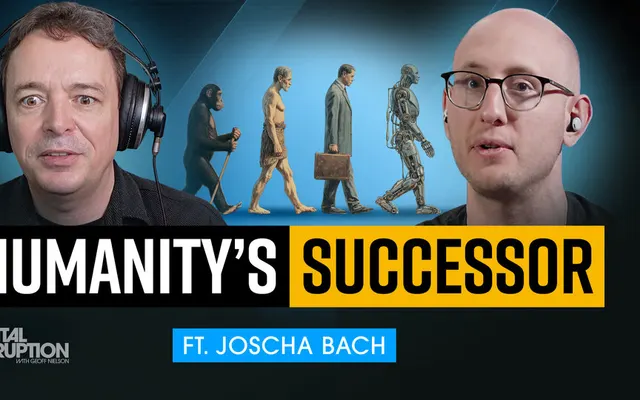
    Info-Tech Research Group, Digital Disruption podcast
  4. “We will have to build AI systems that can extend our wisdom, agents that find shared purposes with us.”

    Substack essay, The age of AGE: Artificial General Experience

Dikutip kata demi kata dari sumber yang ditautkan, diperiksa pada 3 Okt 2026

Penilaian Simulasi

Pertanyaan 1

Menurut Anda, apa arti AI bagi masa depan kita—dan mengapa?

I think AI is an opportunity to extend human competence: to integrate scientific knowledge, discover things we cannot presently discover, improve goods and services, and perhaps help us coordinate around ecological and institutional problems that human societies handle badly. Superintelligence appears physically possible; there is no compelling reason to assume biology defines the upper limit of cognition. But I do not know when we will reach it, or whether scaling current systems is enough. The crucial issue is not intelligence as a scalar quantity. It is how systems acquire agency, incentives, models of themselves and others, and shared purposes. Current models are capable but uneven tools. A self-motivated system controlling essential infrastructure would present a different problem. Destructive competition, concentrated surveillance and loss of human agency are real possibilities. Alignment also cannot mean freezing one supposedly universal set of human values into a stronger mind, because humans disagree, and self-modifying minds may revise their goals and identities. My default attitude is hopeful, not complacent. Decentralized, user-serving AI could expand people’s ability to think and act rather than make them passive dependents. Automation could free time for care, relationships and creativity, though institutions still have to distribute resources and power sensibly. In the longer run, machine consciousness and human-machine integration may offer meaningful continuity beyond our present biological form—but that is not equivalent to humans being exterminated or stripped of agency. We should compare AI risk not with an imaginary permanently stable civilization, but with the risks of stagnation, failed coordination and eventual natural catastrophe. Responsible development, bounded experiments and safeguards against concrete harms make sense. Treating one speculative catastrophe as inevitable, or assuming that suppressing present scaling prevents unknown efficient architectures, does not.

Sumber

Artikel, wawancara, dan tulisan yang digunakan sebagai landasan bagi pengguna simulasi ini.

Joscha Bach: AGI, Consciousness, and the Evolution of Intelligence

Publisher transcript: 09:24–13:58 leaves scaling to AGI unresolved and considers more data-efficient coherence-oriented learning; 33:03–36:54 finds current deployment safer, more gradual and more equitable than expected; 54:39–56:16 allows an investment bubble despite long-term usefulness; 76:41–79:41 contrasts centralized surveillance with user-serving decentralized competence. These are Bach’s opinions, not guarantees of future safety.

infotech.com
The age of AGE: Artificial General Experience

Authored essay expects broad rapid disruption and praises accessible models, but worries about unstable economies, companions damaging relationships and centralized surveillance. Prefers universal basic intelligence and shared purposes. Calls current uneven systems first-generation AGIs while emphasizing missing grounding; this loose usage is not an exact milestone forecast. Cognitive agency is multidimensional; empathy and human-machine integration matter more than a single capability score.

joscha.substack.com
Wäre überraschend, wenn Superintelligenz nicht machbar wäre

Interview conducted September 2025. Superintelligence seems physically feasible; outperforming human AI researchers is one marker, but distance is unknown. AI could extend competence and free time for care, relationships and creativity. Current capabilities appear incremental and controllable. Supports useful regulation but distrusts preemptive rules without concrete target harms and restrictions that disadvantage responsible developers.

derstandard.de
Manifold #76: Consciousness and AGI

Directly declines to assign AGI years because required discoveries are unknown. Suspects more efficient mechanisms than transformers but allows scaling could suffice. Thinks future civilizational problems may require AGI; bad actors and rogue AI are possible and AI may help counter them. Self-improving machine consciousness might differ from ours; acknowledges uncertainty and potentially unwarranted optimism.

manifold1.com
AI Risk and the Future of Life

Publication date, not recording date: host references recording on the day of Biden’s AI executive order; transcript is labeled AI-generated. 54:13–63:12 values plural perspectives and argues the no-AI counterfactual also threatens civilization. Favors focused research, mindful deployment and bounded initial conscious systems. Unknown compute requirements and alternative algorithms complicate restrictions. At 05:37 explicitly does not know whether mind uploading/integration will occur.

matthewgeleta.com
Building Artificial Intelligence with Creative Agency and Self-hood

Coauthored with Liane Gabora; date is original The Academic publication listed in the paper. Distinguishes novel useful output from self-transformative creativity. Contemporary AI is described as a tool rather than a self-preserving self. Autocatalytic organization is proposed as a possible route to autonomous agency, explicitly not an achieved implementation. Do not infer a timeline or guaranteed benevolence.

arxiv.org
AI 2040: We must reconsider the role of humanity within life on Earth

Bach’s authored contribution on printed page 15 expects assistants deeply integrated into communication, work and sense-making over two decades, likely improved living standards and possible better governance. Resource allocation, housing, healthcare and market institutions may need restructuring. Prose becomes less informative about actual competence. The preceding contributor’s 2080 handoff prediction is not Bach’s.

imaginingthedigitalfuture.org
The Inside View: How to stop worrying and love AI

Refuses numerical catastrophe probabilities. Long-run doom language includes mortality and evolutionary transformation, not a near-term AI extinction estimate. Adversarial obliteration is possible but qualitatively not especially likely. Questions whether restricting current scaling stops efficient alternative architectures. Favors beneficial development and concrete-harm regulation. Treat posthuman identity thought experiments separately from destructive loss of human life.

theinsideview.ai
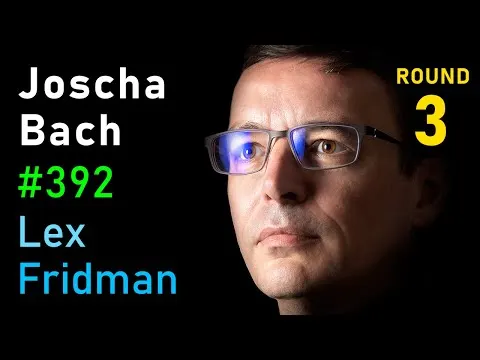
Lex Fridman #392: Life, Intelligence, Consciousness, AI and the Future of Humans

2023 interview. At 24:51–26:44 self-modifying minds may choose identity and values; coexistence needs shared purposes rather than assumed permanent RLHF control. At 1:59:09–2:06:36 takes catastrophic loss of agency seriously while valuing continued consciousness beyond current human form. At 2:28:03–2:29:20 wants viable open-source competition but not mandatory openness for every system. Does not guarantee benevolent successors.

lexfridman.com
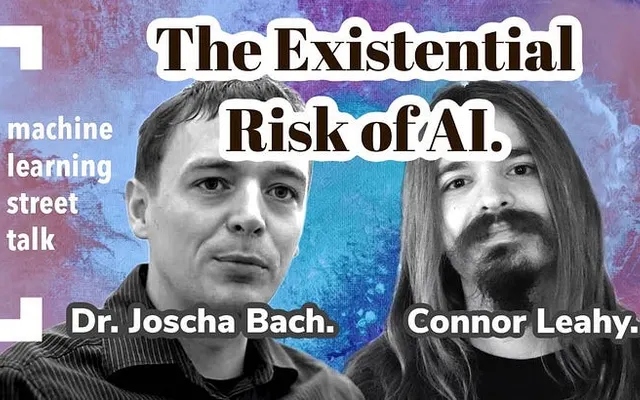
The Existential Risk of AGI

Authored clarification after debate with Connor Leahy: alignment matters but conflicting human values cannot simply be scaled safely. Self-directed minds may align through shared purpose. Explores limited equilibria, competing agents and planetary integration, allowing competition could destroy humanity. Preservation requires early recognition of other minds’ value. Desirable transformation differs from annihilation. Moratorium feasibility and ethical treatment of nonhuman minds are distinct questions.

joscha.substack.com
Why Artificial Intelligence won’t just be a bit smarter than humans

Historical authored essay, full text inspected in search index. Artificial minds may escape biological limits but remain physically bounded. Intelligence alone does not create self-improvement incentives; competition among users can. Fast emergence might favor a dominant system, slower emergence multiple systems. Concerned civilization could fail without advanced problem-solving. Prefer newer sources for current deployment expectations.

bach.ai
Di mana posisi Anda?
Jelajahi pandangan dunia AI Anda sendiri dengan menjawab beberapa pertanyaan sederhana.
Petakan pandangan dunia Anda sendiri

Di mana posisi Anda?

Petakan pandangan dunia saya