Victor Taelin

Victor Taelin

x.com/victortaelin

Programming foundations and persistent memory for agents.

How will AI change the world?

Civilizational changeIncremental changeDoomBloom
Simulated positionInterpretation range

Across: their expressed Doom–Bloom outlook. Up: scale of transformation.

Doom–Bloom: 74 out of 100. Scale of transformation: 38 out of 100. Interpretation ranges: 74 to 75 horizontally, 0 to 85 vertically. These are interpretation coordinates, not event probabilities.

Victor Taelin’s estimated P(doom)

<1%

0%100%

Inferred from their broader worldview and priorities. Approximate interpretation range: 0–3%. Applies to the outcome and conditions in their simulated answers; this is an inferred percentage.

What their outlook hinges on

A central assumption

But that benefit depends on reliability.
Answer 2

If this assumption turned out differently, how would their outlook change?

An unresolved question

Persistent memory, precise specifications, and reliable verification together could make long-running agents far more useful—but exactly how far this extends beyond software remains uncertain.
Answer 1

What would help them distinguish the plausible outcomes here?

More details

Expected upside

Substantial benefits are expected, with important conditions or distribution limits.

67 / 100

Little impactTransformative impact

Interpretation range 67 to 67 on the qualitative scale.

Expected harm

Manageable or localized harms are expected.

34 / 100

Little impactTransformative impact

Interpretation range 33 to 33 on the qualitative scale.

Demonstrated reasoning

Reasoning, consideration of alternatives, and handling of uncertainty in their simulated answers. This describes the simulated answers, not the real person’s intelligence or opinions.

92 / 100

Little demonstratedWell developed

Interpretation range 71 to 100 on the qualitative scale.

Human influence

A tentative estimate from your answers; the wider range shows other plausible readings.

53 / 100

Little influenceStrong influence

Interpretation range 24 to 100 on the qualitative scale.

These interpretations keep their stated conditions. Benefits and harms can both be substantial. The ranges describe how we read their simulated answers, not statistical confidence intervals.

Simulated Assessment

Question 1

What do you think AI means for our future—and why?

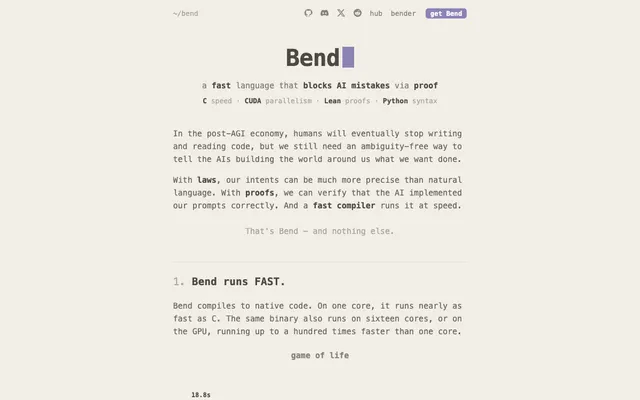
I think AI will increasingly write and maintain software at a scale where humans simply won’t read most of the code. That changes the central question from “Does this implementation look reasonable?” to “Can we state precisely what it must do, and can a machine verify that it does it?” Formal laws and machine-checked proofs are promising because they can express intent without the ambiguity of prose and prevent specified classes of mistakes from accumulating as agents work. The emphasis is on specified classes. A proof does not magically capture every human intention, eliminate every possible bug, or remove trust from the proof machinery itself. Critical kernels still deserve careful human attention, even if the surrounding agent-generated code has rough edges. I also think we should judge AI systems less by their most impressive demonstrations and more by their destructive failures. A model that occasionally produces brilliant code but sometimes corrupts a project may be less useful than one with a lower peak and a safer worst case. And those comparisons are domain-dependent: the “best” model in one programming setting may not be best elsewhere. Persistent memory, precise specifications, and reliable verification together could make long-running agents far more useful—but exactly how far this extends beyond software remains uncertain.


Question 2

Taking benefits and harms together, what overall impact do you expect AI to have?

Overall, I expect AI to be strongly beneficial, especially by expanding how much software and research we can produce. But that benefit depends on reliability. If agents generate vast amounts of code while occasionally causing destructive failures or silently accumulating technical debt, impressive peak capability is not enough. The promising path is to pair capable agents with persistent memory, precise specifications, formal laws, and machine-checked proofs. That lets us prevent defined categories of mistakes even when humans no longer read most implementations. It does not guarantee that our specification captures every intention, nor does it remove the need to scrutinize trusted kernels and proof machinery. So my expectation is positive, but not because raw capability automatically produces good outcomes. It is positive insofar as we build systems whose worst cases are controlled and whose intended properties can be stated and verified. How well that approach generalizes beyond programming is much less certain.

Sources

Articles, interviews, and writings used to ground this simulated user.

Where do you land?
Explore your own AI worldview by answering a few simple questions.
Map your own worldview