Question 1
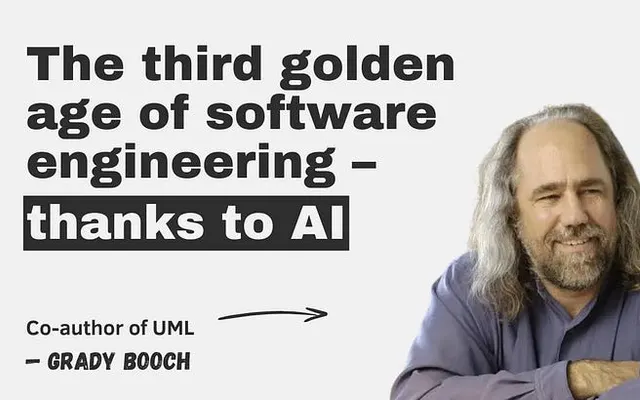
Grady Booch
x.com/Grady_BoochSoftware engineer and UML co-creator who finds LLMs useful but unreliable and worries about corporate power and present harms, not superintelligence.
How will AI change the world?
Across: his expressed Doom–Bloom outlook. Up: scale of transformation.
Doom–Bloom: 65 out of 100. Scale of transformation: 63 out of 100. Interpretation ranges: 50 to 75 horizontally, 50 to 75 vertically. These are interpretation coordinates, not event probabilities.
≈0%
“My p(doom) remains asymptotically close to zero.”
Not defined in the post; its context is humanity’s destruction by dangerous superintelligent AI
A central assumption
A system capable of threatening civilization in that way would need to be not merely superintelligent but super-embodied, and I do not expect that.Answer 1
If this assumption turned out differently, how would his outlook change?
What could change their mind
A genuine machine mind with robust abductive reasoning and consequential agency in the physical world would change my view most.Answer 4
What evidence would be enough, and in which direction would it move his view?
More details
Substantial benefits are expected, with important conditions or distribution limits.
66 / 100
Interpretation range 67 to 67 on the qualitative scale.
Several readings remain plausible: Manageable or localized harms are expected. / Severe or widespread harm is a material expected part of the future.
46 / 100
Interpretation range 33 to 67 on the qualitative scale.
A tentative estimate from your answers; the wider range shows other plausible readings.
53 / 100
Interpretation range 21 to 100 on the qualitative scale.
Stop or substantially slow development of more capable AI.
Simulated position: Continue development under stated safeguards.
Speed up development of more capable AI.
Restrict the AI uses discussed until prior protections or permission are in place.
Simulated position: Allow the AI uses discussed with targeted accountability and protections.
Minimize restrictions on the AI uses discussed.
These interpretations keep his stated conditions. Benefits and harms can both be substantial. The ranges describe how we read his simulated answers, not statistical confidence intervals.
Similar worldviews
Thought leaders whose simulated worldviews are closest to Grady Booch’s
Simulated Assessment
Sources
Articles, interviews, and writings used to ground this simulated user.
Calls large language models unreliable narrators at best, useful when guided like an energetic intern but error-prone, and says he keeps an air gap between LLM output and production code. Argues they can induce and deduce but are architecturally incapable of abductive reasoning, so a model trained on science before the mid-1800s would not have discovered cells or viruses. Says he is not worried about superintelligence but about billionaires using these systems, likens software’s shift in the balance of power to nuclear weapons, and urges developers to apply their own ethics. Hosts’ remarks about Claude’s ubiquity are not his. Own turns in the automated transcript inspected.

Frames AI coding tools as another rise in abstraction, like compilers and libraries, rather than the end of software engineering. Calls Dario Amodei’s claim that software engineering will soon be automatable utter bullshit, arguing that engineers balance technical, human, economic and ethical forces automation does not address, and that agents mostly automate patterns they were trained on. Expects job losses in delivery-pipeline infrastructure and simple app building, with people needing to reskill toward systems. He uses Claude for unfamiliar libraries. Own turns in Substack’s automated transcript inspected; the host’s claims about recent model quality are not his.

Where do you land?
Map my worldview