Question 1

George Hotz
x.com/realgeorgehotzAI builder enthusiastic about useful models and opposed to centralized control.
How will AI change the world?
Across: their expressed Doom–Bloom outlook. Up: scale of transformation.
Doom–Bloom: 75 out of 100. Scale of transformation: 73 out of 100. Interpretation ranges: 75 to 75 horizontally, 73 to 75 vertically. These are interpretation coordinates, not event probabilities.
<1%
Inferred from their broader worldview and priorities. Approximate interpretation range: 0–1%. Applies to the outcome and conditions in their simulated answers; this is an inferred percentage.
A central assumption
Compute is distributed, competitors copy useful ideas, and real agents still face ugly problems involving search, judgment, coordination, and the physical world.Answer 1
If this assumption turned out differently, how would their outlook change?
What could change their mind
A real, reproducible hard takeoff would change my view most: one system rapidly improving itself, overcoming practical search and coordination limits, and building a durable lead that competitors with distributed compute cannot close.Answer 2
What evidence would be enough, and in which direction would it move their view?
More details
Transformative, broadly valuable gains are expected.
88 / 100
Interpretation range 67 to 100 on the qualitative scale.
Severe or widespread harm is a material expected part of the future.
53 / 100
Interpretation range 33 to 67 on the qualitative scale.
Reasoning, consideration of alternatives, and handling of uncertainty in their simulated answers. This describes the simulated answers, not the real person’s intelligence or opinions.
95 / 100
Interpretation range 86 to 100 on the qualitative scale.
Human choices can substantially redirect the AI trajectory.
70 / 100
Interpretation range 49 to 100 on the qualitative scale.
Restrict access to powerful AI.
Allow access subject to capability or use restrictions.
Simulated position: Favor broad or open access to powerful AI.
These interpretations keep their stated conditions. Benefits and harms can both be substantial. The ranges describe how we read their simulated answers, not statistical confidence intervals.
Simulated Assessment
Question 2
What discovery or event would most change your view of AI’s future impact?
Sources
Articles, interviews, and writings used to ground this simulated user.
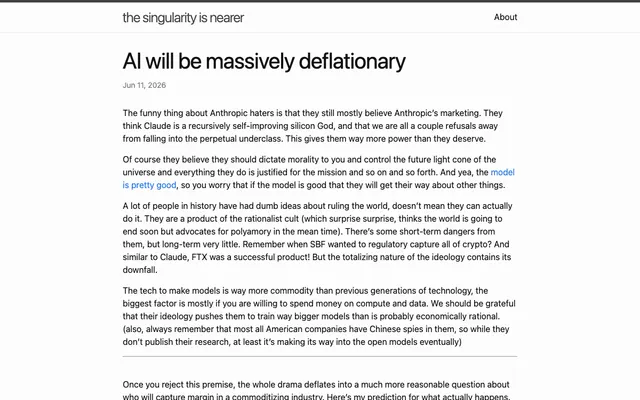
Explains enthusiasm for practical AI while rejecting hype, inevitability claims and frontier-lab value capture.

Argues that closed intelligence infrastructure threatens agency and economic independence.

Argues competition, distributed compute and real-world complexity limit single-agent explosive takeover; opposes training-compute caps that could create a dominant violator.

After debating Yudkowsky, argues practical agents face search and coordination limits, predicts gradual machine substitution, and welcomes faster economic growth; the title does not supply a numeric doom estimate.

Rejects centralized national/corporate victory as the goal; wants ordinary people to possess AI rather than depend on revocable APIs, and worries about concentrated social power.

Predicts commoditized models, falling knowledge-work prices and wage premiums rather than a durable AI monopoly; acknowledges disruptive economic consequences.

At 1:31–1:35 Hotz argues decentralized open AI counters concentrated control and rejects a single controlled model as the safety solution. Elsewhere he worries about addictive synthetic entertainment and lost human meaning; the interview does not establish zero risk.