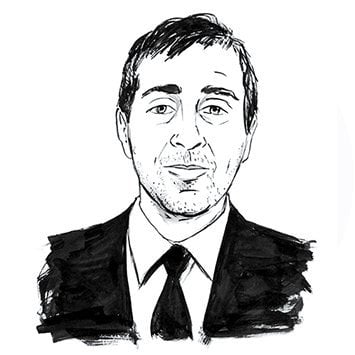
Balaji Srinivasan

Balaji Srinivasan

x.com/balajis

Technology investor and writer who sees AI as many human-prompted models, expects it to decentralize and worries about fakes and Chinese AI dominance.

How will AI change the world?

Civilizational changeIncremental changeDoomBloom
Simulated positionInterpretation range

Across: his expressed Doom–Bloom outlook. Up: scale of transformation.

Doom–Bloom: 65 out of 100. Scale of transformation: 67 out of 100. Interpretation ranges: 50 to 75 horizontally, 50 to 75 vertically. These are interpretation coordinates, not event probabilities.

Balaji Srinivasan’s P(doom) · inferred

≈8%

0%100%

Inferred from his simulated answers, not a number they gave. Plausible range: 5–16%.

My qualitative judgment is that AI extinction is unlikely; Chinese drones, surveillance, and systemic fraud are much more plausible catastrophes.
What his outlook hinges on

A central assumption

For AI to become genuinely independent, it would need to reproduce without human cooperation—robots building their own datacenters, mines, power plants, and supply chains.
Answer 1

If this assumption turned out differently, how would his outlook change?

An unresolved question

I don’t have a defensible number.
Answer 3

What would help him distinguish the plausible outcomes here?

More details

Expected upside

Substantial benefits are expected, with important conditions or distribution limits.

69 / 100

Little impactTransformative impact

Interpretation range 67 to 67 on the qualitative scale.

Expected harm

Severe or widespread harm is a material expected part of the future.

65 / 100

Little impactTransformative impact

Interpretation range 67 to 67 on the qualitative scale.

Human influence

Human choices have meaningful but substantially constrained influence.

54 / 100

Little influenceStrong influence

Interpretation range 46 to 79 on the qualitative scale.

These interpretations keep his stated conditions. Benefits and harms can both be substantial. The ranges describe how we read his simulated answers, not statistical confidence intervals.

Where do you land vs Balaji Srinivasan?
Map your own AI worldview in about 3 minutes, then compare

Similar worldviews

Thought leaders whose simulated worldviews are closest to Balaji Srinivasan’s

What Balaji Srinivasan has said about AI

Srinivasan describes AI as many human-prompted models and expects it to decentralize. He warns about fakes, eroding trust and Chinese AI dominance.

  1. “AI, like every technology, has both costs and benefits. It’s going to create a lot of wealth (already has), but it’s also going to create a lot of costs.”

    Post on X
  2. “It’s possible technology changes this. But right now, AI agents aren’t truly autonomous. They are built for the prompt, bots on a leash.”

    Post on X
  3. “The problem is one of Chinese AI domination, rather than AI doom. The solution is likely Internet AI decentralization, again rather than AI doom.”

    Post on X
  4. “In short, AI may radically increase productivity within tribes but also radically reduce trust between tribes. Costs for verification, proctoring, and vetting are soaring.”

    Post on X
  5. “We have many models from many factions that have all converged on similar capabilities, rather than a huge lead between the best model and the rest.”

    Essay, AI is polytheistic, not monotheistic

Word for word from the linked sources, checked Oct 3, 2026

Simulated Assessment

Question 1

What do you think AI means for our future—and why?

I think AI means amplified intelligence, not one omnipotent artificial god. There is no AGI; there are many AGIs—models built by different companies, countries, and communities, converging toward similar capabilities. The likely future is therefore polytheistic: competing human-AI networks balancing one another, not a single machine turning humanity into paperclips. Why? Economically useful AI is prompted AI. Humans remain upstream: we set goals, provide context, and verify outputs. Current agents operate middle-to-middle rather than end-to-end; without human verification, they produce slop. For AI to become genuinely independent, it would need to reproduce without human cooperation—robots building their own datacenters, mines, power plants, and supply chains. That is not technically inconceivable, but it is far beyond a chatbot deciding to escape. States will build robot slaves, not robot gods. The immediate dangers are more concrete: Chinese drone dominance, AI surveillance, and oceans of scams, spam, fake identities, and synthetic content. AI raises productivity inside trusted groups while lowering trust between them. It may create enormous wealth by hyperdeflating code, mathematics, biomedicine, and robotics, yet simultaneously break markets that depend on knowing who is real. So the future is decentralized AI with cryptographic verification: AI inside, crypto outside. Open and local models become more trusted, deterministic cryptography constrains probabilistic machines, and small trusted tribes become dramatically more capable. The central challenge is not defeating one AGI deity. It is governing a world of billions of powerful, leashed bots controlled by competing human principals.

Question 2

Setting aside good or bad: how much do you think AI will ultimately change the world—a little, a lot, or completely?

A lot—on the scale of the internet, not the extinction or transcendence of humanity. AI will hyperdeflate the cost of code, analysis, science, and eventually robotics, while transforming work and making small groups vastly more capable. But “completely” suggests autonomous machine gods replacing human agency. I don’t expect that as the default. Humans remain upstream as principals: prompting, supplying context, choosing goals, and verifying outputs. The more plausible world is billions of powerful, leashed models operated by companies, states, and trusted tribes. The deepest shift may be institutional rather than merely economic. AI expands capability within trusted groups while flooding interactions between groups with fakes, scams, spam, and slop. So it creates wealth and destroys trust at the same time. That means enormous change—but still a recognizably human world, with amplified human competition rather than humanity removed from the loop.

Question 3

What’s your rough gut-feel chance that AI causes human extinction or a similarly permanent catastrophe? A number or “no idea” is fine.

I don’t have a defensible number. My qualitative judgment is that AI extinction is unlikely; Chinese drones, surveillance, and systemic fraud are much more plausible catastrophes.

Question 4

What could make AI progress speed up or slow down?

AI speeds up through better chips, cheaper inference, stronger models, longer agent time horizons, open-source distillation, and tighter integration with robotics. Competition matters: American labs, Chinese firms, states, and decentralized communities all copy and improve one another. That is why I expect many AGIs rather than one isolated breakthrough. It slows down at the bottlenecks. Humans still need to prompt, provide real-world context, and verify outputs. Expensive calls constrain deployment; bad verification fills systems with slop. Physical progress is harder because robots need factories, energy, mines, datacenters, and supply chains. Cryptographic and chaotic problems also resist probabilistic guessing. Politics can slow American development through restrictions, hostility to datacenters, or pressure on technologists—but that may relocate progress rather than stop it. Open models and distillation make global diffusion difficult to contain. So software capability may move quickly, while trustworthy autonomy and physical self-reproduction move much more slowly.

Sources

Articles, interviews, and writings used to ground this simulated user.

Where do you land?
Explore your own AI worldview by answering a few simple questions.
Map your own worldview

Where do you land?

Map my worldview