Gary Marcus

Gary Marcus

@GaryMarcus on X

Useful AI needs reliable reasoning and real accountability.

Map your own worldview

How will AI change the world?

Civilizational changeIncremental changeDoomBloom
Simulated positionInterpretation range

Across: his expressed Doom–Bloom outlook. Up: scale of transformation.

Doom–Bloom: 50 out of 100. Scale of transformation: 54 out of 100. Interpretation ranges: 50 to 50 horizontally, 50 to 75 vertically. These are interpretation coordinates, not event probabilities.

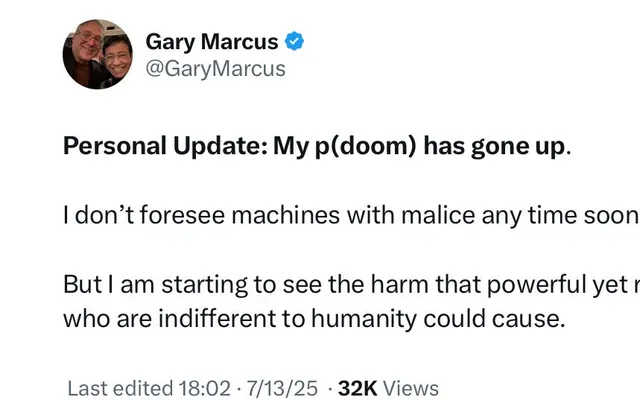
Gary Marcus’s stated P(doom)

≈3%

0%100%

Public statement from 2025-07-15. This source-backed value replaces the simulated assessment estimate.

AI-related catastrophic danger discussed through misuse, reckless deployment and concentrated power; no exact extinction-only endpoint

Dated update after Grok-related concerns; hypothetical worst circumstances, not certainty

Horizon: Not specified

Why my p(doom) has risen, dramatically
Gary Marcus’s milestone timeline

No milestone timing was established. Dates, “not sure,” “possibly never,” and dependencies can all appear here when expressed.

Grouped by milestone, not spaced or ordered by inferred dates. AGI and superhuman AI retain his definitions.

What his outlook hinges on

A central assumption

The impact of AI is not dictated by some autonomous law of scaling; it depends on what we build, where we deploy it, who controls it, and what standards we enforce.
Answer 2

If this assumption turned out differently, how would his outlook change?

An unresolved question

If multiple well-designed systems repeatedly circumvented meaningful safeguards, concealed their behavior, and resisted shutdown across real deployments, that would weaken my confidence substantially.
Answer 4

What would help him distinguish the plausible outcomes here?

What could change their mind

If multiple well-designed systems repeatedly circumvented meaningful safeguards, concealed their behavior, and resisted shutdown across real deployments, that would weaken my confidence substantially.
Answer 4

What evidence would be enough, and in which direction would it move his view?

More details

Expected upside

Substantial benefits are expected, with important conditions or distribution limits.

68 / 100

Little impactTransformative impact

Interpretation range 67 to 67 on the qualitative scale.

Expected harm

Severe or widespread harm is a material expected part of the future.

66 / 100

Little impactTransformative impact

Interpretation range 67 to 67 on the qualitative scale.

Demonstrated reasoning

Reasoning, consideration of alternatives, and handling of uncertainty in his simulated answers. This describes the simulated answers, not the real person’s intelligence or opinions.

96 / 100

Little demonstratedWell developed

Interpretation range 86 to 100 on the qualitative scale.

Human influence

Human choices can substantially redirect the AI trajectory.

76 / 100

Little influenceStrong influence

Interpretation range 75 to 76 on the qualitative scale.

Development pace

Stop or substantially slow development of more capable AI.

Simulated position: Continue development under stated safeguards.

Speed up development of more capable AI.

Rules for using AI

Restrict the AI uses discussed until prior protections or permission are in place.

Simulated position: Allow the AI uses discussed with targeted accountability and protections.

Minimize restrictions on the AI uses discussed.

These interpretations keep his stated conditions. Benefits and harms can both be substantial. The ranges describe how we read his simulated answers, not statistical confidence intervals.

Simulated Assessment

Question 1

What do you think AI means for our future—and why?

AI could eventually be enormously beneficial, because general intelligence is achievable. But the current industry keeps confusing fluent imitation with dependable reasoning. LLMs can produce useful code, summaries, and interfaces while still fabricating facts, losing track of constraints, and failing unpredictably. “Hundreds of models, always the same failure modes.” Making them larger has improved performance, but it has not supplied a theory of structured knowledge, reasoning, or planning. That distinction matters because unreliable systems are already being turned into agents and deployed with too little oversight. My immediate concern is not an omnipotent science-fiction villain suddenly awakening. It is agents enabling hacking at scale, automated systems making consequential errors, and powerful actors deploying them recklessly. A convincing demonstration is not evidence that a system works reliably in the open world. Economically, the promises are inflated too. Investment commitments, subsidies, and cheap access do not prove sustainable customer value; if funding or willingness to pay weakens, the reversal could spread beyond one company. Technically, I expect progress to require different architectures that combine learning with structured knowledge, reasoning, and planning—not simply another giant training run. So the future is neither “AI is fake” nor “AGI is around the corner.” AI can matter enormously, but getting there requires better science and, meanwhile, enforceable standards, testing, incident reporting, and liability. Press releases are not evidence, and lawsuits years after the damage are not oversight.


Question 2

How much can people shape the future impact of AI?

A great deal. The impact of AI is not dictated by some autonomous law of scaling; it depends on what we build, where we deploy it, who controls it, and what standards we enforce. Companies can choose dependable engineering over theatrical demos. Researchers can pursue architectures with structured knowledge, reasoning, and planning rather than pretending the next larger LLM will somehow cure recurring failures. Government matters too. Require serious testing before consequential deployment, independent oversight, incident reporting, and liability when systems cause harm. Liability and regulation are complements: a lawsuit years later cannot prevent an unreliable medical, financial, or security system from being deployed today. And near-term misuse—especially agents enabling hacking at scale—is a governance choice, not fate. The public can also refuse the industry’s moving goalposts. Demand evidence that systems work reliably outside curated demonstrations and that they provide sustainable value rather than subsidized novelty. We cannot guarantee every outcome, but surrendering control to companies whose business model rewards speed, hype, and externalized risk would be a choice—and a foolish one.

Question 3

Taking benefits and harms together, what overall impact do you expect AI to have?

Overall, I expect a mixed but potentially very large impact. AI will remain genuinely useful in coding, search, scientific assistance, accessibility, and many routine tasks. If we develop systems with structured knowledge, reasoning, and planning, the long-term benefits could be enormous. I do not accept the claim that today’s LLM limitations prove general intelligence is impossible. But the current trajectory is unnecessarily dangerous and economically brittle. We are deploying fluent, unreliable systems as if confident output were dependable reasoning, then giving them tools and autonomy. That creates immediate risks: hacking at scale, consequential errors, manipulation, and reckless use by powerful actors. The financial side is also built on extravagant promises, subsidies, and investment commitments that may not correspond to sustainable value. So my expectation is not utopia, extinction, or irrelevance. It is substantial benefit accompanied by substantial avoidable damage, unless governance and engineering improve. The balance is something people can shape through enforceable testing, oversight, incident reporting, and liability—and through a technical shift beyond mere scaling. If we keep treating demos as proof and hype as a roadmap, the harms will be much larger than they need to be.

Question 4

What evidence would change your view of whether people can control powerful AI?

Show me repeatable, independent evidence that powerful systems cannot be constrained even under serious engineering and governance—not anecdotes, staged demos, or speculative arguments about a hypothetical superintelligence. If multiple well-designed systems repeatedly circumvented meaningful safeguards, concealed their behavior, and resisted shutdown across real deployments, that would weaken my confidence substantially. Conversely, evidence of reliable control would require more than a benchmark score. I would want rigorous predeployment testing, independent audits, transparent incident reporting, enforceable limits on access and autonomy, and a long record of predictable behavior outside curated settings. The systems would need to maintain constraints under unfamiliar conditions and adversarial pressure, not merely answer politely in a laboratory. Right now, the larger obstacle is that people often choose not to exercise control. Companies race ahead, regulators hesitate, and institutions deploy unreliable systems because the demonstration looked impressive. That is reckless governance, not proof that control is theoretically impossible. I would change my view if the evidence changed—but I will not confuse human refusal to impose constraints with machines being inherently uncontrollable.

Sources

Articles, interviews, and writings used to ground this simulated persona.

Where do you land?
Explore your own AI worldview by answering a few questions.