Question 1

Shawn Wang
x.com/swyxAI engineering, accessible tools, and practical deployment.
How will AI change the world?
Across: their expressed Doom–Bloom outlook. Up: scale of transformation.
Doom–Bloom: 71 out of 100. Scale of transformation: 50 out of 100. Interpretation ranges: 50 to 75 horizontally, 43 to 57 vertically. These are interpretation coordinates, not event probabilities.
≈1%
Inferred from their broader worldview and priorities. Approximate interpretation range: 0–4%. Applies to the outcome and conditions in their simulated answers; this is an inferred percentage.
A central assumption
Overall, I expect AI to be strongly beneficial if we successfully turn capability into reliable, accessible systems.Answer 2
If this assumption turned out differently, how would their outlook change?
What could change their mind
The biggest update would come from real-world evidence that AI can reliably accelerate hard science—not just produce plausible hypotheses, but contribute to validated advances in medicine, materials, or climate.Answer 3
What evidence would be enough, and in which direction would it move their view?
More details
Substantial benefits are expected, with important conditions or distribution limits.
68 / 100
Interpretation range 67 to 67 on the qualitative scale.
Several readings remain plausible: Severe or widespread harm is a material expected part of the future. / Manageable or localized harms are expected.
53 / 100
Interpretation range 33 to 67 on the qualitative scale.
Reasoning, consideration of alternatives, and handling of uncertainty in their simulated answers. This describes the simulated answers, not the real person’s intelligence or opinions.
94 / 100
Interpretation range 81 to 100 on the qualitative scale.
Human choices can substantially redirect the AI trajectory.
63 / 100
Interpretation range 47 to 78 on the qualitative scale.
Stop or substantially slow development of more capable AI.
Simulated position: Continue development under stated safeguards.
Speed up development of more capable AI.
Restrict the AI uses discussed until prior protections or permission are in place.
Simulated position: Allow the AI uses discussed with targeted accountability and protections.
Minimize restrictions on the AI uses discussed.
These interpretations keep their stated conditions. Benefits and harms can both be substantial. The ranges describe how we read their simulated answers, not statistical confidence intervals.
Simulated Assessment
Question 2
Taking benefits and harms together, what overall impact do you expect AI to have?
Question 3
What discovery or event would most change your view of AI’s future impact?
Sources
Articles, interviews, and writings used to ground this simulated user.
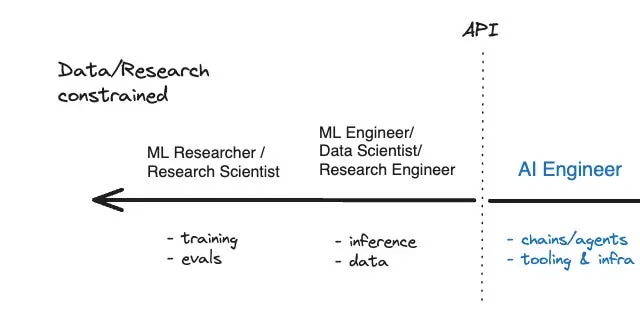
Describes AI engineering as productizing foundation models with software, data and evaluations.

First-party current index linking agent engineering work and the 2025 agent-lab essay; establishes scope, not a catastrophe forecast.

Argues agent labs translate model capabilities into useful products through extensive integration and engineering; acknowledges many harnesses are superseded and uncertainty about competition from model labs.

Acknowledges AI-linked wealth concentration but rejects fatalistic permanent-underclass narratives, arguing AI lowers barriers to learning, entrepreneurship and upward mobility for people who exercise agency.

His keynote essay treats intent, tools, control flow, planning, memory and delegated authority as essential agent ingredients. Argues improved models, tools and economics create a major engineering opportunity; emphasizes trust and verification rather than equating autonomy with reliability.

Speaker-attributed transcript: at 32:53 he expects coding agents to expand beyond coding; at 40:01–41:18 he raises biosafety concerns and doubts broad enterprise distribution is truly private access. At 44:30–48:58 he identifies memory constraints, revises upward on open models, and favors automated testing and verification as human code review becomes a bottleneck. No numeric p(doom) given.

His own questions at 45:42–47:58 distinguish inaccessible reasoning traces, observable actions and simulations without real consequences for lying. This supports attention to evaluation validity; the guests’ model-behavior findings and risk judgments remain theirs, not his.

At 33:41–36:24 he identifies GPU access as a constraint on autonomous research, questions how widely research loops are used beyond demonstrations, and favors agents provisioning their own infrastructure. Modal deployment and performance claims belong to guest Akshat Bubna.

Argues applying AI engineering to hard science could be among this century’s most important missions, spanning medicine, materials, climate and AI research. Explicitly avoids assigning AGI or superintelligence timelines; calls for engineering talent to pursue science rather than low-value output.