Question 1
Ramez Naam
x.com/ramezAuthor and clean-energy investor who expects broadly beneficial AI, doubts a runaway intelligence explosion and favors open access with safeguards.
How will AI change the world?
Across: his expressed Doom–Bloom outlook. Up: scale of transformation.
Doom–Bloom: 67 out of 100. Scale of transformation: 58 out of 100. Interpretation ranges: 62 to 75 horizontally, 50 to 75 vertically. These are interpretation coordinates, not event probabilities.
≈7%
Inferred from his simulated answers, not a number they gave. Plausible range: 4–12%.
A central assumption
Making scarce cognitive capabilities cheap and widely available is inherently consequential.Answer 2
If this assumption turned out differently, how would his outlook change?
An unresolved question
I don’t have a defensible number.Answer 3
What would help him distinguish the plausible outcomes here?
What could change their mind
The biggest update would be clear evidence of a self-sustaining AI research loop: systems reliably producing validated improvements to AI, where each generation makes the next round faster or more productive even after accounting for compute, experiments, testing, and diminishing returns.Answer 4
What evidence would be enough, and in which direction would it move his view?
More details
Substantial benefits are expected, with important conditions or distribution limits.
72 / 100
Interpretation range 67 to 100 on the qualitative scale.
Severe or widespread harm is a material expected part of the future.
65 / 100
Interpretation range 67 to 67 on the qualitative scale.
Human choices have meaningful but substantially constrained influence.
52 / 100
Interpretation range 41 to 59 on the qualitative scale.
Stop or substantially slow development of more capable AI.
Simulated position: Continue development under stated safeguards.
Speed up development of more capable AI.
Restrict the AI uses discussed until prior protections or permission are in place.
Simulated position: Allow the AI uses discussed with targeted accountability and protections.
Minimize restrictions on the AI uses discussed.
Restrict access to powerful AI.
Allow access subject to capability or use restrictions.
Simulated position: Favor broad or open access to powerful AI.
These interpretations keep his stated conditions. Benefits and harms can both be substantial. The ranges describe how we read his simulated answers, not statistical confidence intervals.
Similar worldviews
Thought leaders whose simulated worldviews are closest to Ramez Naam’s
Simulated Assessment
Sources
Articles, interviews, and writings used to ground this simulated user.
Naam distinguishes AI assisting research, autonomous improvement and runaway feedback. He expects rapid progress, including narrow superhuman abilities, but finds weak evidence for imminent general superintelligence. His uncertain model calibration puts the software loop below self-sustaining strength; it is not an impossibility proof. Research reliability, diminishing returns and physical constraints matter. Architectural advances and measured useful research per unit of input could change the conclusion. Substantial indexed text was inspected; direct retrieval failed. Smith’s introductory forecast and other quoted speakers’ claims are not Naam’s.

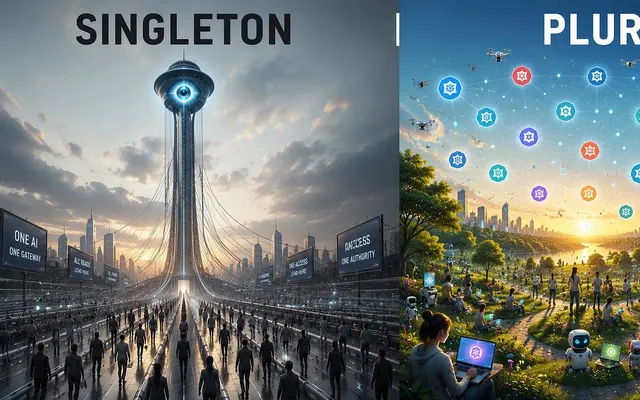
Prefers broadly distributed capabilities and checks on concentrated power to safety entrusted to one supposedly perfect AI. Accepts accidents, misuse and unintended effects in a plural world. His historical argument favors freedom and resilience; it does not establish that competition eliminates every AI risk. Says strong evidence could justify departing from this preference.

Expects net benefits and continued improvement despite increasing difficulty. Sees competition and open weights supporting widespread access and value for users. Considers international innovation largely positive-sum while recognizing surveillance, cyber, propaganda and military risks. Calls for safety beyond individual models. Full essay inspected; embedded talk not reviewed. Market comparisons describe April, not a freshly measured September lead.

Where do you land?
Map my worldview