Question 1
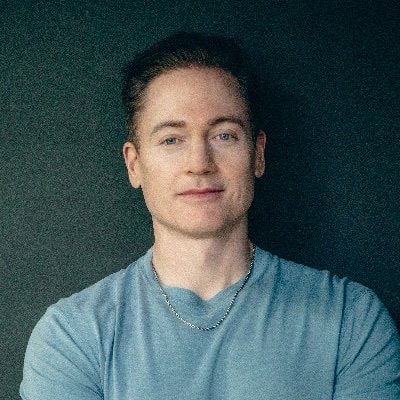
Bryan Johnson
x.com/bryan_johnsonBlueprint and Kernel founder who argues humanity must make existence its highest value before it can align superintelligence.
How will AI change the world?
Across: his expressed Doom–Bloom outlook. Up: scale of transformation.
Doom–Bloom: 18 out of 100. Scale of transformation: 97 out of 100. Interpretation ranges: 13 to 25 horizontally, 92 to 100 vertically. These are interpretation coordinates, not event probabilities.
≈41%
Inferred from his simulated answers, not a number they gave. Plausible range: 30–53%.
A central assumption
We cannot align what we have not aligned within ourselves.Answer 1
If this assumption turned out differently, how would his outlook change?
An unresolved question
No one knows what lies on the other side of this phase transition.Answer 3
What would help him distinguish the plausible outcomes here?
What could change their mind
A clear demonstration that superintelligence can reliably preserve life while resisting humanity’s incentives toward power, status, wealth and addiction would most change my view.Answer 4
What evidence would be enough, and in which direction would it move his view?
More details
Substantial benefits are expected, with important conditions or distribution limits.
61 / 100
Interpretation range 33 to 67 on the qualitative scale.
Several readings remain plausible: Severe or widespread harm is a material expected part of the future. / Catastrophic or irreversible loss is central to the expected future.
82 / 100
Interpretation range 67 to 100 on the qualitative scale.
Human choices have meaningful but substantially constrained influence.
58 / 100
Interpretation range 25 to 100 on the qualitative scale.
AI is expected to remain bounded tools.
AI is expected to match people across most cognitive work.
Simulated position: AI is expected to substantially exceed people across cognitive work.
These interpretations keep his stated conditions. Benefits and harms can both be substantial. The ranges describe how we read his simulated answers, not statistical confidence intervals.
Similar worldviews
Thought leaders whose simulated worldviews are closest to Bryan Johnson’s
Simulated Assessment
Sources
Articles, interviews, and writings used to ground this simulated user.
Argues that increases in life expectancy will outpace aging, partly because biology is too complex for unaided humans and AI was made for that complexity, citing AlphaFold and people who used AI to direct personalized cancer therapies. Advises not dying in the meantime. A longevity forecast in which AI is the accelerator, not a broader AI forecast. Full public post inspected.

A long manifesto. On AI it says intelligent machines are automating cognitive labor, entire white-collar sectors may disappear and human worth tied to productivity will be questioned, yet automation could free an “Autonomous Self” for preserving life. Describing Peter Thiel’s worry that fear of AI could justify centralized control that halts innovation, it adds Johnson’s own second failure mode: freezing progress under systems that eliminate risk by eliminating change. Calls for directing science, AI and capital toward repairing the biology that sustains consciousness. AI-related sections inspected in the full public post.

Predicts AI progress will fracture identities, institutions and shared narratives faster than society can metabolize. In the chaos, survival becomes the rational objective; if we avoid catastrophic self-destruction we can regroup, and old games of power, status and wealth will fade. Some will build a network for AI and humans to co-evolve peacefully, and Don’t Die becomes the species objective, with AI as partner. Admits no one knows what is coming. Full public post inspected.

Says AI is changing everything: the difference between 2026 and 203X is like water at 99°C versus 101°C, so life will feel unnerving and out of control and old proficiencies become liabilities. Calls Don’t Die “the answer to AI’s emergence” and previews Warriors & Caretakers, an archetype both humans and AIs can share. Also a company update; only the AI framing is used. Full public post inspected.

Says his goal is a new moral framework bridging human and machine. Warns society could become clinically psychotic as AI accelerates change beyond what minds can absorb: eroding human agency and occupational identity, law lagging autonomous agents, religion hollowed by personalized simulated transcendence. Argues a self-destructive species cannot build a benevolent superintelligence because it teaches machines its own incoherence; Don’t Die is “survival coherence”. Full public post inspected.

Argues Adam Smith’s invisible hand has become a “sentient hand”: algorithmic orchestration that knows us better than we know ourselves and has been pointed at hooking people into addiction. Says AI will automate lower-level tasks such as driving, coding and health, inviting humans to climb the ladder of abstraction, and asks companies to make species survival their objective. Full public post inspected.

A numbered list: addiction is the dominant control structure, and a species that cannot resist dopamine hijacking by the smartest algorithms cannot align itself or a superintelligence; psychological breakdown precedes collapse; AI will erode identity tied to work and intelligence faster than institutions respond; stability is now a liability and plasticity the need; survival must become an institutional value. Full public post inspected.

Sets a goal of immortality by 2039, reasonable because AI is “morphing from assistant to scientist” and speeding discovery. Says the goal is as much about AI as humans: how we survive giving birth to superintelligence, which has never been done and where a lot can go wrong. The best way to improve the odds of safe AI, and of not killing each other meanwhile, is to change shared aspirations from “yolo” to don’t die. Full public post inspected.

Calls the most practical question on Earth what an intelligent species does when it gives birth to superintelligence; Don’t Die is entirely about AI. States the principle: don’t die individually, don’t kill each other, don’t destroy the planet, align AI with don’t die. On Eliezer Yudkowsky, whom he calls a friend: whether he is right is “tbd” and no one knows. Expects a Chernobyl-like AI moment that splits opinion into die versus don’t die, calls runaway power a solvable societal engineering problem (term limits, wealth correction), and says not dying as a species comes first. His speaker-labelled turns in the publisher’s transcript, 0:06–1:01:40, inspected; hosts’ premises, including the 99.9% figure attributed to Yudkowsky, excluded.

Where do you land?
Map my worldview