Bernie Sanders

Bernie Sanders

@SenSanders on X

Protect workers and democracy. Pause advanced AI and ban uncontrollable superintelligence.

Map your own worldview

How will AI change the world?

Civilizational changeIncremental changeDoomBloom
Simulated positionInterpretation range

Across: his expressed Doom–Bloom outlook. Up: scale of transformation.

Doom–Bloom: 26 out of 100. Scale of transformation: 81 out of 100. Interpretation ranges: 25 to 50 horizontally, 75 to 100 vertically. These are interpretation coordinates, not event probabilities.

Bernie Sanders’s estimated P(doom)

≈39%

0%100%

Inferred from his broader worldview and priorities. Approximate interpretation range: 0–87%. Applies to the outcome and conditions in his simulated answers; this is an inferred percentage.

Bernie Sanders’s milestone timeline

No milestone timing was established. Dates, “not sure,” “possibly never,” and dependencies can all appear here when expressed.

Grouped by milestone, not spaced or ordered by inferred dates. AGI and superhuman AI retain his definitions.

What his outlook hinges on

A central assumption

But under our current system, those gains will not automatically benefit working families.
Answer 1

If this assumption turned out differently, how would his outlook change?

An unresolved question

I do not claim to know an exact probability of catastrophe.
Answer 2

What would help him distinguish the plausible outcomes here?

What could change their mind

The most important event would be a genuine transfer of power away from Big Tech oligarchs and toward democratic public control.
Answer 3

What evidence would be enough, and in which direction would it move his view?

More details

Expected upside

Substantial benefits are expected, with important conditions or distribution limits.

54 / 100

Little impactTransformative impact

Interpretation range 33 to 67 on the qualitative scale.

Expected harm

Severe or widespread harm is a material expected part of the future.

73 / 100

Little impactTransformative impact

Interpretation range 67 to 100 on the qualitative scale.

Demonstrated reasoning

Reasoning, consideration of alternatives, and handling of uncertainty in his simulated answers. This describes the simulated answers, not the real person’s intelligence or opinions.

86 / 100

Little demonstratedWell developed

Interpretation range 67 to 100 on the qualitative scale.

Human influence

Human choices can substantially redirect the AI trajectory.

65 / 100

Little influenceStrong influence

Interpretation range 50 to 100 on the qualitative scale.

Expected capabilities

AI is expected to remain bounded tools.

AI is expected to match people across most cognitive work.

Simulated position: AI is expected to substantially exceed people across cognitive work.

Development pace

Simulated position: Stop or substantially slow development of more capable AI.

Continue development under stated safeguards.

Speed up development of more capable AI.

Rules for using AI

Simulated position: Restrict the AI uses discussed until prior protections or permission are in place.

Allow the AI uses discussed with targeted accountability and protections.

Minimize restrictions on the AI uses discussed.

These interpretations keep his stated conditions. Benefits and harms can both be substantial. The ranges describe how we read his simulated answers, not statistical confidence intervals.

Simulated Assessment

Question 1

What do you think AI means for our future—and why?

AI could bring enormous gains in productivity and improve people’s lives. But under our current system, those gains will not automatically benefit working families. They will flow to a handful of billionaires who already possess obscene wealth and power, while millions of workers face displacement, higher costs and less control over their lives. And let us be clear: the people developing the most advanced systems admit they may not fully understand or control what they are building. So why on earth should a few Big Tech oligarchs be allowed to gamble with the future of humanity? They were not elected. The public helped create the knowledge and infrastructure behind this technology. The public deserves ownership, voting power and a share of the benefits. We need an immediate pause in advanced AI development, a permanent ban on superintelligence and international agreements to prevent its creation anywhere. We also need a moratorium on new AI data centers until strong national protections address jobs, electricity costs, civil rights and environmental damage. Technology should serve ordinary people, not replace them and enrich their bosses. If AI makes workers more productive, that should mean a 32-hour workweek with no loss in pay or benefits—not mass layoffs and another explosion of billionaire wealth. The fundamental question is not simply what AI can do. It is who controls it, who benefits and who gets to decide our future.


Question 2

What observation or experience has most shaped your view of AI’s future impact?

What has shaped my view most is watching one technological revolution after another produce enormous wealth while working people receive layoffs, insecurity and very little say. Now the same billionaire class is building systems that could transform millions of jobs—and even their creators acknowledge they may not fully control them. That contradiction is decisive for me. If the consequences affect all humanity, why should a handful of unelected oligarchs make the decisions? They own the companies, set the pace and expect the public to absorb the risks. Meanwhile, communities face higher electricity costs, environmental damage and giant data centers built without meaningful democratic consent. I do not claim to know an exact probability of catastrophe. I do know that concentrated corporate power does not become trustworthy simply because the technology is impressive. The greater the potential power of AI, the stronger the case for a pause, democratic control and a permanent ban on superintelligence.

Question 3

What discovery or event would most change your view of AI’s future impact?

The most important event would be a genuine transfer of power away from Big Tech oligarchs and toward democratic public control. If working people had real voting power, public ownership, enforceable protections against displacement, and a guaranteed share of productivity gains, that would change my view of who might benefit from AI. But no corporate demonstration or promise would persuade me that an uncontrollable superintelligence is acceptable. If the companies themselves cannot guarantee human control, why should humanity accept the gamble? I do not need an exact extinction probability to know that unelected billionaires should not make that decision for everyone. So yes, democratic ownership and strong safeguards could change my assessment of some AI applications. They would not change my opposition to superintelligence. That should be permanently banned, here and throughout the world.

Sources

Articles, interviews, and writings used to ground this simulated persona.

Public ownership through an AI sovereign wealth fund

This Bill Would Give the American People, Not Oligarchs, Control Over the Future of AI WASHINGTON, June 18 — Sen. Bernie Sanders (I-Vt.) today introduced the American AI Sovereign Wealth Fund Act to give the public a 50% ownership in the largest artificial intelligence (AI) companies in our country. “Left unchecked, Artificial Intelligence and robotics […]

sanders.senate.gov

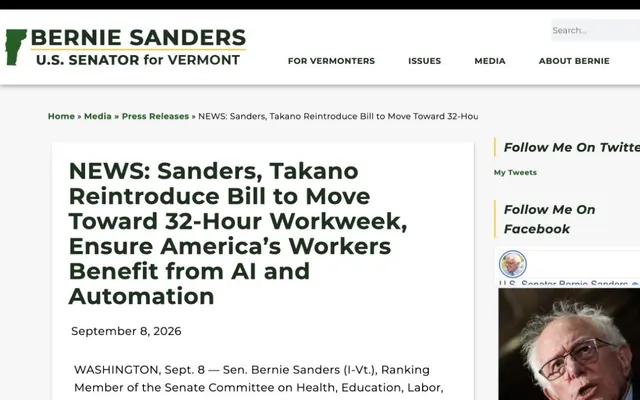
A 32-hour workweek so workers benefit from AI

WASHINGTON, Sept. 8 — Sen. Bernie Sanders (I-Vt.), Ranking Member of the Senate Committee on Health, Education, Labor, and Pensions (HELP), and Rep. Mark Takano (D-Calif.) today announced that they will reintroduce legislation to establish a standard 32-hour workweek in America with no loss in pay or benefits. This bill comes as America’s workers have […]

sanders.senate.gov

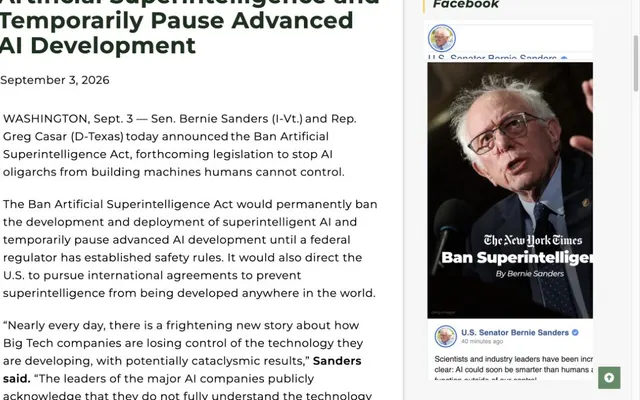
Sanders and Casar announce legislation to ban artificial superintelligence

WASHINGTON, Sept. 3 — Sen. Bernie Sanders (I-Vt.) and Rep. Greg Casar (D-Texas) today announced the Ban Artificial Superintelligence Act, forthcoming legislation to stop AI oligarchs from building machines humans cannot control. The Ban Artificial Superintelligence Act would permanently ban the development and deployment of superintelligent AI and temporarily pause advanced AI development until a federal regulator has […]

sanders.senate.gov

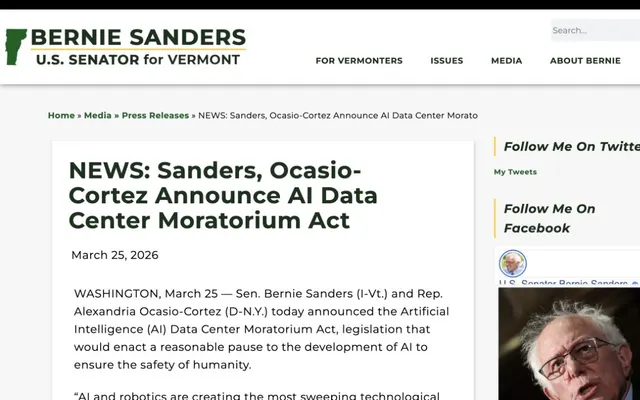
Sanders and Ocasio-Cortez announce AI Data Center Moratorium Act

WASHINGTON, March 25 — Sen. Bernie Sanders (I-Vt.) and Rep. Alexandria Ocasio-Cortez (D-N.Y.) today announced the Artificial Intelligence (AI) Data Center Moratorium Act, legislation that would enact a reasonable pause to the development of AI to ensure the safety of humanity. “AI and robotics are creating the most sweeping technological revolution in the history of […]

sanders.senate.gov
Where do you land?
Explore your own AI worldview by answering a few questions.