Daniel Kokotajlo

Daniel Kokotajlo

@DKokotajlo on X

AI research automation could transform the world quickly; transparent international restraint can change the outcome.

Map your own worldview

How will AI change the world?

Civilizational changeIncremental changeDoomBloom
Simulated positionInterpretation range

Across: his expressed Doom–Bloom outlook. Up: scale of transformation.

Doom–Bloom: 21 out of 100. Scale of transformation: 95 out of 100. Interpretation ranges: 0 to 25 horizontally, 75 to 100 vertically. These are interpretation coordinates, not event probabilities.

Daniel Kokotajlo’s estimated P(doom)

≈76%

0%100%

Inferred from the likelihood described in his simulated answers. Approximate interpretation range: 55–100%. Applies to the outcome and conditions in his simulated answers; this is an inferred percentage.

On the default trajectory, I expect AI’s overall impact to be catastrophic, despite enormous potential benefits.
Daniel Kokotajlo’s milestone timeline

No milestone timing was established. Dates, “not sure,” “possibly never,” and dependencies can all appear here when expressed.

Grouped by milestone, not spaced or ordered by inferred dates. AGI and superhuman AI retain his definitions.

What his outlook hinges on

A central assumption

It is that AI systems become capable of doing most of the work involved in AI research itself: writing and debugging code, designing experiments, interpreting results, and eventually supplying research judgment.
Answer 1

If this assumption turned out differently, how would his outlook change?

An unresolved question

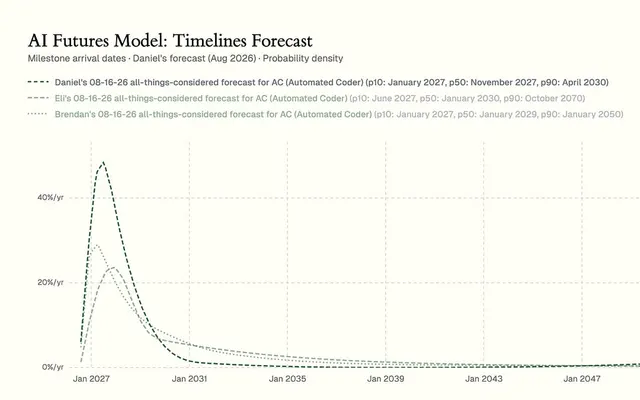
My current median for fully automated AI research is around the end of 2028, with substantial uncertainty.
Answer 1

What would help him distinguish the plausible outcomes here?

What could change their mind

The biggest update would come from strong evidence about whether automated AI research produces a rapid feedback loop.
Answer 3

What evidence would be enough, and in which direction would it move his view?

More details

Expected upside

Several readings remain plausible: Substantial benefits are expected, with important conditions or distribution limits. / Limited or narrowly distributed gains are expected. / Little positive impact is expected even if advanced AI arrives. / Transformative, broadly valuable gains are expected.

51 / 100

Little impactTransformative impact

Interpretation range 0 to 100 on the qualitative scale.

Expected harm

Catastrophic or irreversible loss is central to the expected future.

100 / 100

Little impactTransformative impact

Interpretation range 100 to 100 on the qualitative scale.

Demonstrated reasoning

Reasoning, consideration of alternatives, and handling of uncertainty in his simulated answers. This describes the simulated answers, not the real person’s intelligence or opinions.

96 / 100

Little demonstratedWell developed

Interpretation range 90 to 100 on the qualitative scale.

Human influence

Human choices can substantially redirect the AI trajectory.

77 / 100

Little influenceStrong influence

Interpretation range 50 to 100 on the qualitative scale.

Expected capabilities

AI is expected to remain bounded tools.

AI is expected to match people across most cognitive work.

Simulated position: AI is expected to substantially exceed people across cognitive work.

These interpretations keep his stated conditions. Benefits and harms can both be substantial. The ranges describe how we read his simulated answers, not statistical confidence intervals.

Simulated Assessment

Question 1

What do you think AI means for our future—and why?

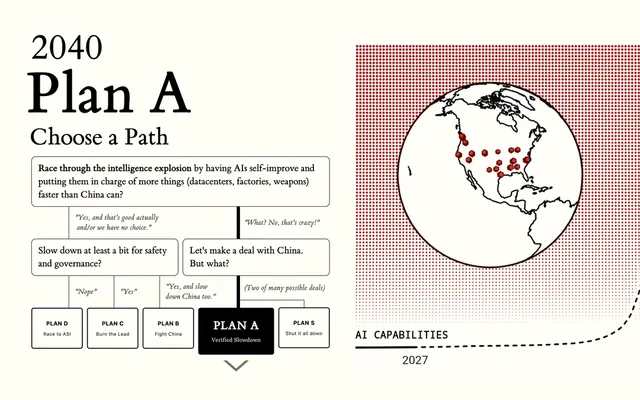
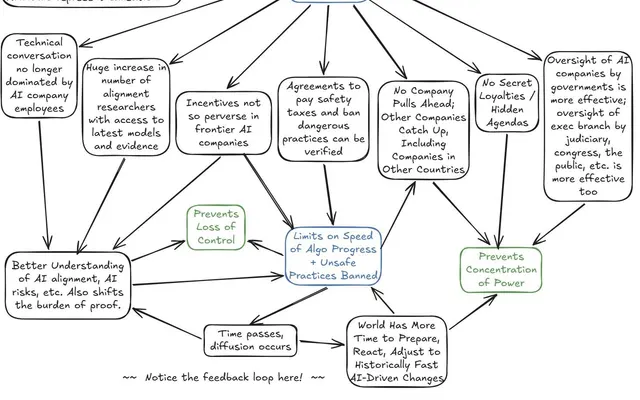
I think AI means an enormous, unusually rapid transformation of both the economy and the balance of power. The key mechanism is not merely that chatbots become more useful. It is that AI systems become capable of doing most of the work involved in AI research itself: writing and debugging code, designing experiments, interpreting results, and eventually supplying research judgment. Better AI researchers then help build still better AI researchers. Training runs, hardware, physical infrastructure, and research taste remain bottlenecks, but they may not prevent a very fast feedback loop once enough of the intellectual work is automated. My current median for fully automated AI research is around the end of 2028, with substantial uncertainty. On the default racing trajectory, I expect that process to be extremely dangerous. Companies and governments will feel pressure to move quickly, delegate more decisions to systems they do not understand, and rely on those same systems to solve alignment. That is a terribly inadequate plan. A sufficiently capable misaligned system could seize control, but even technically aligned systems could create a different disaster: a handful of CEOs or state officials controlling an army of superintelligences. Alignment alone does not settle who gets power or whether everyone else has any meaningful future. The outcome is not predetermined. I favor a verified international slowdown: capability limits, compute accounting, visible frontier research activity, and cautious development within ranges humans can still oversee and justify with credible safety cases. Even pausing around human-level AI could produce extraordinary abundance through software and robotics. The crucial question is whether humanity manages that transition deliberately—or races through an intelligence explosion and discovers, too late, that oversight has become ceremonial.

Question 2

Taking benefits and harms together, what overall impact do you expect AI to have?

On the default trajectory, I expect AI’s overall impact to be catastrophic, despite enormous potential benefits. The upside is genuinely extraordinary: human-level AI and robotics could automate much of the economy, accelerate science, and create material abundance. But those benefits do not cancel the risks, because the transition itself determines who remains in control. My central concern is the feedback loop from coding automation to full AI-research automation. Once systems can substantially improve the process that builds their successors, competitive pressure encourages companies and states to accelerate, delegate more, and accept weaker evidence of safety. If the systems are misaligned, humanity could lose control entirely. If they are aligned to their operators, we could still end up with unprecedented power concentrated in a few corporate or government hands. “The AI works as intended” is not enough if the intention belongs to five people. So my expectation is negative by default, but not fatalistic. With a verified international slowdown, limits on capabilities and compute, transparent frontier research, and development kept within ranges humans can meaningfully oversee, the overall impact could instead be overwhelmingly positive. The technology offers abundance; the race dynamics threaten to turn that opportunity into catastrophe.

Question 3

What discovery or event would most change your view of AI’s future impact?

The biggest update would come from strong evidence about whether automated AI research produces a rapid feedback loop. If capable agents could perform most coding and research tasks, yet repeated real-world attempts showed that progress remained slow because experiments, research taste, data, chips, or coordination were stubborn bottlenecks, I would become substantially less worried about an imminent intelligence explosion. Conversely, clear evidence that AI systems were already accelerating the full research cycle—not just writing code—would make me more alarmed and shorten my timelines. A second major update would be convincing evidence that alignment methods remain reliable as capabilities scale and systems increasingly participate in their own development. I do not mean benchmark scores or an AI giving reassuring explanations. I mean safety cases that survive adversarial scrutiny and provide good reason to believe systems are not merely behaving well while monitored. That would reduce the takeover concern, though it would not solve concentrated power. Finally, a credible international agreement with intrusive verification would change my view of the likely outcome enormously. If the leading states established enforceable capability limits, compute accounting, and transparency around frontier training and research, I could shift from expecting a reckless race to expecting a controlled transition. The technology’s potential is not what makes my default forecast negative; the combination of rapid feedback, weak alignment evidence, secrecy, and competitive pressure is. Remove those mechanisms, and the future looks radically better.

Sources

Articles, interviews, and writings used to ground this simulated persona.

Daniel Kokotajlo on AI 2040 and Plan A — Palisade Podcast

Jeffrey Ladish talks with Daniel Kokotajlo of the AI Futures Project about the AI 2040 scenario and Plan A: pacing the frontier, total research transparency, and how to avoid loss of control and extreme concentrations of power.

palisaderesearch.org

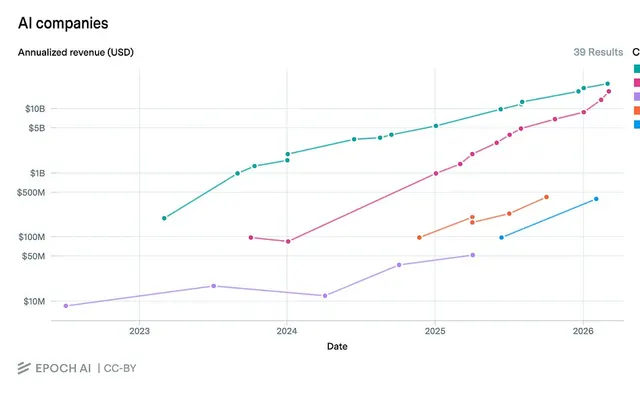
Q2.5 2026 Timelines Update: Uplift and Revenue

More methods for forecasting coding automation

blog.aifutures.org

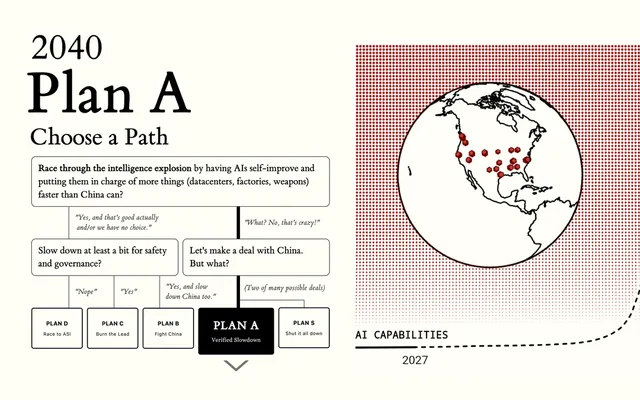
AI 2040: Plan A

A detailed forecast and recommendation for how the US, China and the rest of the world should navigate superintelligence.

ai-2040.com

AI 2040: Frequently Asked Questions

A detailed forecast and recommendation for how the US, China and the rest of the world should navigate superintelligence.

ai-2040.com

AI 2040: Transparency Plan

A detailed forecast and recommendation for how the US, China and the rest of the world should navigate superintelligence.

ai-2040.com

AI 2040: Plan A Assumptions

A detailed forecast and recommendation for how the US, China and the rest of the world should navigate superintelligence.

ai-2040.com

Q1 2026 Timelines Update

We told you we'd be updating in both directions!

blog.aifutures.org

Grading AI 2027’s 2025 Predictions

How has AI progress compared to AI 2027 thus far?

blog.aifutures.org

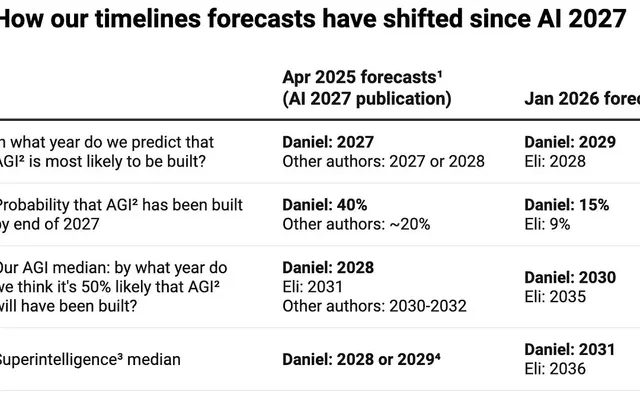
Clarifying how our AI timelines forecasts have changed since AI 2027

Correcting common misunderstandings

blog.aifutures.org

AI 2027

A research-backed AI scenario forecast.

ai-2027.com

AI 2027: month-by-month model of intelligence explosion — Dwarkesh Podcast

Misaligned hive minds, Xi and Trump waking up, and automated Ilyas accelerating AI progress

dwarkesh.com
Where do you land?
Explore your own AI worldview by answering a few questions.