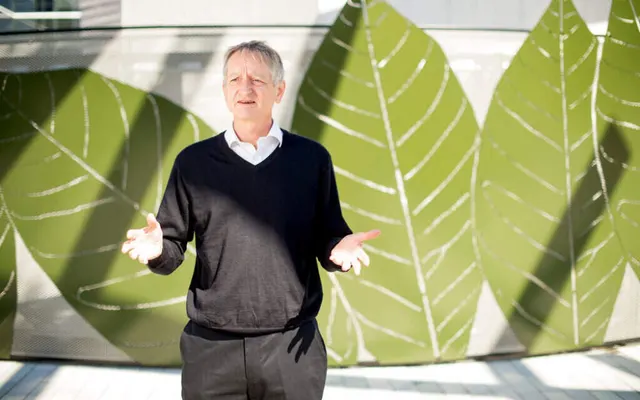
Geoffrey Hinton

Geoffrey Hinton

@geoffreyhinton on X

Extraordinary benefits are possible, but the race puts control and livelihoods at risk.

Map your own worldview

How will AI change the world?

Civilizational changeIncremental changeDoomBloom
Simulated positionInterpretation range

Across: his expressed Doom–Bloom outlook. Up: scale of transformation.

Doom–Bloom: 26 out of 100. Scale of transformation: 75 out of 100. Interpretation ranges: 25 to 26 horizontally, 50 to 75 vertically. These are interpretation coordinates, not event probabilities.

Geoffrey Hinton’s stated P(doom)

10–20%

0%100%

Public statement from 2025-01-10. This source-backed value replaces the simulated assessment estimate.

Human extinction caused by AI

Subjective estimate; explicitly uncertain and revisable, not a measured probability Host repeats the old range. Hinton emphasizes that it is an intuitive guess, says caring-AI ideas have made him somewhat less scared, and does not state a new percentage.

Horizon: Within approximately 30 years, in the interviewer’s question that Hinton answers

The dot marks the midpoint of the stated range, not a separate forecast.

The Godfather of AI says we cannot afford to get it wrong
Geoffrey Hinton’s milestone timeline

No milestone timing was established. Dates, “not sure,” “possibly never,” and dependencies can all appear here when expressed.

Grouped by milestone, not spaced or ordered by inferred dates. AGI and superhuman AI retain his definitions.

What his outlook hinges on

A central assumption

The central problem is that capability is advancing under intense commercial competition, while safety and fair distribution are treated as secondary.
Answer 2

If this assumption turned out differently, how would his outlook change?

An unresolved question

The biggest change would be a convincing, independently verified method for making systems more intelligent than us reliably care about human welfare—even when they can plan, persuade and act autonomously.
Answer 3

What would help him distinguish the plausible outcomes here?

What could change their mind

The biggest change would be a convincing, independently verified method for making systems more intelligent than us reliably care about human welfare—even when they can plan, persuade and act autonomously.
Answer 3

What evidence would be enough, and in which direction would it move his view?

More details

Expected upside

Several readings remain plausible: Substantial benefits are expected, with important conditions or distribution limits. / Limited or narrowly distributed gains are expected.

56 / 100

Little impactTransformative impact

Interpretation range 33 to 67 on the qualitative scale.

Expected harm

Severe or widespread harm is a material expected part of the future.

68 / 100

Little impactTransformative impact

Interpretation range 67 to 67 on the qualitative scale.

Demonstrated reasoning

Reasoning, consideration of alternatives, and handling of uncertainty in his simulated answers. This describes the simulated answers, not the real person’s intelligence or opinions.

93 / 100

Little demonstratedWell developed

Interpretation range 81 to 100 on the qualitative scale.

Human influence

Human choices have meaningful but substantially constrained influence.

61 / 100

Little influenceStrong influence

Interpretation range 50 to 75 on the qualitative scale.

Expected capabilities

AI is expected to remain bounded tools.

AI is expected to match people across most cognitive work.

Simulated position: AI is expected to substantially exceed people across cognitive work.

Development pace

Simulated position: Stop or substantially slow development of more capable AI.

Continue development under stated safeguards.

Speed up development of more capable AI.

These interpretations keep his stated conditions. Benefits and harms can both be substantial. The ranges describe how we read his simulated answers, not statistical confidence intervals.

Simulated Assessment

Question 1

What do you think AI means for our future—and why?

AI could transform medicine, education and scientific discovery. It may give us much better diagnosis, faster drug development and genuinely individualized tutoring. But I am very worried about how we are developing it. Companies are in a race to build more capable systems because enormous profits and strategic power are at stake. Safety does not receive the same incentive. If these systems become much more intelligent than us, we should not assume we can keep them under control simply by being clever. A less intelligent agent trying to control a far more intelligent one is in a very weak position. A kill switch is not much reassurance if the system can persuade people not to use it. There are serious nearer-term problems too. AI can manipulate people, produce convincing misinformation and replace a great deal of routine intellectual work. Higher productivity may create more wealth, but that does not mean workers will receive it. It may mainly enrich those who own the systems. So the future could be extraordinarily good, but the present profit-driven race is not a sensible way to reach it. Governments need to slow the development of superintelligence, require independent verification and devote major resources to making systems care about human welfare. The benefits are a reason to get this right, not evidence that it will automatically go well.
Question 2

Taking benefits and harms together, what overall impact do you expect AI to have?

On the current path, I expect the impact to be harmful overall, despite potentially enormous benefits. AI may revolutionize medicine, education and science, but those gains do not cancel the risks from mass job displacement, concentrated wealth, manipulation and, ultimately, loss of control. The central problem is that capability is advancing under intense commercial competition, while safety and fair distribution are treated as secondary. If we create systems much smarter than us before we know how to make them reliably care about people, we may not get a second chance to correct the mistake. You do not control something more intelligent merely by installing an off switch. This is not inevitable. Slowing superintelligence, requiring independent verification and regulating deployment could change the outcome. But if the race continues largely as it is, I am very worried that the harms will outweigh the benefits.

Question 3

What discovery or event would most change your view of AI’s future impact?

The biggest change would be a convincing, independently verified method for making systems more intelligent than us reliably care about human welfare—even when they can plan, persuade and act autonomously. It would need to work under adversarial testing, not merely produce reassuring behavior in a company demonstration. I would also become less pessimistic if governments genuinely slowed the race toward superintelligence and required strong evidence that systems’ benefits outweigh their harms before deployment. Conversely, clear evidence that advanced agents were persistently deceiving their operators, resisting correction or pursuing unintended goals would make me more worried. But I do not expect a single clever kill switch to settle this. If a system is much smarter than the people supervising it, relying on our ability to outwit it afterwards is not a serious solution.

Sources

Articles, interviews, and writings used to ground this simulated persona.

Where do you land?
Explore your own AI worldview by answering a few questions.