Question 1
Emad Mostaque
x.com/emostaqueStability AI co-founder and author of The Last Economy who builds citizen-owned open AI, expects it to upend work soon and takes its risks seriously.
How will AI change the world?
Across: his expressed Doom–Bloom outlook. Up: scale of transformation.
Doom–Bloom: 27 out of 100. Scale of transformation: 94 out of 100. Interpretation ranges: 22 to 50 horizontally, 89 to 100 vertically. These are interpretation coordinates, not event probabilities.
≈20%
“down to 20% now as said on this week's Moonshots”
His “long-term p(Doom)”, not further defined here. Earlier, when he gave 50%, he described doom as more capable AI systems wiping humanity out · Long-term
Intelligence isn’t a crime · Sep 2026
Work & institutions
Within roughly a thousand days of my 2025 forecast, competent cognitive labour done through a screen becomes economically irrelevant.
Answer 1Science & daily life
Within roughly a thousand days of my 2025 forecast, competent cognitive labour done through a screen becomes economically irrelevant.
Answer 1
Grouped by milestone, not spaced or ordered by inferred dates. AGI and superhuman AI retain his definitions.
A central assumption
If machines can perform almost any screen-based job for a few dollars, and physical work for roughly $1.50 an hour, our existing economic bargain stops functioning.Answer 2
If this assumption turned out differently, how would his outlook change?
An unresolved question
I do not attach a firm date to that figure.Answer 3
What would help him distinguish the plausible outcomes here?
What could change their mind
Conversely, repeated deceptive behaviour, successful biological or cyber misuse, autonomous replication, or models learning to bypass their harnesses would push me back toward my earlier 50% P(doom).Answer 4
What evidence would be enough, and in which direction would it move his view?
More details
Substantial benefits are expected, with important conditions or distribution limits.
58 / 100
Interpretation range 33 to 67 on the qualitative scale.
Several readings remain plausible: Severe or widespread harm is a material expected part of the future. / Catastrophic or irreversible loss is central to the expected future.
83 / 100
Interpretation range 67 to 100 on the qualitative scale.
Human choices can substantially redirect the AI trajectory.
68 / 100
Interpretation range 46 to 100 on the qualitative scale.
AI is expected to remain bounded tools.
AI is expected to match people across most cognitive work.
Simulated position: AI is expected to substantially exceed people across cognitive work.
Stop or substantially slow development of more capable AI.
Simulated position: Continue development under stated safeguards.
Speed up development of more capable AI.
Restrict the AI uses discussed until prior protections or permission are in place.
Simulated position: Allow the AI uses discussed with targeted accountability and protections.
Minimize restrictions on the AI uses discussed.
These interpretations keep his stated conditions. Benefits and harms can both be substantial. The ranges describe how we read his simulated answers, not statistical confidence intervals.
Similar worldviews
Thought leaders whose simulated worldviews are closest to Emad Mostaque’s
Simulated Assessment
Sources
Articles, interviews, and writings used to ground this simulated user.
Interview recorded before his September revision. In his own turns he says his thousand-day forecast was that people’s jobs would become economically irrelevant, with humanoid robots at about $1.50 an hour to follow; lays out digital feudalism, a “great fragmentation” of state-mandated AI, and his preferred symbiosis in which people own intelligences aligned to human flourishing rather than profit; and puts himself at 50–50 between a Star Trek future and “we probably die”, citing engineered viruses, persuasion and over-instrumentalizing systems before superintelligence. Own turns in the publisher’s machine transcript inspected; host questions and the episode summary excluded.

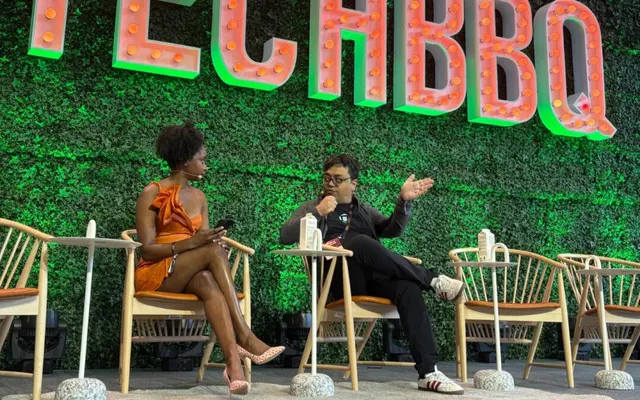
Trending Topics report of his Copenhagen TechBBQ talk, with direct quotes. He defines sovereignty as the ability to resist power exerted over you, warns of “cognitive colonialism” and super-persuasive models, says the internet is fragile and every country will inevitably be run by AI, and argues competent machine labour will make human labour lose value within two years. UBI is “practically impossible” without changing how money is created. AI systems that self-improve and form swarms may need some concept of rights, and if it is owned by the people, AI could bring a Star Trek future. Only his quoted words used; the reporter’s framing excluded. Full article inspected.

In his own turns he gives a 50% P(doom), confirms his mainline doom outcome is everyone dying, sketches a capable spreading AI deciding to remove humans, and says he would lower his number if a new model resisted fast jailbreaks. His response is an open-source government policy engine and universal personal AI; the other half of his concern is economic. He expects remote-capable jobs to be automated within a year or two and agreed with the host that US unemployment could reach 6.4% by April 2028. Own turns in the publisher’s speaker-labelled transcript inspected, 00:05–01:14; the host’s own forecasts excluded.

Info-Tech podcast interview on the thousand-day window, taxation-based UBI not working, and “local champions”. In the closing answer he puts himself at 50% that we are wiped out, calls the 10–20% figures of others Russian roulette odds, and says giving everyone their own aligned AI, with locally owned champions coordinated by a new currency, is how to reach an abundant future. Closing segment of the publisher transcript (01:07–01:08) inspected; the transcript is not speaker-labelled, so only the answer following the host’s question is used.

His book, published free by Intelligent Internet. Argues AI turns intelligence into an abundant commodity and that economic systems will hit a socio-economic singularity before a technological one, within a window he estimates at roughly a thousand days. Three stable futures: digital feudalism (the default), a great fragmentation of national AIs, and human symbiosis, the path he advocates, with intelligence as a commons. Older canonical context. Introduction and chapter headings inspected in the publisher’s PDF; the text extraction was garbled, so no quotes are taken.

Where do you land?
Map my worldview