Question 1
Miles Brundage
x.com/Miles_BrundageFormer OpenAI policy research head who leads the nonprofit AVERI and argues for independent audits, enforced safety standards and federal AI law.
How will AI change the world?
Across: his expressed Doom–Bloom outlook. Up: scale of transformation.
Doom–Bloom: 24 out of 100. Scale of transformation: 85 out of 100. Interpretation ranges: 19 to 50 horizontally, 75 to 100 vertically. These are interpretation coordinates, not event probabilities.
≈7%
Inferred from his simulated answers, not a number they gave. Plausible range: 2–21%.
Work & institutions
Very powerful AI is imminent, labs are using AI to accelerate further AI development, and the resulting feedback could compress decades of institutional and technological change into a few years.
Answer 3
Grouped by milestone, not spaced or ordered by inferred dates. AGI and superhuman AI retain his definitions.
A central assumption
Very powerful AI is imminent, labs are using AI to accelerate further AI development, and the resulting feedback could compress decades of institutional and technological change into a few years.Answer 3
If this assumption turned out differently, how would his outlook change?
An unresolved question
I don’t have a personal number I can defend.Answer 4
What would help him distinguish the plausible outcomes here?
What could change their mind
The biggest update would be strong evidence that automated AI development does—or does not—create a rapid feedback loop that sharply compresses our ability to iterate on safety.Answer 5
What evidence would be enough, and in which direction would it move his view?
More details
Transformative, broadly valuable gains are expected.
88 / 100
Interpretation range 67 to 100 on the qualitative scale.
Severe or widespread harm is a material expected part of the future.
75 / 100
Interpretation range 67 to 100 on the qualitative scale.
Human choices can substantially redirect the AI trajectory.
69 / 100
Interpretation range 50 to 75 on the qualitative scale.
AI is expected to remain bounded tools.
AI is expected to match people across most cognitive work.
Simulated position: AI is expected to substantially exceed people across cognitive work.
Restrict the AI uses discussed until prior protections or permission are in place.
Simulated position: Allow the AI uses discussed with targeted accountability and protections.
Minimize restrictions on the AI uses discussed.
These interpretations keep his stated conditions. Benefits and harms can both be substantial. The ranges describe how we read his simulated answers, not statistical confidence intervals.
Similar worldviews
Thought leaders whose simulated worldviews are closest to Miles Brundage’s
Simulated Assessment
Sources
Articles, interviews, and writings used to ground this simulated user.
An op-ed agreeing with the more than a thousand lab employees who asked the US government to help “pace” automated AI development. He proposes that companies invite deep independent audits, join industry coordination bodies, fund verification tools for a possible US–China agreement, and support rather than kill legislation such as the Frontier Act and whistleblower protections. He thinks cooperation with China cannot yet be ruled out. Bylined as AVERI’s leader and a former OpenAI head of policy research; his own argument. Full text inspected on the Guardian page.

Remarks at a Nobel laureates’ assembly on AI and nuclear war. He says people are voluntarily handing control to AI, starting inside the labs, and that speed and competition make loss of control possible even if almost no one wants it. AI now outperforms expert virologists on many hazardous tasks, and lying by AI systems has been normalized. He backs global frontier auditing and urges employees to push for verified guardrails. He has reservations about the Rome Declaration and warns about regulatory capture. Full post inspected.

Quotes his late-2024 view that AI exceeding humans in nearly every cognitive domain is almost certain within a few years. Argues that 2025 was largely wasted, so the realistic goal is to “80/20” policy and narrowly avoid the worst cases (AI bioweapons killing billions, rogue AI takeover, stable global totalitarianism), while accepting serious but lesser harms. He says AI is not necessarily net bad, AI has big upside, and safety is not as hard as some claim, but without more action we will probably face avoidable harms and possibly a worst case. Full post inspected.

Announces AVERI, the nonprofit he cofounded to make independent auditing of frontier AI effective and universal. He argues companies should not check their own homework, whether AI is a normal technology or an unusually dangerous one, and that AI gets far less outside scrutiny than other technologies. He hopes auditing helps prevent catastrophic outcomes and enables beneficial deployment. Personal framing of an organizational mission; the AI-generated scrutiny estimates he cites are illustrative, by his own account. Full post inspected.

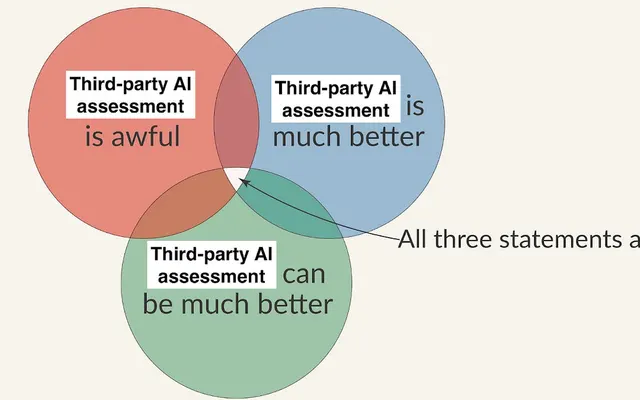
Older context. He expects big changes within ten years and sees AI as comparable to electricity. He says risk reduction and benefits are not zero-sum, calls transparency low-hanging fruit, backs SB 53-style rules scaled to company size, and supports a framework of standards, evidence and incentives including third-party audits. He then said progress looked more gradual and allowed iteration, which made him more optimistic about solvability but pessimistic about neglected policy. His September 2026 posts revise this. Lightly edited transcript inspected; only his turns used.

Where do you land?
Map my worldview