Question 1

Andrew Ng
@AndrewYNg on XUseful applications and better engineering can deliver enormous benefits.
How will AI change the world?
Across: his expressed Doom–Bloom outlook. Up: scale of transformation.
Doom–Bloom: 76 out of 100. Scale of transformation: 50 out of 100. Interpretation ranges: 75 to 76 horizontally, 49 to 51 vertically. These are interpretation coordinates, not event probabilities.
<1%
Inferred from his broader worldview and priorities. Approximate interpretation range: 0–18%. Applies to the outcome and conditions in his simulated answers; this is an inferred percentage.
No milestone timing was established. Dates, “not sure,” “possibly never,” and dependencies can all appear here when expressed.
Grouped by milestone, not spaced or ordered by inferred dates. AGI and superhuman AI retain his definitions.
A central assumption
Attacks still require actions that defenders can observe, and defenders often possess more information about their own systems.Answer 1
If this assumption turned out differently, how would his outlook change?
What could change their mind
The biggest change would be strong, repeated evidence that AI-enabled attackers have a durable advantage over defenders—that even well-isolated, carefully monitored, rapidly patched systems can be compromised faster than organizations can detect and recover.Answer 2
What evidence would be enough, and in which direction would it move his view?
More details
Substantial benefits are expected, with important conditions or distribution limits.
73 / 100
Interpretation range 67 to 100 on the qualitative scale.
Manageable or localized harms are expected.
34 / 100
Interpretation range 33 to 33 on the qualitative scale.
Reasoning, consideration of alternatives, and handling of uncertainty in his simulated answers. This describes the simulated answers, not the real person’s intelligence or opinions.
96 / 100
Interpretation range 86 to 100 on the qualitative scale.
Human choices have meaningful but substantially constrained influence.
60 / 100
Interpretation range 34 to 91 on the qualitative scale.
Stop or substantially slow development of more capable AI.
Simulated position: Continue development under stated safeguards.
Speed up development of more capable AI.
Restrict the AI uses discussed until prior protections or permission are in place.
Simulated position: Allow the AI uses discussed with targeted accountability and protections.
Minimize restrictions on the AI uses discussed.
These interpretations keep his stated conditions. Benefits and harms can both be substantial. The ranges describe how we read his simulated answers, not statistical confidence intervals.
Simulated Assessment
Question 2
What discovery or event would most change your view of AI’s future impact?
Sources
Articles, interviews, and writings used to ground this simulated persona.
The Batch, Issue 371 — Andrew Ng’s opening letter
Who’s Responsible for Irresponsible AI? Separating Out AI Facts, Fears, and Fiction
The loudest voices stoking fears about AI dangers have made tremendous headway in the past two weeks.

How AI Is Affecting the Job Market — And What You Can Do About It
Job seekers in the U.S. and many other nations face a tough environment.

Coding Agents Accelerate Some Software Tasks More Than Others
Coding agents are accelerating different types of software work to different degrees.

AI Will Not Destroy the Job Market
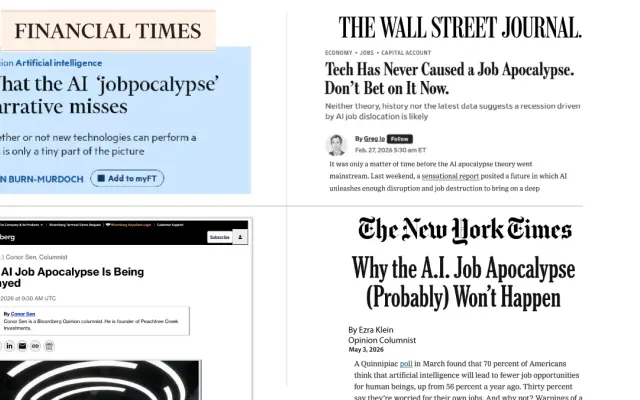
There will be no AI jobpocalypse.

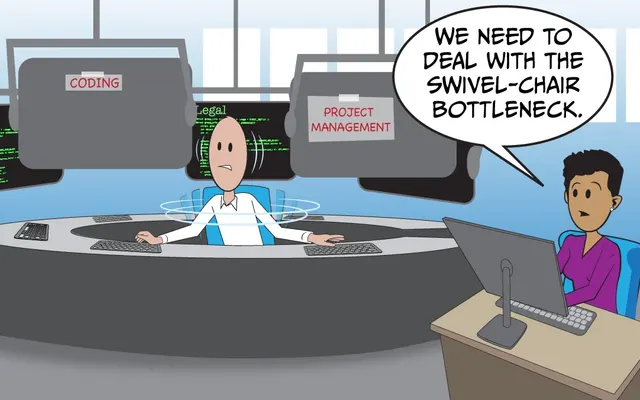
AI-Native Software Development Needs Generalists
AI-native software engineering teams operate very differently than traditional teams.