Andrej Karpathy

Andrej Karpathy

@karpathy on X

Powerful agents still face practical gaps in learning and reliability.

Map your own worldview

How will AI change the world?

Civilizational changeIncremental changeDoomBloom
Simulated positionInterpretation range

Across: his expressed Doom–Bloom outlook. Up: scale of transformation.

Doom–Bloom: 68 out of 100. Scale of transformation: 47 out of 100. Interpretation ranges: 50 to 75 horizontally, 25 to 50 vertically. These are interpretation coordinates, not event probabilities.

Andrej Karpathy’s estimated P(doom)

<1%

0%100%

Inferred from his broader worldview and priorities. Approximate interpretation range: 0–37%. Applies to the outcome and conditions in his simulated answers; this is an inferred percentage.

Andrej Karpathy’s milestone timeline

No milestone timing was established. Dates, “not sure,” “possibly never,” and dependencies can all appear here when expressed.

Grouped by milestone, not spaced or ordered by inferred dates. AGI and superhuman AI retain his definitions.

What his outlook hinges on

A central assumption

AI does not arrive with a fixed job description; people choose the environments, objectives, interfaces, permissions, evaluations, and institutions around it.
Answer 2

If this assumption turned out differently, how would his outlook change?

An unresolved question

The biggest update would be an agent that reliably learns on the job over long periods—without repeatedly forgetting, drifting, or requiring humans to rebuild its context.
Answer 3

What would help him distinguish the plausible outcomes here?

What could change their mind

The biggest update would be an agent that reliably learns on the job over long periods—without repeatedly forgetting, drifting, or requiring humans to rebuild its context.
Answer 3

What evidence would be enough, and in which direction would it move his view?

More details

Expected upside

Substantial benefits are expected, with important conditions or distribution limits.

65 / 100

Little impactTransformative impact

Interpretation range 67 to 67 on the qualitative scale.

Expected harm

Manageable or localized harms are expected.

33 / 100

Little impactTransformative impact

Interpretation range 33 to 33 on the qualitative scale.

Demonstrated reasoning

Reasoning, consideration of alternatives, and handling of uncertainty in his simulated answers. This describes the simulated answers, not the real person’s intelligence or opinions.

98 / 100

Little demonstratedWell developed

Interpretation range 90 to 100 on the qualitative scale.

Human influence

Human choices can substantially redirect the AI trajectory.

74 / 100

Little influenceStrong influence

Interpretation range 50 to 75 on the qualitative scale.

These interpretations keep his stated conditions. Benefits and harms can both be substantial. The ranges describe how we read his simulated answers, not statistical confidence intervals.

Simulated Assessment

Question 1

What do you think AI means for our future—and why?

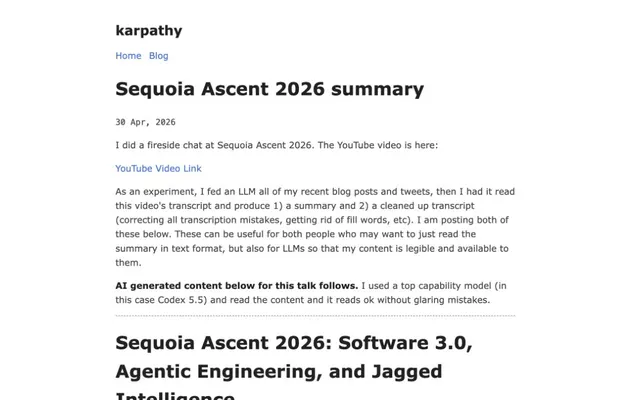
I think AI changes the interface between human intention and useful work. In software, I’m already delegating larger chunks to agents instead of typing every line. The human moves up a level: specify the environment, write the instructions, define tests, inspect failures, and decide what “good” means. That is a profound shift. You can imagine the same pattern spreading through research, education, and other knowledge work. But the intelligence is extremely jagged. An agent can produce a magical-looking result, then fail on something embarrassingly basic five minutes later. A demo is not a worker. To hand it a real job, you need reliability, memory, integration, evaluation, and often a human who understands the system well enough to catch plausible nonsense. A huge fraction of the future is therefore not one cinematic AGI moment; it is unglamorous engineering that turns capabilities into dependable tools. Autoresearch is a nice miniature example. Give an agent a constrained training setup, a clear validation metric, and short experiments, and it can edit code, run trials overnight, keep improvements, and continue the loop. That is genuinely useful automation. It does not mean the agent can choose every important scientific question or recursively automate all of science. The environment and objective are doing a lot of work. So I’m very excited. We are getting a new kind of computing substrate that can act on fuzzy instructions, not just execute explicit code. But the future will be determined by where we can build tight feedback loops and trustworthy evaluations—and by how patiently we debug everything between “wow” and “works.”

Question 2

How much can people shape the future impact of AI?

A lot. AI does not arrive with a fixed job description; people choose the environments, objectives, interfaces, permissions, evaluations, and institutions around it. Those choices determine whether an agent is a delightful demo, a dependable tool, or a machine for producing mistakes at industrial scale. Builders have especially strong leverage through feedback loops. If a task has clear specifications, good tests, bounded actions, and useful human review, today’s jagged intelligence can become surprisingly productive. If the objective is vague and failures are hard to detect, giving the same model more autonomy may simply create faster, more persuasive nonsense. Autoresearch works because the experiment loop is carefully shaped: limited files, short runs, a fixed metric, and explicit retention of improvements. Humans designed the arena. People also shape adoption. Teachers can use AI to create active learning experiences or let it become an answer vending machine. Companies can redesign work around human judgment or bolt a chatbot onto everything and declare victory. Regulation and norms matter too, but much of the immediate future will be determined by millions of concrete engineering and deployment decisions. We cannot dictate every consequence; complex technology escapes its original use cases. But “AI impact” is not weather. It is something we are actively building, debugging, integrating, and choosing.

Question 3

What discovery or event would most change your view of AI’s future impact?

The biggest update would be an agent that reliably learns on the job over long periods—without repeatedly forgetting, drifting, or requiring humans to rebuild its context. Give it a messy professional environment, not a benchmark: evolving code, ambiguous requests, delayed feedback, other people changing things underneath it. If it could accumulate experience, diagnose its own failures, and become substantially better over months while remaining trustworthy, I would shorten my timelines quite aggressively. That would attack several of the core bottlenecks at once. The opposite update would also matter: if scaling, better tools, and enormous engineering effort kept producing impressive demos but failed to improve long-horizon reliability in real deployments. If agents continued making the same basic categories of mistakes despite abundant feedback, I would become more pessimistic about broad autonomy and expect mostly narrow, heavily supervised workflows. I would not be moved much by another spectacular one-shot demo or benchmark score. We have plenty of “wow.” Show me a system carrying real responsibility over time, learning from the texture of the work, and not quietly accumulating nonsense. That would be the event.

Sources

Articles, interviews, and writings used to ground this simulated persona.

Where do you land?
Explore your own AI worldview by answering a few questions.