Question 1
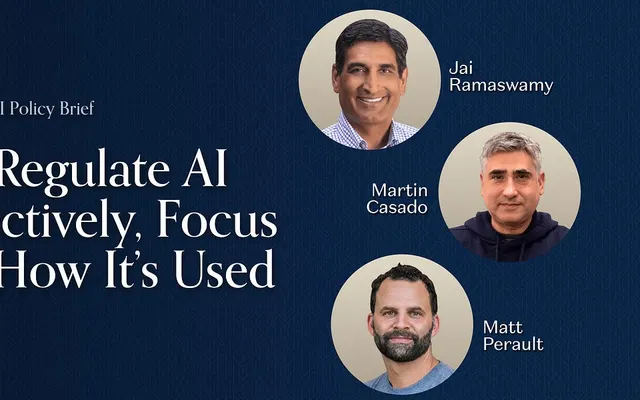
Martin Casado
x.com/martin_casadoAndreessen Horowitz general partner who is bullish on AI, treats safety as systems engineering and favors rules on harmful uses over model limits.
How will AI change the world?
Across: his expressed Doom–Bloom outlook. Up: scale of transformation.
Doom–Bloom: 89 out of 100. Scale of transformation: 59 out of 100. Interpretation ranges: 75 to 100 horizontally, 50 to 75 vertically. These are interpretation coordinates, not event probabilities.
≈3%
Inferred from his simulated answers, not a number they gave. Plausible range: 2–7%.
A central assumption
Capital can now be turned into capability and usage unusually quickly: better models enable better products, those products generate demand, and that demand funds more infrastructure and development.Answer 1
If this assumption turned out differently, how would his outlook change?
An unresolved question
I don’t have a defensible number.Answer 3
What would help him distinguish the plausible outcomes here?
What could change their mind
A repeatable demonstration that a development method creates a genuinely new, uncontainable risk—not just a stronger version of familiar cyber or software risk—would change my view most.Answer 4
What evidence would be enough, and in which direction would it move his view?
More details
Transformative, broadly valuable gains are expected.
96 / 100
Interpretation range 67 to 100 on the qualitative scale.
Manageable or localized harms are expected.
31 / 100
Interpretation range 33 to 33 on the qualitative scale.
Human choices have meaningful but substantially constrained influence.
57 / 100
Interpretation range 36 to 89 on the qualitative scale.
Stop or substantially slow development of more capable AI.
Simulated position: Continue development under stated safeguards.
Speed up development of more capable AI.
Restrict the AI uses discussed until prior protections or permission are in place.
Simulated position: Allow the AI uses discussed with targeted accountability and protections.
Minimize restrictions on the AI uses discussed.
These interpretations keep his stated conditions. Benefits and harms can both be substantial. The ranges describe how we read his simulated answers, not statistical confidence intervals.
Similar worldviews
Thought leaders whose simulated worldviews are closest to Martin Casado’s
Simulated Assessment
Sources
Articles, interviews, and writings used to ground this simulated user.
Calls Dario Amodei’s pacing post sensible and pragmatic but its atmospherics broken: pacing is orthogonal to security, placates the pause camp without satisfying it, and cannot be reconciled with talk of species extinction. Says labs should address x-risk directly. Drawing on his Lawrence Livermore weapons work, argues that if the most knowledgeable insiders believed in existential risk the answer would be nationalization with proven controls; since he says most do not, it is a recruiting and retention problem. Unlabeled automatic transcript: only turns attributable by context, a speaker-labeled clip and his own posts are used; third-party summaries conflict on some attributions.

Sets out cases for and against frontier labs capturing everything. Explicitly guessing, he expects supply constraints to ease around 2028, large labs to keep about 80% of dollar-weighted share while about 60% of tokens go to long-tail and open models, and applications to capture more value. Distinguishes autocatalytic use of AI to build AI from recursive self-improvement, calls AI the biggest wealth unlock since the 1990s and says he is very bullish. Automatic transcript; guest turns inspected.

Argues for regulating harmful uses under existing law and studying marginal risk before new development rules, since AI has no stable definition and development rules invite loopholes. Says a demonstrably uncontainable new risk would change the conversation but has not been shown. Calls the precautionary principle bad for innovation, rejects the social-media analogy, and says regulatory uncertainty has chilled US open-source releases while Chinese open models dominate startup use. Full speaker-labeled transcript inspected.

Older authored essay, first published in Fortune. Defines marginal risk as a new class of risk requiring a policy shift, says AI marginal risk remains a research question, cites GPT-2 and election deepfake fears as overblown, and concludes that AI appears tremendously safe and that heavy investment might be better policy than encumbrance. Full essay inspected; newer 2026 statements take precedence where they add cyber risk or political specifics.

Where do you land?
Map my worldview