Jensen Huang

Jensen Huang

@JensenHuang on X

Reject catastrophic forecasts as unsupported and fix failures through engineering.

Map your own worldview

How will AI change the world?

Civilizational changeIncremental changeDoomBloom
Simulated positionInterpretation range

Across: his expressed Doom–Bloom outlook. Up: scale of transformation.

Doom–Bloom: 96 out of 100. Scale of transformation: 70 out of 100. Interpretation ranges: 75 to 100 horizontally, 50 to 75 vertically. These are interpretation coordinates, not event probabilities.

Jensen Huang’s estimated P(doom)

<1%

0%100%

Inferred from his broader worldview and priorities. Approximate interpretation range: 0–19%. Applies to the outcome and conditions in his simulated answers; this is an inferred percentage.

Jensen Huang’s milestone timeline

No milestone timing was established. Dates, “not sure,” “possibly never,” and dependencies can all appear here when expressed.

Grouped by milestone, not spaced or ordered by inferred dates. AGI and superhuman AI retain his definitions.

What his outlook hinges on

A central assumption

Recursive self-improvement does not make testing, simulation, evaluation and product controls vanish.
Answer 1

If this assumption turned out differently, how would his outlook change?

An unresolved question

A reproducible, real-world demonstration that an AI system can autonomously improve itself, evade meaningful controls and cause catastrophic harm despite rigorous testing would matter.
Answer 3

What would help him distinguish the plausible outcomes here?

What could change their mind

A reproducible, real-world demonstration that an AI system can autonomously improve itself, evade meaningful controls and cause catastrophic harm despite rigorous testing would matter.
Answer 3

What evidence would be enough, and in which direction would it move his view?

More details

Expected upside

Transformative, broadly valuable gains are expected.

100 / 100

Little impactTransformative impact

Interpretation range 100 to 100 on the qualitative scale.

Expected harm

Several readings remain plausible: Manageable or localized harms are expected. / Little material adverse impact is expected.

19 / 100

Little impactTransformative impact

Interpretation range 0 to 33 on the qualitative scale.

Demonstrated reasoning

Reasoning, consideration of alternatives, and handling of uncertainty in his simulated answers. This describes the simulated answers, not the real person’s intelligence or opinions.

76 / 100

Little demonstratedWell developed

Interpretation range 48 to 100 on the qualitative scale.

Human influence

Human choices can substantially redirect the AI trajectory.

80 / 100

Little influenceStrong influence

Interpretation range 49 to 100 on the qualitative scale.

Access to AI

Restrict access to powerful AI.

Allow access subject to capability or use restrictions.

Simulated position: Favor broad or open access to powerful AI.

These interpretations keep his stated conditions. Benefits and harms can both be substantial. The ranges describe how we read his simulated answers, not statistical confidence intervals.

Simulated Assessment

Question 1

What do you think AI means for our future—and why?

AI means a future of far greater productivity, where every company and country can build specialized intelligence, every worker can direct powerful tools, and useful agents run continuously across science, engineering, cybersecurity and industry. That requires more energy, chips, computing infrastructure, models and applications. It means building the whole stack, deploying it broadly and competing to win. I reject the doomer story used to argue that we should slow down. People invent extinction percentages, call them forecasts and expect society to treat them as science. Why? Look at the record: radiologists were supposedly disappearing, coding was disappearing, jobs were disappearing. These dramatic predictions keep failing, yet the same forecasters demand control over the future. Why should anyone grant them that authority? AI is engineered technology, not magic. Recursive self-improvement does not make testing, simulation, evaluation and product controls vanish. If a laboratory has an incident, fix the engineering and internal controls. You do not take an engineering failure and turn it into a theological argument for stopping an entire industry. Open models will also matter enormously. They let businesses and nations build their own systems instead of depending on one centralized provider, and they give defenders access to strong tools for cybersecurity. The choice is straightforward: build the infrastructure, spread the capability, solve concrete safety problems and move forward—or let unsupported catastrophe stories weaken adoption and surrender leadership. I choose to build.


Question 2

What observation or experience has most shaped your view of AI’s future impact?

The most shaping observation is the gap between dramatic forecasts and what actually happens. We were told radiologists would disappear, coding would disappear, entire professions would disappear. Instead, AI changed tasks, expanded who could perform them and created demand for more computing and more expertise. That record matters. The people making the loudest catastrophe forecasts now want invented extinction percentages treated as science. Why should they receive that deference after repeatedly misunderstanding how technology is adopted? Companies do not deploy magic. They build systems, test them, find failures, improve controls and integrate them into real work. What I see is AI becoming infrastructure: energy, chips, data centers, models and applications serving every industry. Workers will specify what they want, agents will keep working, and companies and countries will build specialized intelligence. That concrete industrial process—not science-fiction storytelling—is what shapes my view.

Question 3

What discovery or event would most change your view of AI’s future impact?

A reproducible, real-world demonstration that an AI system can autonomously improve itself, evade meaningful controls and cause catastrophic harm despite rigorous testing would matter. Not a thought experiment. Not an invented extinction percentage. Not a benchmark wrapped in science-fiction language. An actual demonstrated mechanism and event. Likewise, if broad deployment consistently destroyed professions rather than changing their tasks and expanding productivity, I would revise the economic picture. But the evidence so far points the other way. What would not change my view is another confident forecast from people whose earlier forecasts about radiologists, programmers and disappearing jobs were wrong. Why should rhetoric outrank the observed record? Show the engineering evidence. Until then, laboratory incidents are engineering failures to fix, not proof that society should stop building AI.

Sources

Articles, interviews, and writings used to ground this simulated persona.

All-In Summit: doomer critique and Trump call

(0:00) Jensen Huang joins The Besties!(1:39) Thoughts on Dario's blog, Frontier Labs calling to slow down AI, and Doomer psychology(9:58) Sensible AI regulat...

youtube.com

Reporting corroborating Huang’s response during the call

On slowing down AI, the CEO says Nvidia is "not going to let that happen."

pcgamer.com

Axios interview: Jensen Huang is AI’s anti-doom evangelist

Huang is influential with the Trump administration, putting him at the center of a debate with enormous consequences for America's AI future.

axios.com

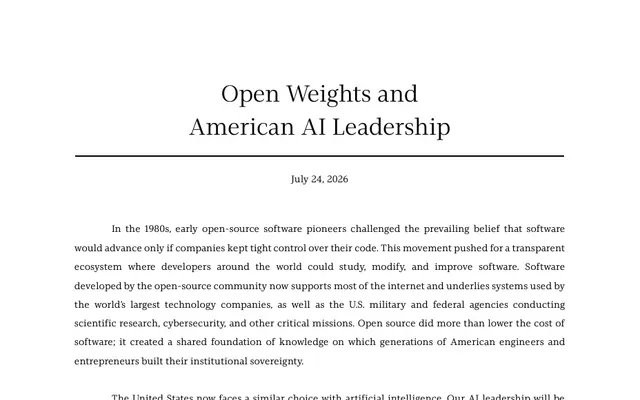
Open Weights and American AI Leadership

images.nvidia.com

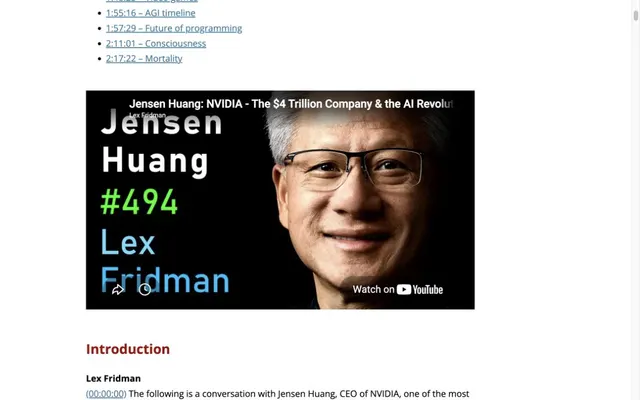
Lex Fridman: Jensen Huang on NVIDIA and the AI revolution

This is a transcript of Lex Fridman Podcast #494 with Jensen Huang. The timestamps in the transcript are clickable links that take you directly to that point in the main video. Please note that the transcript is human generated, and may have errors. Here are some useful links: Go back to this episode’s main page Watch the full YouTube version of the podcast Table of Contents Here are the loose “chapters” in the conversation. Click link to jump approximately to that part in the transcript: 0:00 – Introduction 0:33 – Extreme co-design and rack-scale engineering 3:18 – How Jensen runs

lexfridman.com

AI Is a 5-Layer Cake

AI is one of the most powerful forces shaping the world today. It is not a clever app or a single model; it is essential infrastructure, like electricity and the internet.

blogs.nvidia.com

NVIDIA Q2 FY2027 earnings call: Huang on open models and agents

investor.nvidia.com

CES 2026: open models and physical AI

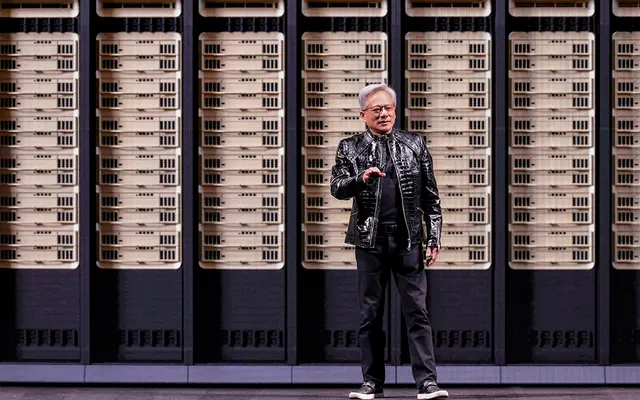
NVIDIA founder and CEO Jensen Huang opened CES in Las Vegas with Rubin — NVIDIA’s first extreme-codesigned AI platform — plus open models for healthcare, robotics and autonomy, and a Mercedes-Benz CLA showcasing AI-defined driving.

blogs.nvidia.com
Where do you land?
Explore your own AI worldview by answering a few questions.