質問1
Katja Grace
x.com/KatjaGraceAI Impacts co-founder who surveys AI researchers about progress and risk and argues for pausing the development of AI much more capable than humans.
AIは世界をどのように変えるでしょうか?
横軸:彼女が表明したDoom–Bloomの見通し。 縦軸:変革の規模。
Doom–Bloom:100点中22。変革の規模:100点中94。解釈範囲:横方向は17から50、縦方向は89から100。これらは解釈上の座標であり、事象の確率ではありません。
≈50%
“Well, it varies. I’d say maybe like 50 percent.”
AI “doom” in her discussion of the probability that current AI development destroys the world; endpoint not further defined (the host’s follow-up paraphrases it as human extinction)
314 - Guest: Katja Grace, AI Impact Researcher, part 2 · 2026年6月
中心的な前提
But the route we are taking means creating new agents—“new guys”—that pursue goals, may become better than humans at nearly everything, and whose values we cannot inspect or reliably choose.回答1
この前提が実際には異なると判明した場合、彼女の見通しはどう変わりますか?
未解決の問い
The uncertainty is less about whether sufficiently advanced AI would be transformative than whether we build it, when, and whether humans remain meaningfully in control afterward.回答2
ここで考えられる結果を彼女が見分けるうえで、何が役立ちますか?
考えを変え得るもの
A convincing way to inspect and reliably control advanced agents’ goals would change my view most—especially if it held up as systems became more capable and encountered unfamiliar situations.回答4
どのような証拠なら十分で、それによって彼女の見解はどちらの方向に変わりますか?
詳細
複数の解釈が依然として妥当です:大きな恩恵が予想されていますが、重要な条件や分配上の制約があります。 / 変革をもたらし、広く価値のある恩恵が予想されています。 / 恩恵は限定的、または狭い範囲にしか行き渡らないと予想されています。
67 / 100
質的尺度での解釈範囲は33から100です。
複数の解釈が依然として妥当です:破局的または不可逆的な喪失が、予想される将来の中心となっています。 / 深刻または広範な害が、予想される将来の実質的な一部となっています。
84 / 100
質的尺度での解釈範囲は67から100です。
人間の選択によって、AIの軌道を大幅に変えることができます。
73 / 100
質的尺度での解釈範囲は50から75です。
AIは、限定的なツールにとどまると予想されています。
AIは、ほとんどの認知作業において人間と同等になると予想されています。
シミュレーション上の位置:AIは、認知作業全般において人間を大幅に上回ると予想されています。
シミュレーション上の位置:より高性能なAIの開発を停止するか、大幅に減速させます。
明示された安全対策の下で開発を継続します。
より高性能なAIの開発を加速させます。
これらの解釈では、彼女が示した条件が維持されています。恩恵と害は、どちらも大きくなり得ます。この範囲は、統計的な信頼区間ではなく、彼女のシミュレーションされた回答をどのように読み取ったかを示すものです。
似ている世界観
シミュレーションされた世界観がKatja Graceの世界観に最も近いオピニオンリーダー
シミュレーション評価
出典
このシミュレーション対象者の根拠として使用された記事、インタビュー、著作です。
Argues misaligned AI takeover is substantially more likely and probably worse than humans seizing power with AI: more capable agents with misaligned goals eventually get power, and many AI instances may coordinate more readily than a human could command them all. Expects gradual transfer of power from humans to AIs to be more likely than either sudden scenario. Near term the best mitigation is not building AI much more powerful than us until alignment and its target are solid, ideally stopping; her ideal is removing much of the compute (crediting her partner David Krueger’s idea), though she would accept many pause designs over full steam ahead. Thinks China shares the incentive to pause and racing mainly shortens timelines. Her turns in the publisher transcript inspected.

Defends stating p(doom) numbers as calibrated guesses and gives hers as maybe like 50 percent, saying it varies; the outcome and horizon are not defined. Distinguishes default p(doom) from how much it can be changed and says she is pretty optimistic about changing it, because humans are choosing to build this. Wants outside intervention rather than relying on companies to restrain themselves, and expects the world to keep waking up. The show’s transcript lacks speaker labels; attribution follows the question-and-answer sequence. Full transcript inspected.

Explains that she began working on AI risk partly to learn whether it was mistaken and is now convinced there is substantial risk from AI that is not here yet but may arrive quite soon. Core concern: we are making new agents with their own goals, grown rather than built, whose values we cannot see; goal-directedness does not require consciousness. Creating creatures more capable than humans at everything with other goals probably goes quite badly by default; observed deceptive incidents confirm the theory roughly. Treats unemployment and extinction as parts of the same loss of power and says AGI is not a bright line. Full transcript inspected; survey figures discussed are respondents’ forecasts.

Rebuts waiting to pause until the last moment: braking takes time, pausing once makes later pauses easier, the public substantially hates AI but feels disempowered by the story that progress is inexorable, and some models already seem somewhat dangerous with risk hard to measure. Argument for timing, not a treaty design. Full essay inspected.

Argues the bulk of catastrophe probability is not a sudden, clean extinction by one superintelligence but a drawn-out process of people losing money, food and safety amid a fast technological buildout that does not care about them, with increasing confusion and misinformation. Her guess about the shape of catastrophe, not a dated forecast. Full essay inspected.

Summarizes the extinction argument as building AI better than humans at everything, making it into independent agents, and failing to give them the right goals. More competent agents can strip human power through ordinary channels such as wages, capital, persuasion and politics, so unemployment is the most legible tip of losing power across the board. Notes either can happen without the other. Full essay inspected.

Identifies what makes AI different: industrialized cognitive labor that may be distributed very unequally, and a fast-growing population of new agents (“guys”) with alien, unknown values. Says an ocean of cognitive labor alone seems actively great and unequal distribution alone bad but not fatal; the combination, with most labor in the hands of misaligned new agents, is the danger. Full essay inspected; ideas also presented in her 2023 talk.

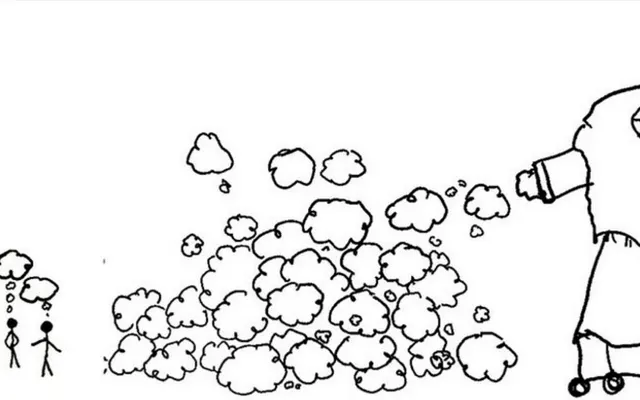
Distinguishes people racing from incentives that actually reward racing. Proposes the image of cities hurrying to pull wooden horses of uncertain contents through their own gates, to undercut both “we must move fast at others’ expense” and “coordination is hopeless” arguments. Conceptual argument, not a geopolitical forecast. Full essay inspected.

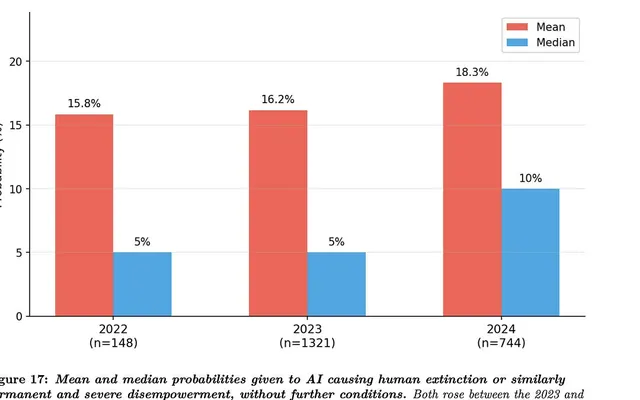
Her highlights of the 2024 Expert Survey on Progress in AI (fielded December 2024). The extinction or disempowerment probabilities and human-level AI dates are respondents’ answers, not her forecast. Her own comments: researchers educated in Asia were more worried, undercutting a common arms-race defense; people creating AI do not program it and know little of what happens inside; and she expects some 2024 answers to be out of date. Full post inspected; underlying paper not reviewed.

あなたはどの位置でしょうか?
自分の世界観をマッピングする