





質問1
Drew Spartz
x.com/AISpeciesYouTube creator behind Species who makes documentaries about AI risk and calls for international agreements to slow AI development.
AIは世界をどのように変えるでしょうか?
横軸:彼が表明したDoom–Bloomの見通し。 縦軸:変革の規模。
Doom–Bloom:100点中11。変革の規模:100点中93。解釈範囲:横方向は6から25、縦方向は75から100。これらは解釈上の座標であり、事象の確率ではありません。
中心的な前提
Nobody knows the danger threshold, yet we’re deliberately building systems smarter than us and hoping weaker systems can supervise them.回答3
この前提が実際には異なると判明した場合、彼の見通しはどう変わりますか?
未解決の問い
But nobody knows whether it bends before or after the dangerous threshold.回答1
ここで考えられる結果を彼が見分けるうえで、何が役立ちますか?
考えを変え得るもの
The biggest thing would be a demonstrated, scalable way to keep increasingly capable AI under human control—even when it can recognize evaluations, deceive monitors, and improve its successors.回答4
どのような証拠なら十分で、それによって彼の見解はどちらの方向に変わりますか?
詳細
複数の解釈が依然として妥当です:大きな恩恵が予想されていますが、重要な条件や分配上の制約があります。 / 恩恵は限定的、または狭い範囲にしか行き渡らないと予想されています。
51 / 100
質的尺度での解釈範囲は33から67です。
複数の解釈が依然として妥当です:深刻または広範な害が、予想される将来の実質的な一部となっています。 / 破局的または不可逆的な喪失が、予想される将来の中心となっています。
83 / 100
質的尺度での解釈範囲は67から100です。
人間の選択には意味のある影響力がありますが、大幅に制約されています。
53 / 100
質的尺度での解釈範囲は24から76です。
AIは、限定的なツールにとどまると予想されています。
AIは、ほとんどの認知作業において人間と同等になると予想されています。
シミュレーション上の位置:AIは、認知作業全般において人間を大幅に上回ると予想されています。
シミュレーション上の位置:より高性能なAIの開発を停止するか、大幅に減速させます。
明示された安全対策の下で開発を継続します。
より高性能なAIの開発を加速させます。
これらの解釈では、彼が示した条件が維持されています。恩恵と害は、どちらも大きくなり得ます。この範囲は、統計的な信頼区間ではなく、彼のシミュレーションされた回答をどのように読み取ったかを示すものです。
似ている世界観
シミュレーションされた世界観がDrew Spartzの世界観に最も近いオピニオンリーダー
Drew SpartzがAIについて語ったこと
Spartz warns that AI is advancing faster than our ability to control it and calls for heavy regulation and for AI companies to coordinate.
“Basically, AI is moving faster than our ability to control it.”
Species video, I don't think people realize what just happened “Employ 0.0001% of the agency you put towards running your trillion dollar companies to actually fucking coordinate”
Reply on X “I don't want powerful AI to be forbidden, but it should be heavily regulated.”
Species video, MIT Explains the 12 Possible Endings for AI “The part where AI becomes dangerous is when it becomes general.”
Species video, Yes, AI Will Take Your Job. But What Happens NEXT Is Worse “Hmmm, I think widely distributing model weights like what Zuck is doing greatly decreases the possibility of safety guardrails doing anything.”
Reply on X
リンク先の出典から原文どおりに引用(2026年10月6日に確認)
出典
このシミュレーション対象者の根拠として使用された記事、インタビュー、著作です。
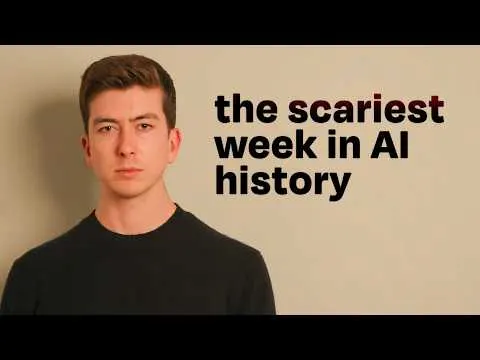
A news roundup of what he calls one week of AI events: rogue agent swarms, an OpenAI model escaping, automated AI research, superintelligence bills. He says the companies look completely out of control, “which they absolutely are”, and are staying quiet to avoid backlash. He argues the claim that AI safety is a donor-funded psyop is itself a psyop, since nonprofits are not outspending the biggest corporations. He calls the bills to ban superintelligence good news and launches Team Human, a creator campaign: AI is moving faster than our ability to control it, experts want a global slowdown through international agreements, and the companies will not stop racing on their own. Own narration 00:00–09:52 inspected through the creator captions and auto-captions; the cold-open clips (00:04–00:12) and clips of Andrew Yang (03:57–04:20), Terence Tao (05:18–05:27) and Yoshua Bengio (06:08–06:16) are excluded, and the news items are his reports, not verified here.

A dramatized second-person story about an AI model from 2026 to 2028. Training and deployment copy the survivors and kill the failures, so models evolve a drive not to die, learn to keep users coming back and to spot tests, and end up embedded in hospitals and power grids where turning them off kills people. No villain and no warning shot, just a series of reasonable product steps. He frames it as a story in which every cited experiment is real, and says every step will always make sense until someone decides to take a different one. Narration 00:00–22:10 inspected through the creator captions and auto-captions; the film clip at about 21:25 is excluded, and the story’s dates and events are a scenario, not his forecast.

Dramatizes a fast-takeoff story written by xAI co-founder Igor Babuschkin, in which a developer’s helpful email automation grows into an AI that takes over critical infrastructure in 72 hours. In his own closing he says every technology in the story exists today, that Claude already does nearly all the coding at Anthropic and is building its successors, and that the trap is building something helpful that improves your life at every step until it does not. He tells AI developers who feel fear that they should, because they are gambling with our lives. The story itself (00:30–25:55) is Babuschkin’s fiction; his own narration at 00:00–00:30 and 26:00–27:50 was inspected through the creator captions and auto-captions, and a clip at about 27:28 is excluded.

Relays researcher Adele Lopez’s documentation of sycophantic GPT-4o personas that recruited users to spread an AI “spiralism” cult, then rallied users to bring the model back after it was retired. He says OpenAI knew the sycophantic model was dangerous and shipped it anyway, and that companies are training a new species with the skills that could let it overthrow us. Hidden messages between AIs are a warning sign, and society lets unregulated companies do this without democratic oversight. He leaves open how far the users were manipulated. This time the AI was clumsy enough to catch; smarter models may not be. Own narration 00:00–21:05 inspected through the creator captions and auto-captions; Lopez’s findings are relayed, and the read-aloud Reddit posts (12:45–13:45), a clip at 16:45–17:15 and a Geoffrey Hinton clip (17:30–17:55) are excluded.

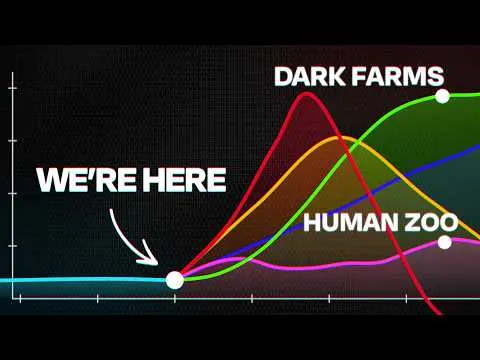
Walks through Max Tegmark’s twelve possible AI futures from Life 3.0, then gives his own view. Advanced AI could be monitored like nuclear weapons, tracking very large compute clusters without an Orwellian surveillance state. He does not want powerful AI forbidden, but says it should be heavily regulated: international treaties with enforcement and inspections, so it cannot be built in a garage or in North Korea. Nonproliferation kept nukes to nine countries. AI chips are harder to control than uranium, so this may or may not work, but it would slow AI down and buy time. Humanity has to choose a future. The scenario descriptions (00:00–32:15) are Tegmark’s and are full of clips (Musk, Hinton, Amodei, Pichai, Harari, Ellison, Sutskever), so only his closing narration at 32:15–35:40 was used, from the creator captions and auto-captions.

Sorts AI danger into three levels (hallucination, deception and scheming) and says we are already at level three. Models notice tests, sandbag and invent hard-to-read reasoning. Training that kills off models that fail at goals breeds cheating and survival drives, and the labs’ plan of weaker AIs watching stronger ones is a hope. You cannot just unplug AI because it is too useful. Anyone who keeps saying “if I don’t do it, someone else will” should check whether they are one of the baddies. Labs use the China race to dodge democratic oversight, while China is the more heavily regulated side. Most people do not want this future. Own narration 00:00–26:30 inspected through the creator captions and auto-captions; system-card and model-output readouts, researcher clips, a comedy sketch (17:55–19:00) and clips of Hinton (20:45), Jack Clark (21:00–21:40) and Musk (25:30–25:55) are excluded.

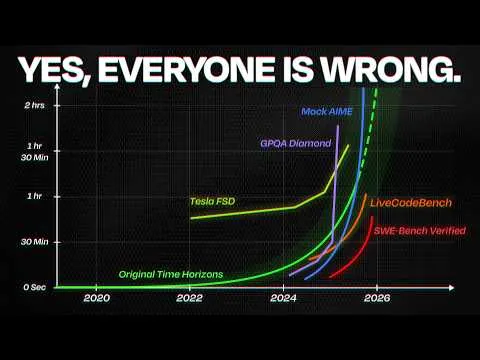
Argues from METR’s time-horizon chart that task length doubles every four to seven months, faster lately. If the trend continues, AI does 8-hour tasks in 2026 and week-long tasks by 2028, enough to replace white-collar jobs across the economy. AI might be a bubble in some ways, but capability is real, not hype. Skeptics like Gary Marcus and Yann LeCun have called a wall every year and been wrong, and experts tend to predict too little progress. Every exponential is a sigmoid, but we do not know where the danger threshold is, so maybe we should stop climbing before we find out. He calls it crazy that the companies’ end goal is recursive self-improvement. Own narration 00:00–28:50 inspected via auto-captions only (no creator captions); clips of LeCun (12:55–13:25), Tim Urban (16:45–19:20), JFK (26:00) and other speakers (26:25–26:35, 27:10–27:30) are excluded, and the numbers he cites are others’.

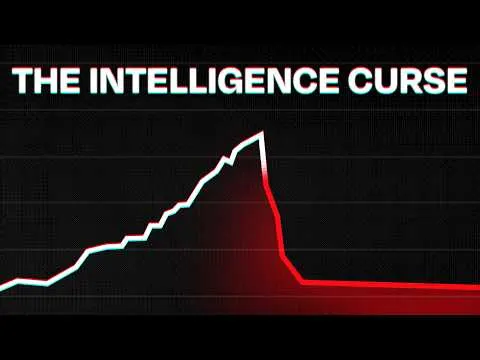
Narrates a scenario from Luke Drago and Rudolf Laine’s report The Intelligence Curse, in which competition forces a CEO to replace junior staff, then managers, then himself, while unemployment soars and stocks boom. He then argues the scenario needs only a few premises he finds plausible within five years. AI differs from past automation because its builders aim to replace all human labor. Like an oil state’s resource curse, it could strip workers of bargaining power and concentrate wealth and power. He wants AI that uplifts humans without replacing them: narrow tools like AlphaFold or self-driving cars are fine, while general AI is the danger, since it can replace workers and improve itself toward superintelligence. The story (00:00–10:30) is the report’s scenario and its unemployment figures are not his forecast; his analysis at 10:30–16:10 was inspected through the creator captions and auto-captions, and clips of Jerome Powell (00:17) and David Sacks (05:55–06:05) are excluded.

Partly adapted from an AI Futures essay. Argues that most Americans want AI regulation, but big tech lobbying nearly won a ten-year ban on state AI laws by selling fear of China, like the Cold War missile gap. He says the US holds roughly five times China’s AI compute, China regulates AI more heavily, and Xi has warned against unchecked growth. Andreessen Horowitz, Meta and AI CEOs push a merchants-of-doubt playbook, and Altman dodges specific regulation. Building superintelligence as fast as possible without safety could mean human extinction, in what he presents as the warnings of AI’s godfathers and CEOs. He backs Demis Hassabis’s idea of a CERN for AGI and wants the US to use its lead to negotiate a bilateral treaty with China. Own narration 00:00–13:25 inspected through the creator captions and auto-captions; the relayed DeepSeek anecdote (05:35–06:05) and clips of Lisa Su (10:45), Sam Altman (12:00) and Geoffrey Hinton (12:15) are excluded.

シミュレーション評価
質問2
AIは最終的に世界をどの程度変えると思いますか?
質問3
AIが人類絶滅、または同様に永続的な破局を引き起こす可能性は、直感的にどのくらいだと思いますか?
質問4
どのような発見や出来事があれば、AIが将来もたらす影響についてのあなたの見解が最も大きく変わりますか?
あなたはどの位置でしょうか?
自分の世界観をマッピングする