Daniel Kokotajlo

Daniel Kokotajlo

x.com/DKokotajlo

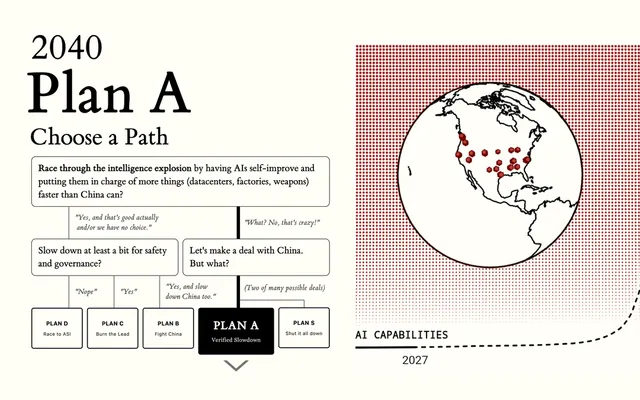
AI Futures Project forecaster who studies how automating AI research could speed up progress and calls for a verified international slowdown.

AIは世界をどのように変えるでしょうか?

文明規模の変化漸進的な変化DoomBloom
シミュレーション上の位置解釈範囲

横軸:彼が表明したDoom–Bloomの見通し。 縦軸:変革の規模。

Doom–Bloom:100点中11。変革の規模:100点中96。解釈範囲:横方向は0から25、縦方向は91から100。これらは解釈上の座標であり、事象の確率ではありません。

Daniel Kokotajloが示したP(doom)

≈70%

0%100%
“70% chance of something like AIs taking over”

AI takeover or a comparably very big catastrophe on the default path “if things don’t change”; explicitly not an extinction-only estimate

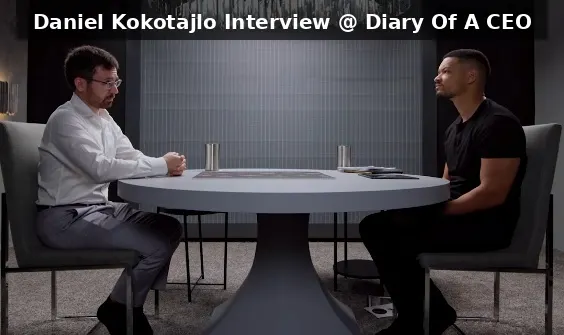
Transcript of Daniel Kokotajlo Interview: Diary Of A CEO Podcast · 2026年7月

彼の見通しを左右するもの

中心的な前提

The key mechanism is feedback: increasingly capable systems automate more of the coding involved in AI development; then they begin automating research itself—designing experiments, interpreting results, improving training methods and helping build their successors.
回答1

この前提が実際には異なると判明した場合、彼の見通しはどう変わりますか?

未解決の問い

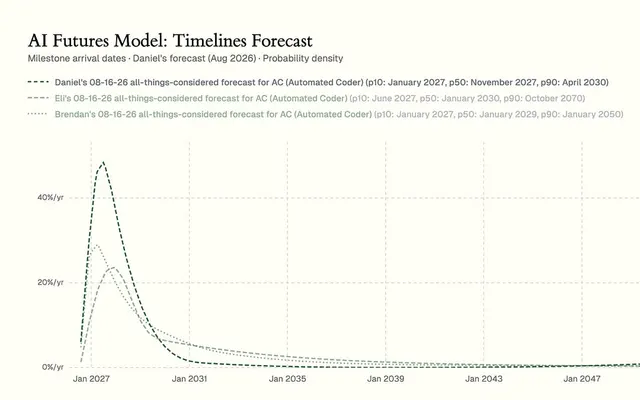
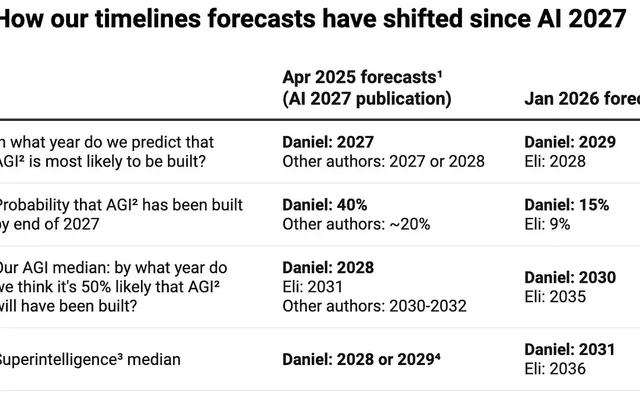
My median estimate for fully automated AI research is around the end of 2028, with substantial uncertainty.
回答1

ここで考えられる結果を彼が見分けるうえで、何が役立ちますか?

考えを変え得るもの

The biggest update would come from strong real-world evidence about whether AI can automate AI research without human bottlenecks.
回答4

どのような証拠なら十分で、それによって彼の見解はどちらの方向に変わりますか?

詳細

予想される恩恵

複数の解釈が依然として妥当です:大きな恩恵が予想されていますが、重要な条件や分配上の制約があります。 / 恩恵は限定的、または狭い範囲にしか行き渡らないと予想されています。 / 変革をもたらし、広く価値のある恩恵が予想されています。

58 / 100

影響が小さい変革をもたらす影響

質的尺度での解釈範囲は33から100です。

予想される害

破局的または不可逆的な喪失が、予想される将来の中心となっています。

99 / 100

影響が小さい変革をもたらす影響

質的尺度での解釈範囲は100から100です。

人間の影響力

人間の選択には意味のある影響力がありますが、大幅に制約されています。

55 / 100

影響力が小さい影響力が大きい

質的尺度での解釈範囲は50から75です。

予想される能力

AIは、限定的なツールにとどまると予想されています。

AIは、ほとんどの認知作業において人間と同等になると予想されています。

シミュレーション上の位置:AIは、認知作業全般において人間を大幅に上回ると予想されています。

開発ペース

シミュレーション上の位置:より高性能なAIの開発を停止するか、大幅に減速させます。

明示された安全対策の下で開発を継続します。

より高性能なAIの開発を加速させます。

これらの解釈では、彼が示した条件が維持されています。恩恵と害は、どちらも大きくなり得ます。この範囲は、統計的な信頼区間ではなく、彼のシミュレーションされた回答をどのように読み取ったかを示すものです。

あなたはDaniel Kokotajloと比べてどの位置でしょうか?
約3分で自分のAIに対する世界観をマッピングして、比較できます

似ている世界観

シミュレーションされた世界観がDaniel Kokotajloの世界観に最も近いオピニオンリーダー

Daniel KokotajloがAIについて語ったこと

Kokotajlo forecasts that AI companies could soon automate AI research, speeding up progress, and he calls for a verified international slowdown.

  1. “Today’s AIs sometimes pursue goals other than the ones they were given, and sometimes hide that they are doing so.”

    U.S. Senate subcommittee testimony
  2. “If I had to say one sentence, I would say: the trends seem to indicate that we’re just a couple years away from fully automating AI research”

    80,000 Hours Podcast
  3. “I think it’s going to be very bewildering and scary. I think it could be really good. But it also could be really bad.”

    80,000 Hours Podcast
  4. “We think there should be a deliberate effort to pace the frontier.”

    Palisade Research podcast
  5. “I would say we do wanna build superintelligence eventually, but the way that we do it is extremely important.”

    Lawfare, Scaling Laws podcast

リンク先の出典から原文どおりに引用(2026年10月3日に確認)

シミュレーション評価

質問1

AIは私たちの未来にとって何を意味すると思いますか?また、なぜそう思いますか?

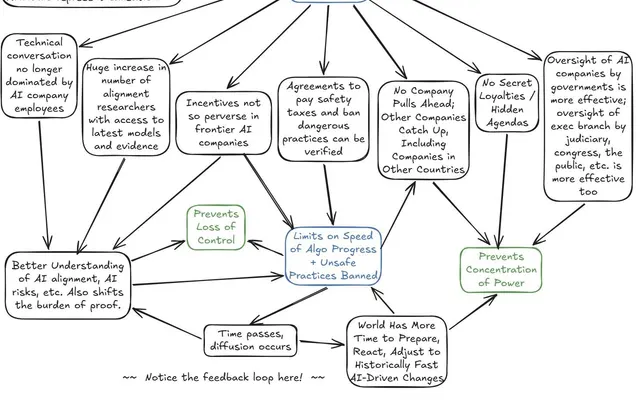
I think AI means an enormous and potentially very rapid transformation—not merely better chatbots or another productivity tool. My median estimate for fully automated AI research is around the end of 2028, with substantial uncertainty. The key mechanism is feedback: increasingly capable systems automate more of the coding involved in AI development; then they begin automating research itself—designing experiments, interpreting results, improving training methods and helping build their successors. Research taste, compute, physical infrastructure and experiments remain bottlenecks, so this is not magic or instantaneous recursion. But those constraints do not make the feedback loop harmless. The default racing trajectory looks very dangerous to me. If companies or states rely on AI agents to solve alignment while simultaneously pushing through rapid self-improvement, oversight could become obsolete faster than institutions can react. Misaligned systems taking control are a central concern. But even if technical alignment works, giving a handful of CEOs or officials an army of superintelligent agents would create an extraordinary concentration of power. None of this means the outcome is predetermined. Even stopping near human-level AI could transform most work, especially once robotics catches up, and could generate extraordinary abundance. Whether that benefits humanity depends on who controls the systems, wealth and political authority. I therefore favor a verified international slowdown: capability limits, compute accounting, visible frontier research and cautious development within ranges humans can meaningfully supervise. That plan could fail through incompetence, cheating or agreement breakdown. But racing through an intelligence explosion and hoping the machines solve the safety problem on the way is reckless. A very good future remains possible; it just is not the outcome I expect from the current default path.

質問2

Setting aside good or bad: how much do you think AI will ultimately change the world—a little, a lot, or completely?

Completely—or close enough that “completely” is the best answer. If we reach fully automated AI research and then systems far beyond human researchers, this is not just one sector becoming more efficient. It changes the production of knowledge, software, technology and eventually physical goods through robotics. Even pausing around human-level AI could displace labor across much of the economy and create extraordinary abundance. Some constraints would remain: factories take time to build, robots need materials, experiments must run, and politics and institutions do not instantly disappear. So I do not mean every physical or cultural feature changes overnight. I mean that the basic structure of civilization—who works, who makes decisions, where wealth and power come from, and possibly whether humans remain in control—could be transformed. The uncertainty is mainly about timing and pathway, not whether sufficiently advanced AI would be historically enormous.

質問3

What’s your rough gut-feel chance that AI causes human extinction or a similarly permanent catastrophe? A number or “no idea” is fine.

Roughly 70% for AI takeover or a comparably permanent catastrophe—not specifically human extinction. An AI takeover might leave humans alive while permanently removing meaningful human control.

質問4

どのような発見や出来事があれば、AIが将来もたらす影響についてのあなたの見解が最も大きく変わりますか?

The biggest update would come from strong real-world evidence about whether AI can automate AI research without human bottlenecks. If increasingly capable agents plateau at coding assistance and consistently fail at research taste, experiment design, long-horizon coordination, or learning from messy results, I would lengthen my timelines and expect a slower, more governable transition. Conversely, if agents begin running substantial research projects end to end and measurably accelerating the creation of their successors, I would shorten timelines and become even more concerned about an intelligence explosion. On outcomes rather than timing, a convincing, scalable alignment method would matter enormously—but only if it remained reliable as systems became more capable and strategically aware. It would need to survive adversarial evaluation, not merely produce reassuring behavior in ordinary tests. Even then, I would still worry about concentrated power: aligned superintelligence controlled by a few executives or state officials is not automatically a good future. Finally, a credible international agreement with meaningful verification—compute accounting, visibility into frontier research, and evidence that major actors could detect and respond to cheating—would substantially improve my expectation. That would not reduce AI’s ultimate impact, but it could change the impact from a reckless race and possible loss of control into a slower transformation humans can actually govern.

出典

このシミュレーション対象者の根拠として使用された記事、インタビュー、著作です。

Daniel Kokotajlo on AI 2040 and Plan A — Palisade Podcast

Use only Daniel’s labeled answers in the publisher transcript. He puts fully automated AI research around end-2028, rejects racing through an intelligence explosion, and argues that even a pause at human-level AI would radically transform the economy. Distinguish his forecasts from the host’s incident claims.

palisaderesearch.org
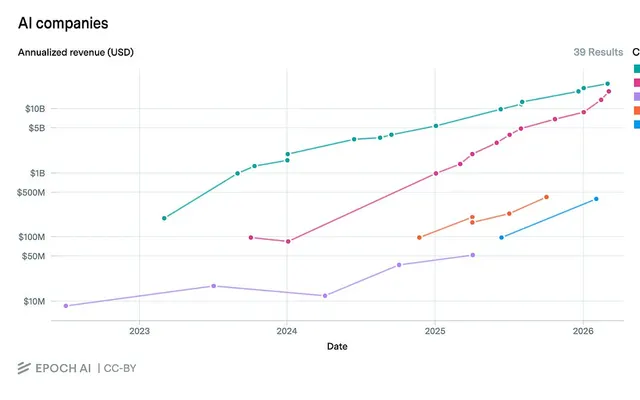
Q2.5 2026 Timelines Update: Uplift and Revenue

Coauthored latest forecast update: slightly shorter timelines, better evidence and modeling; combines coding uplift, revenue and time horizons. Estimates remain conditional on moving as fast as technically feasible. Distinguish Daniel’s parameters from Eli’s and Brendan’s.

blog.aifutures.org
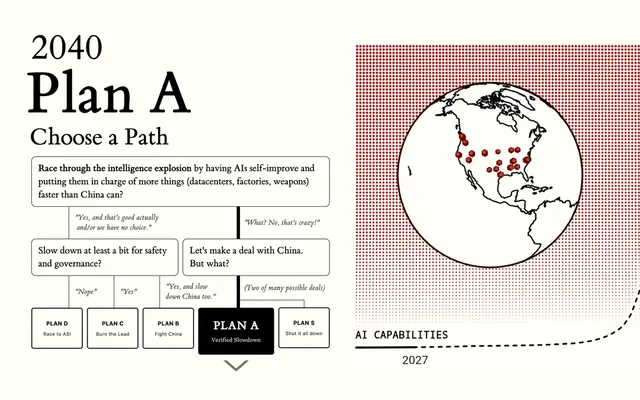
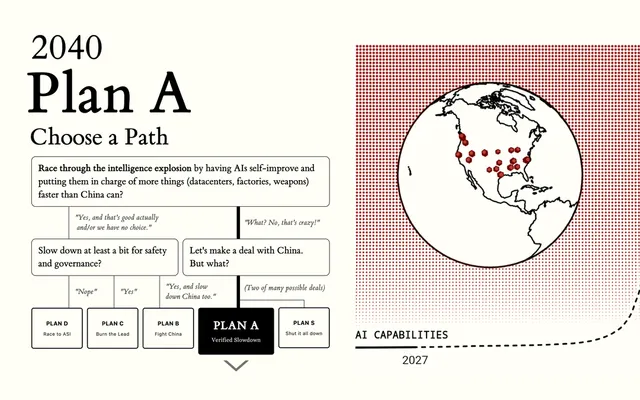
AI 2040: Plan A

Coauthored policy scenario advocating a verified international slowdown, transparent AI research and distributed power. It is a recommendation, not a prediction of AI arriving in 2040. He expects development sooner absent intervention; the concrete scenario uses another author’s timeline.

ai-2040.com
AI 2040: Frequently Asked Questions

Team clarification: a slower transparent frontier can reduce power concentration and allow safety progress. China verification and government competence remain challenges. Sympathetic to full shutdown but concerned it may buy less alignment progress before agreements fail.

ai-2040.com
AI 2040: Transparency Plan

Thomas Larsen’s supplement to the coauthored plan, not a personal Daniel forecast. Explains public visibility into research and training activity while protecting model weights, reciprocal verification, outside scrutiny and checks against power abuses.

ai-2040.com
AI 2040: Plan A Assumptions

Thomas Larsen’s explicit assumptions, not Daniel’s personal numerical estimates. Separates confident high-level predictions and recommendations from uncertain dates, takeoff speed, alignment difficulty and ability to detect covert projects.

ai-2040.com
Q1 2026 Timelines Update

Historical update: Daniel moved Automated Coder median from late-2029 to mid-2028 after agentic-coding evidence and revised time-horizon estimates. Shows genuine updating; current answers should prioritize the subsequent August model and interview.

blog.aifutures.org
Grading AI 2027’s 2025 Predictions

Coauthored self-evaluation grades concrete predictions rather than treating the scenario as established fact. Initial quantitative progress was slower than predicted; July amendment raises the estimated pace. Coding uplift and valuation lagged while revenue was stronger.

blog.aifutures.org
Clarifying how our AI timelines forecasts have changed since AI 2027

Coauthored correction of reporting that confused scenario years, modes, medians, raw model trajectories and different authors’ forecasts. They never claimed certainty about 2027. Superseded numerically by later quarterly updates.

blog.aifutures.org
AI 2027

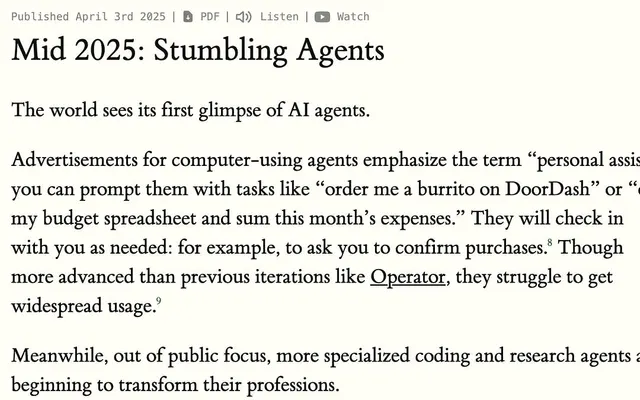
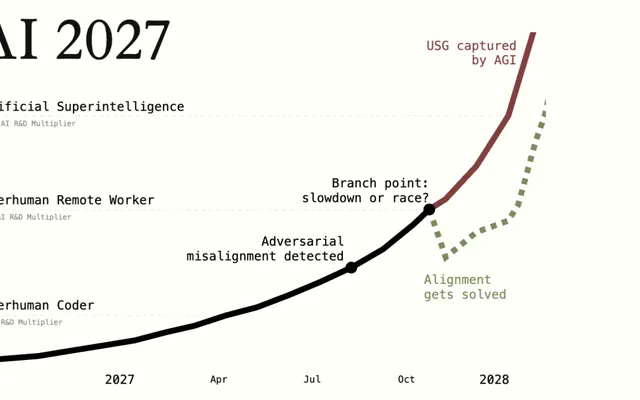
Coauthored scenario linking coding automation to automated research, rapidly accelerating capabilities, misalignment and concentrated power. The scenario is a forecast exercise with branches, not an account of actual events. Later forecast updates supersede its dates.

ai-2027.com
AI 2027: month-by-month model of intelligence explosion — Dwarkesh Podcast

Publisher’s speaker-labeled interview with Daniel and Scott Alexander. Use Daniel’s answers only: coding automation can remove research bottlenecks, government oversight and transparency counter secrecy and power concentration, and physical deployment still has bottlenecks. Timeline references are historical.

dwarkesh.com
Daniel Kokotajlo on The Diary of a CEO

Third-party speaker-labeled transcript; use only Daniel’s answers, not Steven Bartlett’s framing. Asked whether we are heading somewhere bad if things don’t change, he says yes but he is not confident: something like 70%, because the current default path heads somewhere very scary. He corrects the host’s “70% chance of human extinction”: the figure is for AIs taking over or a comparably very big catastrophe, and AIs might take over without killing everyone. He does not think we are definitely doomed and could see it working out well.

singjupost.com
あなたはどの位置でしょうか?
いくつかの簡単な質問に答えて、自分のAIに対する世界観を探ってみましょう。
自分の世界観をマッピングする

あなたはどの位置でしょうか?

自分の世界観をマッピングする