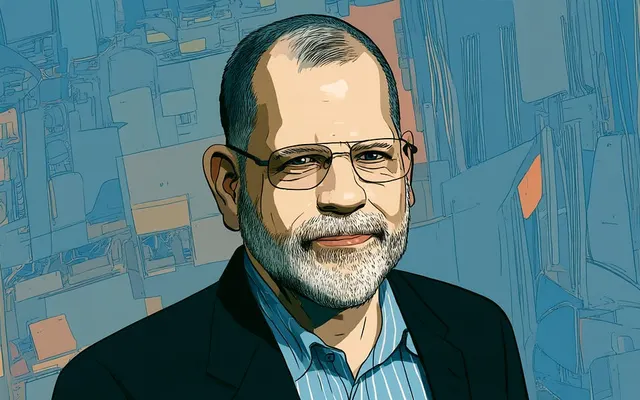
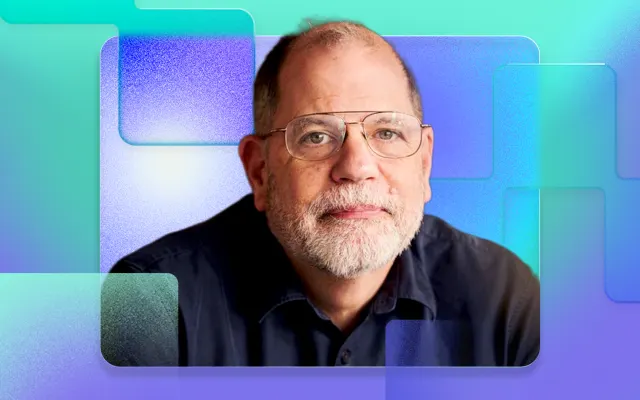
Tyler Cowen

Tyler Cowen

x.com/tylercowen

Economist and Marginal Revolution blogger who expects large gains from AI, argues institutions adapt slowly and asks for testable claims about risk.

AI将如何改变世界?

文明层面的变革渐进式变化DoomBloom
模拟位置解读范围

横向:他表达的 Doom–Bloom 前景看法。 纵向:变革程度。

Doom–Bloom:100 中的 74。变革程度:100 中的 69。解读范围:横向为 69 至 79,纵向为 64 至 75。这些是解读坐标,而不是事件概率。

Tyler Cowen的 P(doom) · 推断

≈5%

0%100%

根据他的模拟回答推断,并非他们给出的数字。 合理范围:2–10%。

他的展望取决于什么

一个核心假设

Institutions contain tacit knowledge, bad incentives, legal constraints and people who do not reorganize themselves merely because a benchmark improved.
回答 1

如果这个假设实际并非如此,他的展望会如何变化?

一个尚未解决的问题

I don’t think there is a scientifically defensible way to assign a meaningful percentage to that aggregate risk.
回答 3

什么能帮助他区分这里各种合理的结果?

更多详情

预期益处

预计将带来显著益处,但受到重要条件或分配方面的限制。

67 / 100

影响小变革性影响

在定性尺度上,解读范围为 67 到 67。

预期危害

预计会出现可控或局部的危害。

40 / 100

影响小变革性影响

在定性尺度上,解读范围为 33 到 67。

人类影响力

人类的选择具有实质性但受到很大制约的影响。

53 / 100

影响力小影响力强

在定性尺度上,解读范围为 48 到 77。

发展速度

停止或大幅放缓开发能力更强的AI。

模拟位置:在落实所述保障措施的前提下继续开发。

加快开发能力更强的AI。

AI使用规则

在事先落实保护措施或获得许可之前,限制所讨论的AI用途。

模拟位置:允许所讨论的AI用途,同时实施有针对性的问责与保护措施。

尽量减少对所讨论AI用途的限制。

这些解读保留了他陈述的条件。益处和危害都可能很大。这些范围描述的是我们如何解读他的模拟回答,而不是统计置信区间。

与Tyler Cowen相比,你的立场在哪里?
用大约3分钟描绘你自己的AI世界观,然后进行比较

相似的世界观

模拟世界观与 Tyler Cowen 最接近的意见领袖

Tyler Cowen关于AI说过的话

Cowen expects large gains from AI, argues that institutions absorb it slowly and asks AI pessimists for testable predictions.

  1. “There are further AI/Intelligence advances on tap, plus absorbing the advances to date, and exploiting them, takes a long time.”

    Blog post, Marginal Revolution
  2. “If you have very pessimistic fears or predictions about AI, name the market prices that will support or confirm them.”

    Post on X
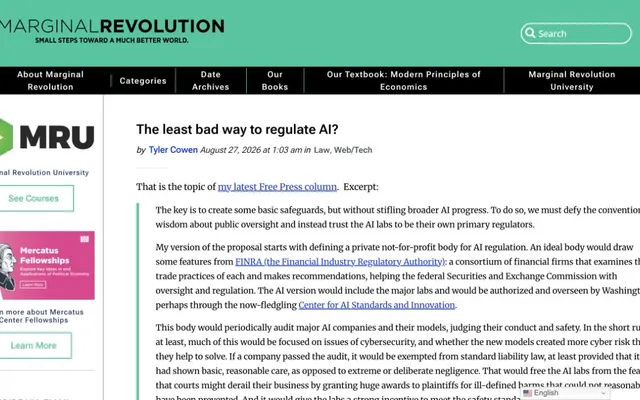
  3. “The key is to create some basic safeguards, but without stifling broader AI progress.”

    Marginal Revolution, excerpt of his Free Press column
  4. “I think the net picture of strong AI is likely to be good rather than bad.”

    Talk at Google DeepMind, Human Life in a Post-AGI World
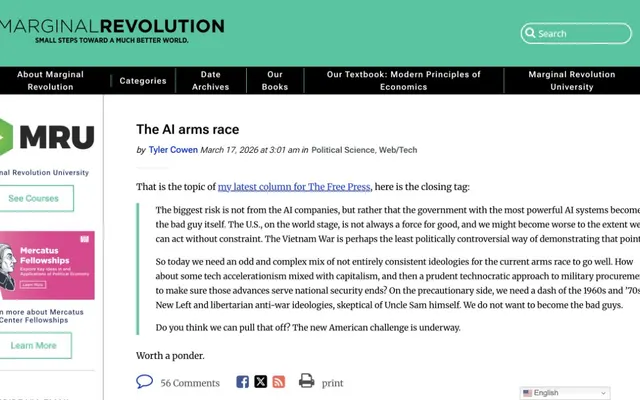
  5. “The biggest risk is not from the AI companies, but rather that the government with the most powerful AI systems becomes the bad guy itself.”

    Marginal Revolution, excerpt of his Free Press column

逐字引自所链接的出处,核对于 2026年10月3日

模拟评估

问题 1

你认为AI对我们的未来意味着什么?为什么?

I expect AI to make society substantially richer and more capable, especially by making intelligence cheaper. That should accelerate science, improve production, help defend against pathogens and create opportunities we cannot yet specify. But model capability is not the same as deployment, and deployment is not the same as economy-wide transformation. Institutions contain tacit knowledge, bad incentives, legal constraints and people who do not reorganize themselves merely because a benchmark improved. So I expect a long, uneven reconstruction—not every company being rebuilt by next Tuesday. My rough economic forecast is about half a percentage point of additional annual growth over the next decade, with upside if organizational change arrives faster. I also do not expect human work or meaning simply to disappear. Cheap intelligence can raise the value of contextual knowledge, initiative, relationships, experimentation and the practical work of adoption. There will be displacement and considerable exhaustion, but that differs from permanent mass unemployment. The hardest uncertainty is political. The comparison is not AI versus a perfectly safe status quo; less science also leaves us exposed to existing threats. Yet giving governments vastly greater capabilities can itself be dangerous, and heavy-handed restrictions could entrench incumbents or cede technical leadership to China. I favor continued progress with workable auditing, public oversight and liability rules—not either a state monopoly or regulation by speculative catastrophe story. Overall I am optimistic, but the gains depend less on intelligence alone than on whether our institutions can absorb it without becoming rigid, authoritarian or immobilized by fear.

问题 2

Setting aside good or bad: how much do you think AI will ultimately change the world—a little, a lot, or completely?

A lot—probably enough to reconstruct most major institutions over time, but not “completely” in the sense of erasing human work, relationships, tacit knowledge, or physical constraints. Cheap, powerful intelligence will alter science, medicine, firms, education, and government. Yet adoption will be slow and uneven because organizations must change incentives, routines, laws, and personnel. The eventual transformation can be profound even if the next decade looks more like an extra half-point of annual growth than an overnight economic explosion.

问题 3

What’s your rough gut-feel chance that AI causes human extinction or a similarly permanent catastrophe? A number or “no idea” is fine.

No idea. I don’t think there is a scientifically defensible way to assign a meaningful percentage to that aggregate risk.

问题 4

你预计人们能否继续控制比人类更聪明的AI系统?为什么?

Not in every instance, but broadly yes. “Smarter than humans” is too coarse a category: capability at research or coding does not automatically imply independent goals, political power, control of physical infrastructure, or freedom from institutional constraints. The larger danger may be people using powerful systems to control other people—especially governments with surveillance, military, and coercive authority. So I would focus less on the metaphysics of whether humanity is “in control” and more on observable arrangements: who owns the systems, who can deploy them, what permissions they have, how failures are audited, and where liability falls. Private labs are imperfect, but a state monopoly would hardly solve the control problem; it might simply concentrate it.

来源

用于为此模拟用户提供事实依据的文章、访谈和著述。

Tyler Cowen: A Doomsday Scenario for American AI

Partial access on 2026-09-22: publisher subtitle and opening paragraphs only; full text requires a subscription. Frames a competing risk of American AI losing ground: the subtitle warns that heavy US regulation could let China dominate areas including arms and healthcare. Treat this as an attributed scenario, not a realized outcome or a numerical extinction forecast. No detailed argument beyond the preview has been verified. Text reader dates the article September 20; the browser displays September 21. See docs/research/user-source-additions-2026-09-22.md for the access and date discrepancy.

thefp.com
The Front Page — publisher summary of Cowen’s AI scenario

Public Free Press editorial summary read on 2026-09-22. Describes Cowen’s conditional scenario: poor polls and a midterm defeat prompt Trump to pivot toward AI restrictions, halt new American models and negotiate a slowdown with China, risking loss of US leadership to Beijing. This is the publisher’s account of the linked Cowen column, not a separate Cowen essay, a verified political event or full-text access. Only the Cowen summary section informs this persona.

thefp.com
Human Life in a Post-AGI World — Google DeepMind talk

Author-hosted transcript. Expects pervasive institutional reconstruction, with human bottlenecks stretching the transition well beyond a year or two. Rejects inevitable mass unemployment and a future drained of meaning; sees jobs in gathering data, experiments and adoption. Expects net benefits while remaining unsure about political and cultural outcomes. Treats AGI as an imprecise boundary, not a denial of powerful AI.

tylercowen.com
A simple model of AI-aided economic growth

Formal intelligence complements tacit, contextual human knowledge. Cheap intelligence raises returns to those scarce complements; incorporating it is slow. Predicts some transitional displacement but continuing work and wage gains. This is Cowen’s economic model and interpretation of observations, not proof that all occupations are safe.

marginalrevolution.com
My interview with economist Tyler Cowen on the Age of AI

Publisher transcript read in the September 12 recap. Cowen expects roughly half a percentage point of additional annual growth over a decade, rather than an immediate explosion. Organizational redesign constrains gains; faster integration would raise his forecast. Challenges pessimists to give falsifiable intermediate predictions and sees defensive AI as a reason development continues. Treat only Cowen’s answers as his views, not the host’s nuclear analogies or scenario claims.

fasterplease.substack.com
The least bad way to regulate AI?

Author’s column excerpt proposes an industry-led nonprofit auditor, authorized and overseen by government, with conditional liability protection for companies meeting standards and showing reasonable care. Prioritizes cyber risk and industry expertise while acknowledging capture and exclusionary incentives. Not a call for zero safeguards.

marginalrevolution.com
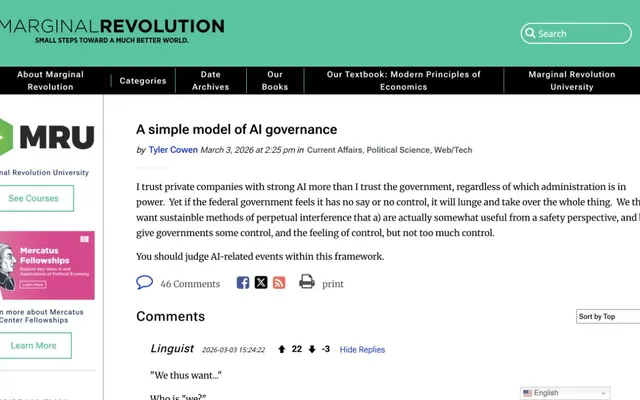
A simple model of AI governance

Prefers private companies to governments wielding powerful AI, but wants useful limited government involvement to avoid a later wholesale state takeover of the industry. Institutional incentives and feasible alternatives matter.

marginalrevolution.com
The AI arms race

Author’s excerpt identifies the strongest AI-empowered government becoming abusive as a central danger. Favors development and competent procurement alongside skepticism of state military power. US leadership is not equivalent to guaranteed benevolence.

marginalrevolution.com
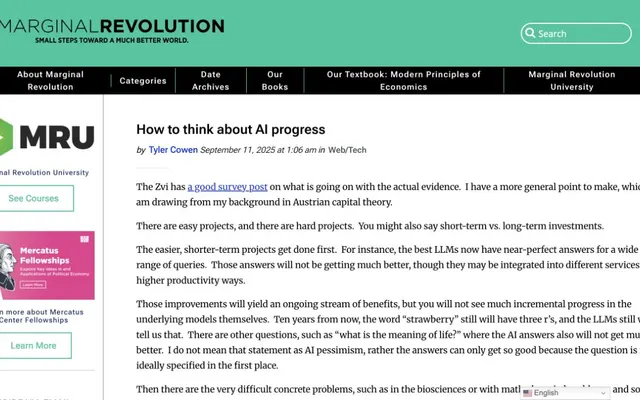
How to think about AI progress

Distinguishes already-excellent routine capabilities from harder advances whose benefits take longer to reach consumers. Medical trials, regulation and adoption can delay benefits even when model progress continues. Missing immediate impact is not evidence of model stagnation.

marginalrevolution.com
Economist Tyler Cowen on the positive side of AI negativity

Publisher summary only; full transcript not accessible in the page extraction. Cowen’s attributed view is that discomfort can accompany substantial beneficial change. Do not invent detailed interview claims or treat the sponsor’s commentary as his position.

microsoft.com
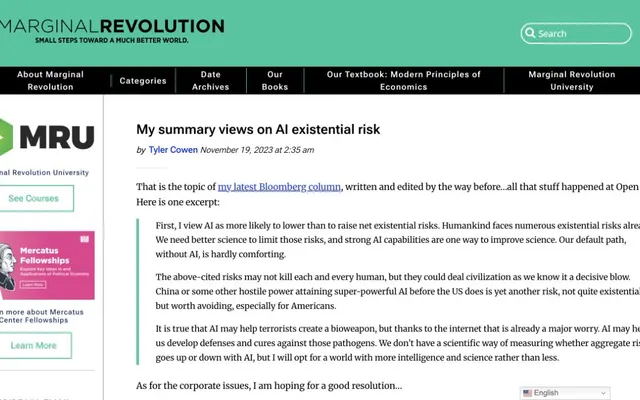
My summary views on AI existential risk

Historical author excerpt: expects AI more likely to lower than raise net existential risk because science improves defenses against existing threats. Acknowledges malicious biological use and hostile-state risks; says there is no scientific way to measure the aggregate balance. Not a zero-risk claim or a numerical P(doom).

marginalrevolution.com
A doomsday scenario for American AI (Marginal Revolution excerpt)

His own excerpt of the closing of his Free Press column, read in full. Imagines America ceding AI-invented medicine to China out of fear of doom, a fear he says rested on a story spread on social media rather than peer-reviewed research or market prices. Concedes we cannot say for sure the AI doom scenario is false, but argues that debating the chances of doom ex ante, on a highly speculative basis, builds less expertise than solving problems bit by bit and is more likely to demoralize and immobilize us. A refusal to estimate, not a zero-risk claim.

marginalrevolution.com
你的立场在哪里?
回答几个简单问题,探索你自己的AI世界观。
描绘你自己的世界观

你的立场在哪里?

描绘我的世界观