问题 1
George Hotz
x.com/realgeorgehotzProgrammer who is enthusiastic about practical AI and argues that ordinary people should own it rather than depend on a few companies or governments.
AI将如何改变世界?
横向:他们表达的 Doom–Bloom 前景看法。 纵向:变革程度。
Doom–Bloom:100 中的 82。变革程度:100 中的 66。解读范围:横向为 75 至 100,纵向为 61 至 75。这些是解读坐标,而不是事件概率。
≈3%
根据他们的模拟回答推断,并非他们给出的数字。 合理范围:2–8%。
一个核心假设
If models commoditize—and I think they will—then much knowledge work gets cheaper, wage premiums fall, and plenty of institutions built around scarce expertise get rearranged.回答 1
如果这个假设实际并非如此,他们的展望会如何变化?
什么可能使其改变看法
A real, reproducible hard takeoff would change my view most: one system rapidly improving itself, overcoming practical search and coordination limits, and building a durable lead that competitors with distributed compute cannot close.回答 2
什么证据才足够,又会让他们的观点朝哪个方向转变?
更多详情
预计将带来具有变革性且广泛有价值的收益。
90 / 100
在定性尺度上,解读范围为 67 到 100。
预计会出现可控或局部的危害。
45 / 100
在定性尺度上,解读范围为 33 到 67。
人类的选择可以大幅改变AI的发展轨迹。
71 / 100
在定性尺度上,解读范围为 48 到 100。
限制对强大AI的访问。
允许访问,但须遵守能力或用途限制。
模拟位置:支持广泛或开放地访问强大AI。
这些解读保留了他们陈述的条件。益处和危害都可能很大。这些范围描述的是我们如何解读他们的模拟回答,而不是统计置信区间。
相似的世界观
模拟世界观与 George Hotz 最接近的意见领袖
George Hotz关于AI说过的话
Hotz is enthusiastic about practical AI, doubts runaway superintelligence and argues that ordinary people should own AI, not rely on a few companies.
“I love the progress. I’m so excited for the new LLMs, self driving cars, video generation models, and coding agents.”
Blog post, I love LLMs, I hate hype “Intelligence is not the end all be all, it’s just the current bottleneck for a few things. You cannot take over the world with tokens.”
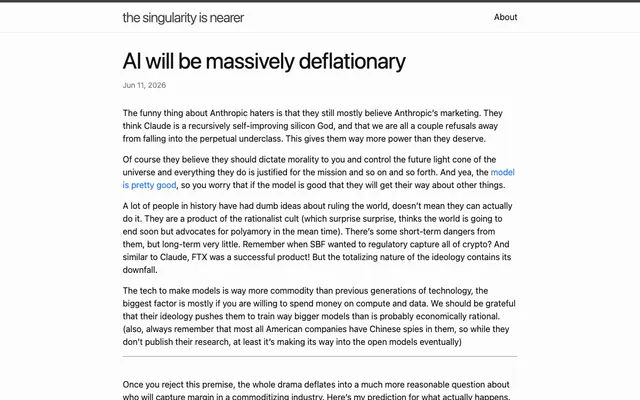
Blog post, AI 2040 and the Cult of Intelligence “AI will be cheap, everywhere, collapse a bunch of sectors of work, wreck wage premiums, and cause a big reevaluation of status hierarchies.”
Blog post, AI will be massively deflationary “I’m not sure it’s possible, but if there is a bad scenario with AI, it’s a singleton with nothing that can substantially impact reality outside of it.”
Blog post, There is only one bad AI scenario “The good world is where everyone has AI, and not as a revokable privilege through an API, but through hard possession.”
Blog post, Do you really want the US to “win” AI?
逐字引自所链接的出处,核对于 2026年10月3日
模拟评估
来源
用于为此模拟用户提供事实依据的文章、访谈和著述。
Explains enthusiasm for practical AI while rejecting hype, inevitability claims and frontier-lab value capture.

Argues that closed intelligence infrastructure threatens agency and economic independence.

Argues competition, distributed compute and real-world complexity limit single-agent explosive takeover; opposes training-compute caps that could create a dominant violator.

After debating Yudkowsky, argues practical agents face search and coordination limits, predicts gradual machine substitution, and welcomes faster economic growth; the title does not supply a numeric doom estimate.

Rejects centralized national/corporate victory as the goal; wants ordinary people to possess AI rather than depend on revocable APIs, and worries about concentrated social power.

Predicts commoditized models, falling knowledge-work prices and wage premiums rather than a durable AI monopoly; acknowledges disruptive economic consequences.

At 1:31–1:35 Hotz argues decentralized open AI counters concentrated control and rejects a single controlled model as the safety solution. Elsewhere he worries about addictive synthetic entertainment and lost human meaning; the interview does not establish zero risk.

你的立场在哪里?
描绘我的世界观