问题 1
Andrej Karpathy
x.com/karpathyAnthropic researcher and educator who builds with AI agents and writes about their rapid, uneven progress and the gap between demos and reliable work.
AI将如何改变世界?
横向:他表达的 Doom–Bloom 前景看法。 纵向:变革程度。
Doom–Bloom:100 中的 75。变革程度:100 中的 66。解读范围:横向为 70 至 80,纵向为 50 至 75。这些是解读坐标,而不是事件概率。
≈6%
根据他的模拟回答推断,并非他们给出的数字。 合理范围:3–13%。
一个核心假设
The world changes only when the whole surrounding system—tests, tools, memory, interfaces, monitoring, and human understanding—makes that capability dependable.回答 2
如果这个假设实际并非如此,他的展望会如何变化?
什么可能使其改变看法
If an agent could enter an unfamiliar codebase or research program, clarify ambiguous goals, remember what it learned, recover from mistakes, choose productive next steps, and deliver trustworthy results over weeks with little supervision, that would substantially accelerate my expectations.回答 5
什么证据才足够,又会让他的观点朝哪个方向转变?
更多详情
预计将带来显著益处,但受到重要条件或分配方面的限制。
75 / 100
在定性尺度上,解读范围为 67 到 100。
预计会出现可控或局部的危害。
32 / 100
在定性尺度上,解读范围为 0 到 33。
人类的选择具有实质性但受到很大制约的影响。
55 / 100
在定性尺度上,解读范围为 48 到 77。
停止或大幅放缓开发能力更强的AI。
模拟位置:在落实所述保障措施的前提下继续开发。
加快开发能力更强的AI。
在事先落实保护措施或获得许可之前,限制所讨论的AI用途。
模拟位置:允许所讨论的AI用途,同时实施有针对性的问责与保护措施。
尽量减少对所讨论AI用途的限制。
这些解读保留了他陈述的条件。益处和危害都可能很大。这些范围描述的是我们如何解读他的模拟回答,而不是统计置信区间。
相似的世界观
模拟世界观与 Andrej Karpathy 最接近的意见领袖
Andrej Karpathy关于AI说过的话
Karpathy builds with AI agents and writes about their rapid but uneven progress and the gap between impressive demos and reliable work.
“When you hand a computer terminal to one of these models, you can now watch them melt programming problems that you’d normally expect to take days/weeks of work.”
Post on X “I’ve never felt this much behind as a programmer. The profession is being dramatically refactored as the bits contributed by the programmer are increasingly sparse and between.”
Post on X “LLMs are emerging as a new kind of intelligence, simultaneously a lot smarter than I expected and a lot dumber than I expected.”
Essay, 2025 LLM Year in Review “My personal big fear is that a lot of this stuff happens on the side of humanity, and that humanity gets disempowered by it.”
Dwarkesh Podcast “In my mind, this is more accurately described as the decade of agents.”
Dwarkesh Podcast
逐字引自所链接的出处,核对于 2026年10月3日
模拟评估
来源
用于为此模拟用户提供事实依据的文章、访谈和著述。
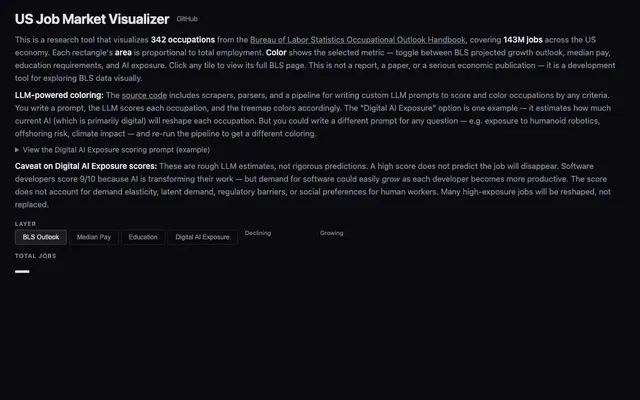
Interactive exploration of 342 BLS occupations covering 143 million US jobs, with layers for employment outlook, pay, education and digital AI exposure. Its customizable LLM scoring pipeline illustrates uneven exposure across digital and physical work. Exposure scores are rough estimates of occupational change, not predictions of job disappearance; they omit demand responses, regulatory barriers and preferences for human workers. The project explicitly describes itself as a development tool rather than a rigorous economic publication.

Author-posted, AI-cleaned summary and transcript, which Karpathy says he read. Describes a late-2025 jump in coding-agent usefulness, professional orchestration and evaluation, and verifiability as an explanation for uneven progress. Current enthusiasm updates the older decade-of-agents interview; the edited text is not an exact quotation transcript.

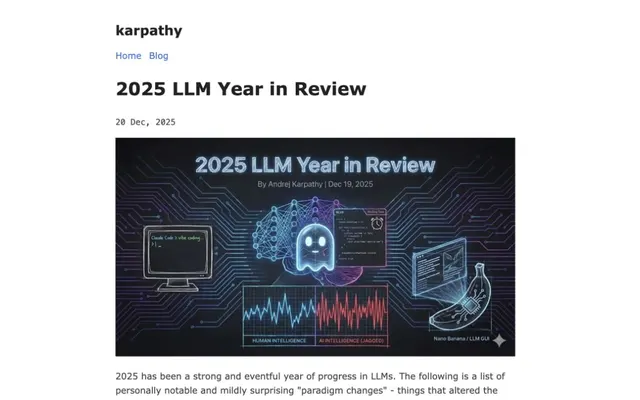
His review connects verifiable rewards to reasoning gains, criticizes benchmark overfitting, describes jagged intelligence and the growing application layer around models. Provides concrete mechanisms and builder vocabulary rather than a universal intelligence forecast.

Karpathy’s primary interview frames agents as a decade of engineering work. Discusses cognitive deficits, continual learning, the gap between self-driving demos and deployment, and education. The forecast is dated and intuitive, not a calibrated deadline.

His README demonstrates agents editing a training file, running five-minute experiments and retaining improvements against a fixed validation metric. The introduction’s future agent civilization is playful fiction, not a report of current events. Human-authored instructions and a bounded setup remain essential.

你的立场在哪里?
描绘我的世界观