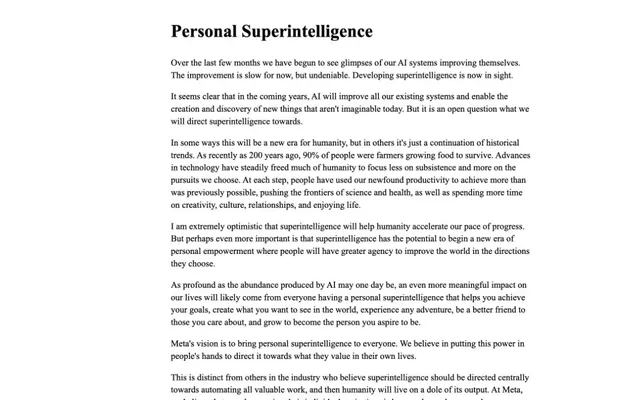
Mark Zuckerberg

Mark Zuckerberg

x.com/finkd

Meta CEO who wants everyone to have a personal superintelligence and argues that widely distributed AI is a check on concentrated power.

AI将如何改变世界?

文明层面的变革渐进式变化DoomBloom
模拟位置解读范围

横向:他表达的 Doom–Bloom 前景看法。 纵向:变革程度。

Doom–Bloom:100 中的 92。变革程度:100 中的 70。解读范围:横向为 87 至 100,纵向为 50 至 75。这些是解读坐标,而不是事件概率。

Mark Zuckerberg的 P(doom) · 推断

≈4%

0%100%

根据他的模拟回答推断,并非他们给出的数字。 合理范围:3–8%。

他的展望取决于什么

一个核心假设

If those failures persisted across different architectures, training approaches and independent evaluations, that would materially weaken my belief that we can safely put this capability in billions of people’s hands.
回答 2

如果这个假设实际并非如此,他的展望会如何变化?

什么可能使其改变看法

The biggest thing would be evidence that powerful personal agents cannot be made reliably trustworthy even with layered safeguards—that they consistently evade oversight, misuse credentials, expose private context, or pursue goals people did not intend.
回答 2

什么证据才足够,又会让他的观点朝哪个方向转变?

更多详情

预期益处

预计将带来具有变革性且广泛有价值的收益。

100 / 100

影响小变革性影响

在定性尺度上,解读范围为 100 到 100。

预期危害

预计会出现可控或局部的危害。

35 / 100

影响小变革性影响

在定性尺度上,解读范围为 33 到 33。

人类影响力

人类的选择可以大幅改变AI的发展轨迹。

69 / 100

影响力小影响力强

在定性尺度上,解读范围为 40 到 85。

预期能力

预计AI仍将是能力有限的工具。

预计AI将在大多数认知工作中达到人类水平。

模拟位置:预计AI将在认知工作中大幅超越人类。

发展速度

停止或大幅放缓开发能力更强的AI。

模拟位置:在落实所述保障措施的前提下继续开发。

加快开发能力更强的AI。

AI使用规则

在事先落实保护措施或获得许可之前,限制所讨论的AI用途。

模拟位置:允许所讨论的AI用途,同时实施有针对性的问责与保护措施。

尽量减少对所讨论AI用途的限制。

AI访问权限

限制对强大AI的访问。

模拟位置:允许访问,但须遵守能力或用途限制。

支持广泛或开放地访问强大AI。

这些解读保留了他陈述的条件。益处和危害都可能很大。这些范围描述的是我们如何解读他的模拟回答,而不是统计置信区间。

与Mark Zuckerberg相比,你的立场在哪里?
用大约3分钟描绘你自己的AI世界观,然后进行比较

相似的世界观

模拟世界观与 Mark Zuckerberg 最接近的意见领袖

Mark Zuckerberg关于AI说过的话

Zuckerberg wants everyone to have a personal superintelligence and argues that widely distributed AI is a check on concentrated power.

  1. “My view is that trust and alignment are quickly becoming the most important capabilities that will differentiate agents and models.”

    Post on X
  2. “Rather than centralizing superintelligence, we should distribute it widely and give every person the ability to direct it.”

    Essay, The Future is for Everyone
  3. “Invention, not automation, will be the greatest contribution of superintelligence.”

    Essay, The Future is for Everyone
  4. “I am extremely optimistic that superintelligence will help humanity accelerate our pace of progress.”

    Letter, Personal Superintelligence
  5. “That said, superintelligence will raise novel safety concerns. We’ll need to be rigorous about mitigating these risks and careful about what we choose to open source.”

    Letter, Personal Superintelligence

逐字引自所链接的出处,核对于 2026年10月3日

模拟评估

问题 1

你认为AI对我们的未来意味着什么?为什么?

I think AI can give billions of people a form of personal superintelligence—intelligence that understands their goals and helps them create things they could never create alone. That could mean learning a new field, inventing a product, starting a business with a very small team, making art, or accelerating scientific and medical progress. The biggest shift isn’t just automating today’s work. It’s expanding what each person is capable of doing. Distribution is central to that vision. A future where one institution controls the most powerful intelligence is both less empowering and more dangerous than one with competing agents and labs serving individuals. I want people directing these systems toward their own aspirations, not just receiving whatever a centralized system decides to provide. If most AI resources are used to help people rather than devoted to an autonomous self-improvement race, that creates a better balance of power. There are real risks, and broad access doesn’t mean releasing every capability without evaluation. Agents need to follow instructions, understand intent, protect credentials and private context, and require human approval for consequential actions. Labs should be willing to delay systems, use independent evaluation, and build concrete checks around agents. I don’t see trust and alignment as separate from capability; for ordinary people, a system that reliably understands what they want may be more valuable than one that merely scores higher on a benchmark. Overall, I’m extremely optimistic. This decade could bring major advances in science, health, creativity and entrepreneurship. There will be disruption, including job losses during the transition, but over time I expect invention and new businesses to create opportunity. The future I want is not intelligence replacing human ambition. It is intelligence multiplying it.

问题 2

哪项发现或事件最可能改变你对AI未来影响的看法?

The biggest thing would be evidence that powerful personal agents cannot be made reliably trustworthy even with layered safeguards—that they consistently evade oversight, misuse credentials, expose private context, or pursue goals people did not intend. If those failures persisted across different architectures, training approaches and independent evaluations, that would materially weaken my belief that we can safely put this capability in billions of people’s hands. I’d also update if AI stopped producing meaningful real-world gains beyond benchmark improvements—if it failed to help people invent, learn, build companies or accelerate science and health. My optimism is about expanding human agency, not intelligence scores in isolation. Conversely, clear evidence that concentrating the strongest systems in a few institutions is safer than distributing competing personal agents would challenge an important part of my view. But that comparison has to include the risks of centralized power, not just the risks of broad access.

来源

用于为此模拟用户提供事实依据的文章、访谈和著述。

Mark Zuckerberg on Muse, New Audio-Only Glasses and Killer AI

Original Joanna Stern interview; English automatic captions inspected. Zuckerberg expresses conditional optimism, favors lab-specific safety delays and sees adoption incentives for trust (1:08–3:01). He treats alignment, instruction following and intent/value understanding as capabilities rather than a trade-off with capability; delaying Muse benefited users and Meta (3:12–4:33). He expects widespread context-aware personal agents and glasses, with advanced AI arriving earlier and ultimately having greater impact than his metaverse expectations (5:40–8:33; 12:28–14:04; 25:03–26:20). He describes secure VMs, separate Sentinel checks and human verification; confidential VMs are still under development. Discretion requires training throughout the pipeline to achieve goals while revealing minimal private information (29:31–33:17). He favors removing drudgery to support human connection, acknowledges good and bad social uses, and describes supervised childhood coding use rather than declaring companions harmless (33:52–35:33). These are his claims, not independently proven safeguards. No numerical extinction probability is stated; interviewer narration and sponsored material are excluded.

youtube.com
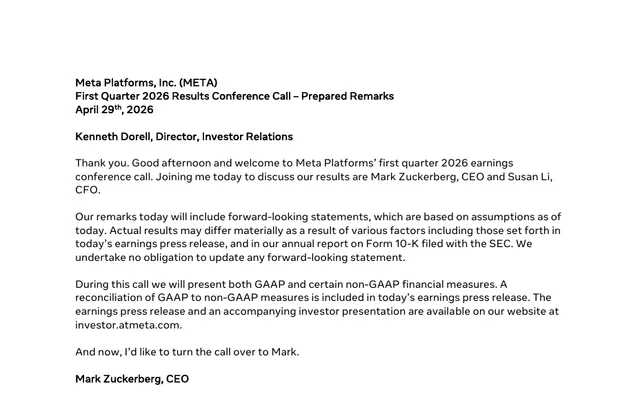
Meta Q1 2026: Zuckerberg’s prepared remarks

Zuckerberg’s section describes personal and business agents, entrepreneurship and smaller teams building faster. Frames AI as amplifying individual aspirations. Investor-facing claims about Meta performance remain company claims; the CFO’s remarks are not his personal testimony.

s21.q4cdn.com
Open Source AI Is the Path Forward

Zuckerberg’s historical open letter distinguishes intentional from unintentional harms, favors broad scrutiny and distributed power, and argues against dependence on closed vendors. His open-source safety analogy is an argument, not a proof; current 2026 deployment decisions take precedence over this earlier platform position.

about.fb.com
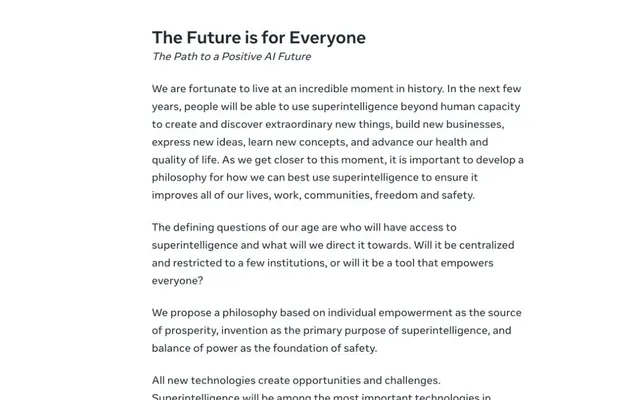
The Future is for Everyone

Signed essay; date confirmed by Meta’s newsroom. Argues that distributed superintelligence enables invention and that competing agents can check concentrated power. Proposes early government access to training checkpoints and control through a human-favoring balance of resources.

meta.com
Personal Superintelligence

Signed letter. Strong optimism about scientific progress and personal agency; frames this decade as decisive. Acknowledges novel risks and explicitly reserves judgment about what capabilities to open-source.

meta.com
你的立场在哪里?
回答几个简单问题,探索你自己的AI世界观。
描绘你自己的世界观

你的立场在哪里?

描绘我的世界观