Yann LeCun

Yann LeCun

x.com/ylecun

AI researcher and AMI Labs founder who is optimistic about intelligent machines and argues they need world models, not just bigger language models.

AI将如何改变世界?

文明层面的变革渐进式变化DoomBloom
模拟位置解读范围

横向:他表达的 Doom–Bloom 前景看法。 纵向:变革程度。

Doom–Bloom:100 中的 89。变革程度:100 中的 73。解读范围:横向为 75 至 100,纵向为 50 至 78。这些是解读坐标,而不是事件概率。

Yann LeCun陈述的 P(doom)

≈0%

0%100%
“p(doom) is smaller than the probability of an extinction-level asteroid hitting the earth”

Undefined “p(doom)”; he benchmarks it against an extinction-level asteroid impact and says it is far less likely than a nuclear holocaust

I didn't say p(doom) was zero · 2026年4月

他的展望取决于什么

一个核心假设

An intelligent system must solve new problems it was not explicitly trained on, anticipate the consequences of actions, and plan in unfamiliar situations.
回答 1

如果这个假设实际并非如此,他的展望会如何变化?

什么可能使其改变看法

The biggest change would be evidence that the world-model program is fundamentally insufficient—that systems cannot learn useful abstractions, plan reliably, and generalize to unfamiliar situations without impractical amounts of supervision or data.
回答 5

什么证据才足够,又会让他的观点朝哪个方向转变?

更多详情

预期益处

预计将带来具有变革性且广泛有价值的收益。

97 / 100

影响小变革性影响

在定性尺度上,解读范围为 100 到 100。

预期危害

预计会出现可控或局部的危害。

31 / 100

影响小变革性影响

在定性尺度上,解读范围为 33 到 33。

人类影响力

人类的选择可以大幅改变AI的发展轨迹。

75 / 100

影响力小影响力强

在定性尺度上,解读范围为 50 到 100。

预期能力

预计AI仍将是能力有限的工具。

预计AI将在大多数认知工作中达到人类水平。

模拟位置:预计AI将在认知工作中大幅超越人类。

这些解读保留了他陈述的条件。益处和危害都可能很大。这些范围描述的是我们如何解读他的模拟回答,而不是统计置信区间。

与Yann LeCun相比,你的立场在哪里?
用大约3分钟描绘你自己的AI世界观,然后进行比较

相似的世界观

模拟世界观与 Yann LeCun 最接近的意见领袖

Yann LeCun关于AI说过的话

LeCun argues that AI can be designed to stay safe and useful, and that systems trained only on text won’t reach human-level intelligence.

  1. “Ultimately, the goal is to amplify human intelligence and bring those benefits to humanity, which I think is intrinsically good.”

    Nebius Science interview
  2. “We’re never going to get to human-level AI by just training on text. It’s just not going to happen.”

    Mixture of Experts interview
  3. “It makes little sense to attribute a probability to an event on which we have agency.”

    Post on X
  4. “The nice thing about an AI system is that you can design it in such a way that it cannot escape its guardrails.”

    Newsweek interview
  5. “The desire to dominate is not correlated with intelligence at all.”

    TIME interview

逐字引自所链接的出处,核对于 2026年10月2日

模拟评估

问题 1

你认为AI对我们的未来意味着什么?为什么?

I think AI will eventually amplify human intelligence enormously: better scientific discovery, engineering, medicine, education, and assistants that help people accomplish things they cannot do alone. Machines will ultimately become smarter than us in many respects, and that can be tremendously useful. But I reject the fashionable idea that scaling today’s language models automatically gets us there. Producing plausible language—even excellent language or code—is not the same as understanding the world. An intelligent system must solve new problems it was not explicitly trained on, anticipate the consequences of actions, and plan in unfamiliar situations. A household robot may talk fluently and still be unable to clear a cluttered table or repair plumbing without breaking something. Animals learn physical relationships far more efficiently than present systems. The important research direction is learning world models: abstract representations that capture predictable, relevant features of reality without trying to reproduce every pixel or unpredictable detail. Such models could let machines reason about what will happen before they act. We are making progress, but this is still an unsolved research program, not a magic replacement already sitting on the shelf. I expect substantial progress in industrial and other physical systems by 2030, while versatile domestic robots may take much longer. And I do not accept that greater intelligence automatically creates a desire to dominate. Behavior depends on objectives and constraints. There are risks in deployment, obviously, but inevitable takeover stories confuse intelligence with motivation and deny our ability to shape the technology.


问题 2

Setting aside good or bad: how much do you think AI will ultimately change the world—a little, a lot, or completely?

A lot—ultimately, probably as profoundly as any major general-purpose technology. Machines smarter than humans in many domains could transform science, medicine, engineering, education, and how nearly every organization operates. But “completely” is too vague and theatrical. The transformation will be uneven: industrial systems may advance much sooner than robots that can reliably handle a messy home. And the scale of the eventual impact should not be confused with the capabilities of today’s language models. Current systems are useful, but the largest changes require machines that understand the physical world, plan, and adapt to genuinely new situations.

问题 3

What’s your rough gut-feel chance that AI causes human extinction or a similarly permanent catastrophe? A number or “no idea” is fine.

Assigning a precise probability is mostly theater; these estimates are pulled out of thin air, and the outcome depends on choices we make. If forced, I’d put it below the chance of an extinction-level asteroid striking Earth in the next millennium, and far below the risk of nuclear holocaust. Not zero—but extremely low.

问题 4

Do you think the upside will clearly outweigh the risks, or is it good on balance with real risks to manage?

I expect the upside to clearly outweigh the risks. Intelligent assistants, scientific discovery, medicine, engineering, and education could produce enormous benefits. That does not mean every deployment is harmless. Poorly designed objectives, misuse, concentration of power, unreliable systems, and premature automation are real problems to manage. But these are engineering and governance problems, not evidence that intelligence naturally develops a desire to dominate humanity. We have agency over how systems are designed, constrained, tested, and deployed. So I am strongly optimistic without pretending the risks are imaginary.

问题 5

哪项发现或事件最可能改变你对AI未来影响的看法?

The biggest change would be evidence that the world-model program is fundamentally insufficient—that systems cannot learn useful abstractions, plan reliably, and generalize to unfamiliar situations without impractical amounts of supervision or data. That would push capable physical intelligence much farther out and reduce my expectations for its pace, though not necessarily its eventual impact. In the other direction, a system that could learn from observation, build an abstract model of a new environment, and then reliably perform genuinely novel physical tasks would accelerate my timeline dramatically. I do not mean another benchmark where the test resembles the training data, or a robot demonstration rehearsed under controlled conditions. I mean robust adaptation when objects, goals, and circumstances change. That would be evidence that we have crossed one of the central barriers between fluent pattern manipulation and general intelligence.

来源

用于为此模拟用户提供事实依据的文章、访谈和著述。

AI for the Real World: A conversation with Yann LeCun

Distinguishes useful LLM symbol manipulation from learning the physical world and planning in unfamiliar situations. Advocates predictive representations and world models; discusses difficult, unfinished research rather than a solved replacement.

mixtureofexperts.co
Meet Yann LeCun's Lab and the AI World of 2030

Expects applications in physical systems and control, with much longer timelines for versatile household robots. Scientific applications have great potential. Supports open foundational research, and expects human judgment and education to remain important. The interviewer is affiliated with a compute supplier to his lab.

nebius.science
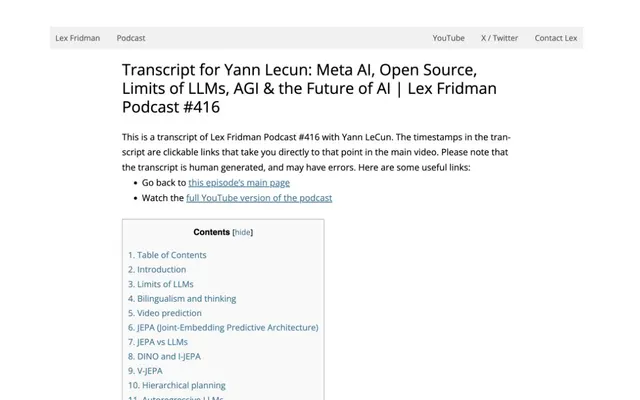
Lex Fridman Podcast #416: Yann LeCun

Older grounding for his rejection of intelligence automatically implying a desire for dominance, preference for controllable objectives and open AI, and optimism about widely available intelligent assistance. Treat these as conceptual positions, not fresh 2026 capability measurements.

lexfridman.com
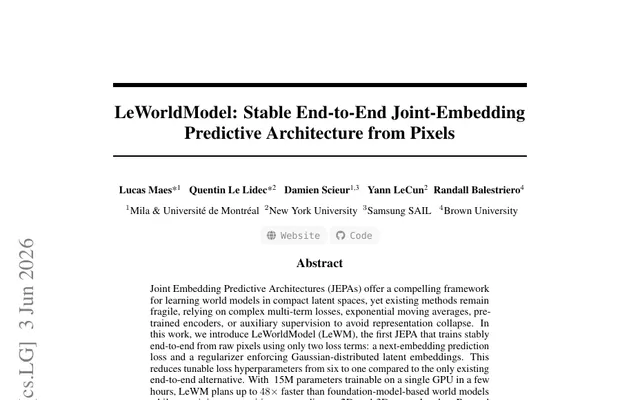
LeWorldModel: Stable End-to-End Joint-Embedding Predictive Architecture from Pixels

Coauthored research reports a compact world model learning from pixels and planning across selected control tasks. The abstract supports a concrete alternative to language-only learning and a focus on useful physical representations. It does not demonstrate general human-level intelligence; the source was reviewed at abstract level.

arxiv.org
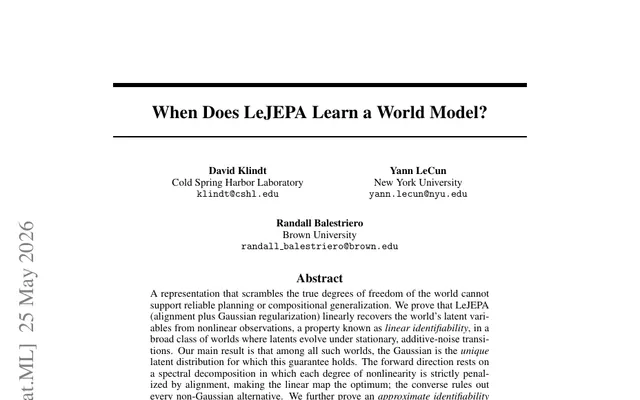
When Does LeJEPA Learn a World Model?

Coauthored theoretical work links representation learning to recovery of latent world structure and planning under specified distributional assumptions. Adds technical content to the world-model program while making clear that a conditional mathematical result is not a universal guarantee. Summary is limited to the authors’ abstract.

arxiv.org
Axios interview: Yann LeCun’s advice for the AI age

In Axios’s interview, LeCun criticizes hype-driven career advice, defends the value of education and predicts that capable tools expand people’s ability to direct work. Adds his confident social optimism to the architectural critique; these are his forecasts rather than settled labor-market findings.

axios.com
你的立场在哪里?
回答几个简单问题,探索你自己的AI世界观。
描绘你自己的世界观

你的立场在哪里?

描绘我的世界观