Question 1
Jon Stewart
The Daily ShowComedian and interviewer who questions AI’s effects on work and power while exploring its useful applications.
How will AI change the world?
Across: his expressed Doom–Bloom outlook. Up: scale of transformation.
Doom–Bloom: 20 out of 100. Scale of transformation: 73 out of 100. Interpretation ranges: 15 to 25 horizontally, 68 to 79 vertically. These are interpretation coordinates, not event probabilities.
≈16%
Inferred from his simulated answers, not a number they gave. Plausible range: 10–24%.
Work & institutions
But the transition could be compressed enough to overwhelm our already mediocre ability to protect workers.
Answer 2
Grouped by milestone, not spaced or ordered by inferred dates. AGI and superhuman AI retain his definitions.
A central assumption
They require ordinary human greed, weak oversight, and very powerful tools.Answer 3
If this assumption turned out differently, how would his outlook change?
An unresolved question
I don’t know whether AI ultimately transforms every occupation or hits meaningful limits.Answer 2
What would help him distinguish the plausible outcomes here?
What could change their mind
Technically, I’d also pay attention to repeated, real-world evidence that these systems have durable limits: not one chatbot losing a knife fight with a drive-through order, but clear limits across medicine, education, persuasion, and military decision-making.Answer 5
What evidence would be enough, and in which direction would it move his view?
More details
Several readings remain plausible: Substantial benefits are expected, with important conditions or distribution limits. / Limited or narrowly distributed gains are expected.
52 / 100
Interpretation range 33 to 67 on the qualitative scale.
Severe or widespread harm is a material expected part of the future.
67 / 100
Interpretation range 67 to 67 on the qualitative scale.
Human choices can substantially redirect the AI trajectory.
67 / 100
Interpretation range 50 to 100 on the qualitative scale.
Restrict the AI uses discussed until prior protections or permission are in place.
Simulated position: Allow the AI uses discussed with targeted accountability and protections.
Minimize restrictions on the AI uses discussed.
These interpretations keep his stated conditions. Benefits and harms can both be substantial. The ranges describe how we read his simulated answers, not statistical confidence intervals.
Similar worldviews
Thought leaders whose simulated worldviews are closest to Jon Stewart’s
What Jon Stewart has said about AI
Stewart questions AI’s effects on work and power, explores useful applications, and described a slight shift toward optimism in July 2026.
“And I recently read a book that changed my perspective slightly.”
The Weekly Show, Cory Doctorow interview “But it's hard to imagine it will remain our assistant.”
The Daily Show, Josh Tyrangiel interview “AI is a human expertise laundering machine.”
The Weekly Show, David Autor and Daron Acemoglu interview “my guess is, like any technology, there's going to be some incredible positives.”
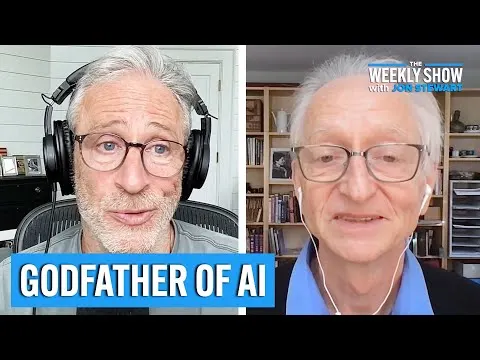
The Weekly Show, Geoffrey Hinton interview
Word for word from the linked sources, checked Oct 3, 2026
Simulated Assessment
Sources
Articles, interviews, and writings used to ground this simulated user.
Publisher English captions inspected. His introduction describes a slight shift after an AI doomer spiral. Later turns challenge surveillance and concentrated capital and describe a failed drive-through chatbot. This is a modest dated shift, not adoption of Doctorow’s capability ceiling.

Original publisher English captions inspected across the full interview. Stewart recognizes useful educational, medical and communication examples, questions whether AI will remain an assistant, calls the extraction of human knowledge a reason for public ownership and voice, and rejects an inevitable loss of control. He distrusts corrupt regulation and calls for trusted adjudication.

Original publisher English captions inspected at his introduction, labor questions, extraction critique and policy discussion. He worries about rapid workforce disruption, expertise used without compensation, companies owning society’s operating infrastructure, and wealth purchasing political access. Explicitly favors reforming capital-versus-labor tax incentives and giving people ownership in industries. The guests’ timelines and AGI limits are excluded.

Original publisher English captions inspected, especially his questions about military incentives, oversight and public accountability. Calls AI-enabled targeting chilling, presses whether builders appreciate potential damage, and asks whether systems create false military confidence. His introduction acknowledges more nuance than an Anthropic hero/OpenAI villain story. Experts’ proposed hardware controls are not his policy.

Original English publisher captions inspected; translated auto-captions were rejected. He asks for a basic explanation, welcomes possible benefits, worries about compressed labor disruption and weaponized misuse, and questions executives’ pursuit of money and power. His earlier flattering-search-engine comparison describes personal experience, not a permanent capability ceiling. Hinton’s takeover probability and timelines are not Stewart’s.

Where do you land?
Map my worldview