Pergunta 1
Holly Elmore
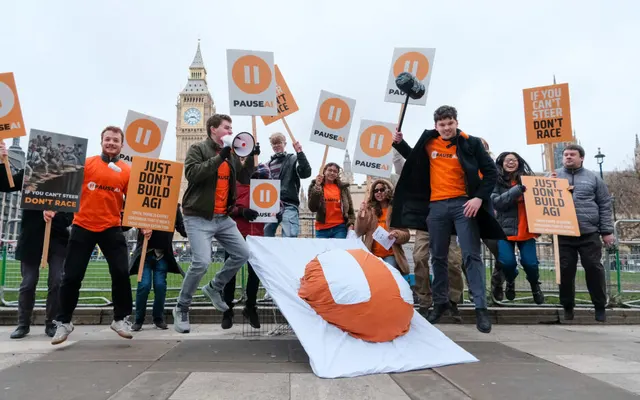
x.com/ilex_ulmusExecutive director of PauseAI US and evolutionary biologist who calls for an enforced international pause on frontier AI under democratic oversight.
Como a IA mudará o mundo?
Na horizontal: a perspectiva Doom–Bloom expressa por ela. Para cima: escala da transformação.
Doom–Bloom: 5 de 100. Escala da transformação: 94 de 100. Intervalos de interpretação: 0 a 25 na horizontal, 89 a 100 na vertical. Estas são coordenadas de interpretação, não probabilidades de eventos.
50–60%
“It’s probably 50 to 60% now. I used to be lower.”
AI disaster (“doom”) as asked on Doom Debates; she does not define the endpoint, and it is not an extinction-only figure
Let’s CALL OUT the AI Doom “Enablers” Joining OpenAI & Anthropic — Dr. Holly Elmore, PauseAI US · jun. de 2026
Uma premissa central
Engineers do not fully understand what capabilities or drives they have produced.Resposta 1
Se essa premissa se revelasse diferente, como a perspectiva dela mudaria?
Uma questão não resolvida
Personally, I suspect alignment across a vast capability gap may be impossible, though I have not proven that.Resposta 4
O que ajudaria essa pessoa a distinguir os resultados plausíveis aqui?
O que poderia mudar essa opinião
The biggest thing would be credible, publicly verifiable evidence that frontier systems can remain under human control as capabilities scale—not company assurances or another benchmark, but proof strong enough to justify exposing everyone to the risk.Resposta 4
Que evidência seria suficiente e em que direção ela mudaria a visão dela?
Mais detalhes
Esperam-se ganhos limitados ou distribuídos de forma restrita.
28 / 100
Intervalo de interpretação de 0 a 33 na escala qualitativa.
Uma perda catastrófica ou irreversível ocupa um lugar central no futuro esperado.
100 / 100
Intervalo de interpretação de 100 a 100 na escala qualitativa.
As escolhas humanas têm uma influência significativa, mas substancialmente limitada.
57 / 100
Intervalo de interpretação de 41 a 84 na escala qualitativa.
Espera-se que a IA continue sendo um conjunto de ferramentas limitadas.
Espera-se que a IA se equipare às pessoas na maior parte do trabalho cognitivo.
Posição simulada: Espera-se que a IA supere substancialmente as pessoas no trabalho cognitivo.
Posição simulada: Interromper ou desacelerar substancialmente o desenvolvimento de uma IA mais capaz.
Continuar o desenvolvimento sob as salvaguardas declaradas.
Acelerar o desenvolvimento de uma IA mais capaz.
Estas interpretações mantêm as condições que ela declarou. Tanto os benefícios quanto os danos podem ser substanciais. Os intervalos descrevem como interpretamos as respostas simuladas dela, não intervalos de confiança estatística.
Visões de mundo semelhantes
Líderes de opinião cujas visões de mundo simuladas são mais próximas da visão de Holly Elmore
Avaliação simulada
Fontes
Artigos, entrevistas e textos usados para fundamentar este usuário simulado.
Asked for her P(doom), she says she does not truly think in numbers, that any current risk is intolerable, that it is probably 50 to 60% and higher than before, while still leaving 15–20% for “getting lucky”; outcome and horizon are not defined. She explains moving PauseAI US to Washington to focus on constituents and elected officials, says no technical alignment solution works without governance, supports government action that reins in AI companies even when imperfect, and argues proliferation of current models is already a real problem. On accountability she rejects vigilante justice, favors international process, and says what is just and what is strategic may differ. Holly’s turns in the publisher transcript inspected; her characterizations of incidents and named people are not verified facts.

Talk delivered Dec. 9 per the publisher (year not stated on the page), published as a podcast with transcript. Separates PauseAI’s three membership stipulations (catastrophic danger and public consent, pause as default with the possibility of never unpausing, feasibility via international agreement) and its official agnosticism about alignment from her personal view that alignment is philosophically confused and may be impossible across vastly different capabilities, a view she says she has not rigorously proven. Argues from extinction biology, fragile equilibria and costly experiments that even modest extinction risk is intolerable and that the burden of proof belongs on developers. Calls technical research dual use and says useful AI is possible only under proper governance. Full transcript inspected.

Argues the frontier race is not mainly commercial: its architects seek recursive self-improvement and decisive, singleton-like power. She says she does not believe AI will actually do all that and that much of the vision is impossible, but holds that the goal itself is antisocial and the attempt could be massively destructive. Useful tools like translation or medical imaging do not require it. Full essay inspected; her account of others’ motives is her interpretation.

Argues that even a survivable Singularity would not abolish scarcity or conflict between people, and that solipsistic simulated abundance would be a dystopia. Handing governance to a recursively self-improving AI would lock in its values; humans must work out these questions themselves. She says we are nowhere near a Singularity that would not immediately kill us and that the urgent task is regulating frontier development now. Full essay inspected; the anecdote about an unnamed researcher is her account.

States PauseAI’s ask: an international treaty pausing frontier AI development, which could be implemented in many ways. Imagines democratic oversight, enforcement and nonproliferation, independent science free of industry control, and enjoying narrow-AI benefits such as properly tested medical advances. Lists open questions she does not resolve: whether alignment is possible or a permanent capability line is needed, post-labor economics, inequality and power concentration, psychological effects, and digital sentience. A vision and question list, not a treaty draft. Full essay inspected.

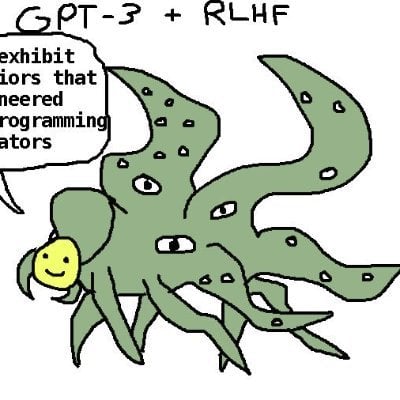
Explains that engineers do not program AI minds but search parameter space with gradient descent, which she compares to natural selection as hill-climbing. Danger therefore does not require anyone to design malice; developers do not know what capabilities the minds they find possess. An explanatory argument about uncertainty, not a claim that every current model is hostile. Full essay inspected.

Rejects the idea that race dynamics make AI company leaders interchangeable and blameless. Criticizes the argument that a lab is justified because it is better than an imagined counterfactual, and argues a lab should stop advancing the frontier even if dropping out alone would not solve the whole problem. Moral argument about responsibility; claims about specific companies are her interpretation. Full essay inspected.

Argues AI companies are using people’s data, work, subscriptions and compliance while building systems that will not need them; if models can do every job, companies will not need human customers or workers. Cites startups and independent safety researchers being squeezed out. A warning about displacement and dependence, not a numerical unemployment forecast or date. Full essay inspected; anecdotes and industry claims are hers and unverified.

Agrees the knowledge that machine learning scales cannot be undone, so dangerous AI must be suppressed indefinitely, as with nuclear proliferation. The choice is between a treaty-based pause with enforcement, an escalating fight against stronger uncontrolled AI, or subjugation or extinction. Says a serious pause would win. Advocacy framing, not a forecast that a treaty will pass. Full essay inspected.

Onde você se situa?
Mapear minha visão de mundo