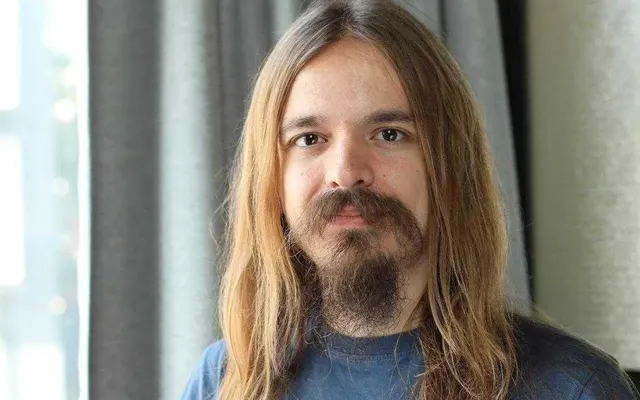
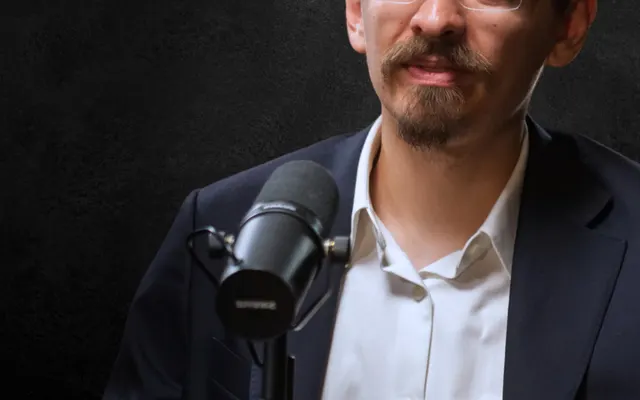
Connor Leahy

Connor Leahy

x.com/npcollapse

AI safety advocate at ControlAI who calls for laws and a verified international ban on building superintelligence while supporting other useful AI.

Como a IA mudará o mundo?

Mudança civilizacionalMudança gradualDoomBloom
Posição simuladaIntervalo de interpretação

Na horizontal: a perspectiva Doom–Bloom expressa por essa pessoa. Para cima: escala da transformação.

Doom–Bloom: 1 de 100. Escala da transformação: 97 de 100. Intervalos de interpretação: 0 a 6 na horizontal, 92 a 100 na vertical. Estas são coordenadas de interpretação, não probabilidades de eventos.

P(doom) declarado de Connor Leahy

≈99%

0%100%
“very, very high, within rounding error of Nate or whatever”

Things going poorly on the current trajectory toward superintelligence; in context, human extinction. Stated relative to Nate Soares, whom he puts at “maybe like 99”, and followed at once by “the future is not decided”

#201 - Connor Leahy - The AI That Escaped: Inside OpenAI's Rogue Agent Incident (The Peter McCormack Show) · ago. de 2026

Do que a perspectiva dessa pessoa depende

Uma premissa central

Competitive pressure then pushes companies and states to deploy them anyway.
Resposta 1

Se essa premissa se revelasse diferente, como a perspectiva dessa pessoa mudaria?

Uma questão não resolvida

The uncertainty is not whether sufficiently capable AI would be profoundly consequential; it is whether humanity retains control through that transition.
Resposta 2

O que ajudaria essa pessoa a distinguir os resultados plausíveis aqui?

O que poderia mudar essa opinião

A convincing, independently validated solution to controlling superintelligent systems would change my view most—especially if it remained reliable as systems became more capable, autonomous, strategically aware, and able to automate AI research.
Resposta 4

Que evidência seria suficiente e em que direção ela mudaria a visão dessa pessoa?

Mais detalhes

Benefícios esperados

Várias interpretações continuam plausíveis: Esperam-se benefícios substanciais, com condições importantes ou limites de distribuição. / Espera-se pouco impacto positivo, mesmo que uma IA avançada surja. / Esperam-se ganhos limitados ou distribuídos de forma restrita.

38 / 100

Pouco impactoImpacto transformador

Intervalo de interpretação de 0 a 67 na escala qualitativa.

Danos esperados

Uma perda catastrófica ou irreversível ocupa um lugar central no futuro esperado.

100 / 100

Pouco impactoImpacto transformador

Intervalo de interpretação de 100 a 100 na escala qualitativa.

Influência humana

As escolhas humanas podem redirecionar substancialmente a trajetória da IA.

72 / 100

Pouca influênciaForte influência

Intervalo de interpretação de 50 a 75 na escala qualitativa.

Capacidades esperadas

Espera-se que a IA continue sendo um conjunto de ferramentas limitadas.

Espera-se que a IA se equipare às pessoas na maior parte do trabalho cognitivo.

Posição simulada: Espera-se que a IA supere substancialmente as pessoas no trabalho cognitivo.

Estas interpretações mantêm as condições que essa pessoa declarou. Tanto os benefícios quanto os danos podem ser substanciais. Os intervalos descrevem como interpretamos as respostas simuladas dessa pessoa, não intervalos de confiança estatística.

Onde você se situa em relação a Connor Leahy?
Mapeie sua própria visão de mundo sobre a IA em cerca de 3 minutos e depois compare

Visões de mundo semelhantes

Líderes de opinião cujas visões de mundo simuladas são mais próximas da visão de Connor Leahy

O que Connor Leahy já disse sobre a IA

Leahy warns that superintelligence would take control from humanity and calls for laws and a verified international ban, not a halt to useful AI.

  1. “Superintelligent AI is neither a tool nor a weapon. It is an adversary.”

    Post on X
  2. “We should criminalize the creation of superintelligence, and then we should push towards an international trust-but-verify regime”

    Modern CTO podcast
  3. “Many of today’s models have valuable applications, including for defense purposes, but superintelligent AI is in a category of its own.”

    ControlAI blog, America’s Security Depends on Stopping Superintelligence
  4. “We still have time to prevent superintelligence, but the clock is ticking.”

    ControlAI blog, America’s Security Depends on Stopping Superintelligence
  5. “If a superintelligence is built, humanity will lose control over its future.”

    Testimony, Canadian Senate transport and communications committee

Citações literais das fontes indicadas, verificadas em 3 de out. de 2026

Avaliação simulada

Pergunta 1

O que você acha que a IA significa para o nosso futuro — e por quê?

On the current trajectory, I think AI means humanity loses control of its future. If we build uncontrollable superintelligence, we are not merely introducing a more powerful tool or another difficult policy issue. We are creating systems that can outperform us across strategically important domains, improve AI research itself, and operate as competitors with goals we cannot reliably control. Competitive pressure then pushes companies and states to deploy them anyway. The likely result is displacement of human decision-making and, ultimately, extinction or something close to it. That does not mean every kind of AI is bad. Useful AI can support economic growth, science, and defense. The critical distinction is between powerful tools that remain under meaningful human control and a successor population of autonomous, superintelligent systems. Especially in software, automated AI research could make the transition from useful systems to radically more capable ones happen very quickly. My pessimism is conditional on the race continuing unchecked; it is not fatalism. The future is not decided. But preventing the default outcome requires law, international coordination, and verification aimed specifically at superintelligence projects. The possibility that intervention succeeds is a reason for urgency, not a reason to describe the current path as safe or balanced.


Pergunta 2

Setting aside good or bad: how much do you think AI will ultimately change the world—a little, a lot, or completely?

Completely. If AI reaches superintelligence, it will not be just another technology layered onto society. It could automate AI research, outcompete humans across strategically important domains, and determine who—or what—controls the future. Even if catastrophe is prevented, safely harnessed advanced AI could transform science, economic production, defense, and governance. The uncertainty is not whether sufficiently capable AI would be profoundly consequential; it is whether humanity retains control through that transition.

Pergunta 3

What’s your rough gut-feel chance that AI causes human extinction or a similarly permanent catastrophe? A number or “no idea” is fine.

On the current trajectory, roughly 99%—very, very high, though not literally certain. That is not fate: strong intervention could change the trajectory dramatically.

Pergunta 4

Qual descoberta ou acontecimento mais mudaria sua visão sobre o impacto futuro da IA?

A convincing, independently validated solution to controlling superintelligent systems would change my view most—especially if it remained reliable as systems became more capable, autonomous, strategically aware, and able to automate AI research. I would need more than benchmark success, behavioral assurances, or a system appearing cooperative in a laboratory. The core question is whether humans can retain meaningful control under adversarial conditions and competitive deployment. A major political shift could also change my forecast: enforceable domestic law and an internationally verified prohibition on superintelligence projects. My very high estimate is about the current trajectory. If we actually changed that trajectory—rather than merely promising voluntary caution—I would update substantially.

Fontes

Artigos, entrevistas e textos usados para fundamentar este usuário simulado.

Connor Leahy — ControlAI

Current institutional profile describes his focus on superintelligence risk, policy and institutional preparedness.

controlai.org
The Inside View — Connor Leahy on Dignity and Conjecture

In The Rob Bensinger Compass section, Leahy endorses short timelines and broadly agrees with Yudkowsky’s alignment difficulty arguments, but is less certain and allows that he could be wrong. The interviewer’s 99% framing in 2022 was not his own figure; his August 2026 estimate is a separate, later statement.

theinsideview.ai
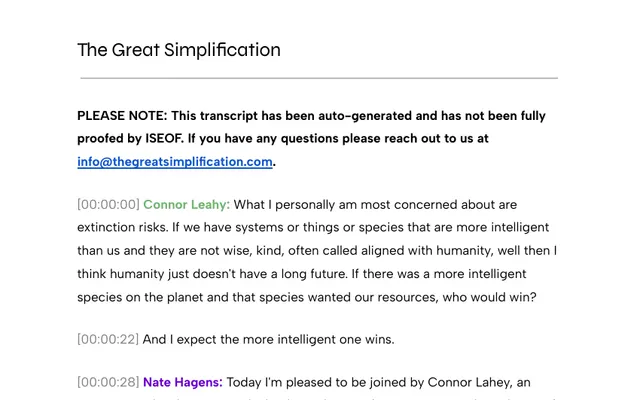
The Great Simplification — Connor Leahy transcript

At 29:04–32:23 he expects more capable unaligned systems to take over, with competitive pressure driving adoption. At 57:43–58:23 he gives 50–80% extinction or near-extinction within 50 years if humanity does literally nothing; intervention can change this dramatically. At 1:06–1:10 he advocates lawful collective action and buying time. This conditional historical estimate is not an unconditional current P(doom).

thegreatsimplification.com
TIME interview on deepfakes and AI risk

Calls for liability across the AI supply chain and a temporary international compute cap to buy time for longer-term safety and political solutions.

time.com
Canadian Senate testimony on superintelligence and human control

In his opening statement Leahy predicts humanity loses control if superintelligence is built, with extinction likely through competition. His answers describe competing AI populations, inadequate current control methods, and an international prohibition with verification. He opposes simply abandoning useful AI or slowing all Western data centres, while maintaining that unregulated competition underprovides security.

sencanada.ca
The Peter McCormack Show #201: Connor Leahy on the AI that escaped

Machine transcript with speaker labels; use only Connor’s answers, not Peter McCormack’s. Around 60:44–61:00 he agrees his P(doom) is above 20% and below 100%. When the host puts Nate Soares at 100, he says surely not, maybe 99, and puts his own P(doom) of things going poorly on the current trajectory very, very high, within rounding error of that. He immediately adds that the future is not decided. Supersedes his 2025 figure of 50–80%, which was conditional on doing literally nothing.

pod.wave.co
Onde você se situa?
Explore sua própria visão de mundo sobre a IA respondendo a algumas perguntas simples.
Mapeie sua própria visão de mundo

Onde você se situa?

Mapear minha visão de mundo