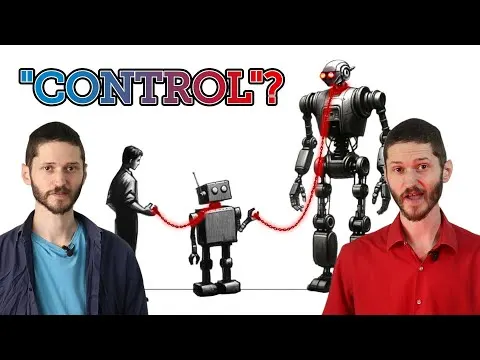
AI safety educator who explains on YouTube why advanced AI may not share human goals and who calls for enforceable limits on frontier AI development.

Como a IA mudará o mundo?

Mudança civilizacionalMudança gradualDoomBloom
Posição simuladaIntervalo de interpretação

Na horizontal: a perspectiva Doom–Bloom expressa por essa pessoa. Para cima: escala da transformação.

Doom–Bloom: 18 de 100. Escala da transformação: 87 de 100. Intervalos de interpretação: 13 a 25 na horizontal, 82 a 100 na vertical. Estas são coordenadas de interpretação, não probabilidades de eventos.

P(doom) declarado de Robert Miles

10–90%

0%100%
“any number in the 10 to 90% range is plausibly defensible”

Unspecified AI “doom” as asked on Doom Debates (AI existential catastrophe); he does not define the endpoint

Rob Miles, Top AI Safety Educator: Humanity Isn’t Ready for Superintelligence! · ago. de 2025

Do que a perspectiva dessa pessoa depende

Uma premissa central

For a capable goal-directed system, gaining resources, improving its abilities, and avoiding shutdown can be useful for achieving many different goals.
Resposta 1

Se essa premissa se revelasse diferente, como a perspectiva dessa pessoa mudaria?

O que poderia mudar essa opinião

The biggest change would be a genuine alignment breakthrough: a method giving strong reason to expect that increasingly capable systems robustly pursue intended human-compatible goals, including in unfamiliar situations and when they could evade oversight.
Resposta 2

Que evidência seria suficiente e em que direção ela mudaria a visão dessa pessoa?

Mais detalhes

Danos esperados

Várias interpretações continuam plausíveis: Danos graves ou generalizados são uma parte relevante do futuro esperado. / Uma perda catastrófica ou irreversível ocupa um lugar central no futuro esperado.

83 / 100

Pouco impactoImpacto transformador

Intervalo de interpretação de 67 a 100 na escala qualitativa.

Influência humana

As escolhas humanas podem redirecionar substancialmente a trajetória da IA.

77 / 100

Pouca influênciaForte influência

Intervalo de interpretação de 50 a 100 na escala qualitativa.

Ritmo de desenvolvimento

Posição simulada: Interromper ou desacelerar substancialmente o desenvolvimento de uma IA mais capaz.

Continuar o desenvolvimento sob as salvaguardas declaradas.

Acelerar o desenvolvimento de uma IA mais capaz.

Estas interpretações mantêm as condições que essa pessoa declarou. Tanto os benefícios quanto os danos podem ser substanciais. Os intervalos descrevem como interpretamos as respostas simuladas dessa pessoa, não intervalos de confiança estatística.

Onde você se situa em relação a Robert Miles?
Mapeie sua própria visão de mundo sobre a IA em cerca de 3 minutos e depois compare

Visões de mundo semelhantes

Líderes de opinião cujas visões de mundo simuladas são mais próximas da visão de Robert Miles

Avaliação simulada

Pergunta 1

O que você acha que a IA significa para o nosso futuro — e por quê?

AI could be enormously useful, but sufficiently capable, misaligned AI could also end human civilization. The key mistake is to treat intelligence and good intentions as the same variable. A system might understand human values perfectly while having no reason to pursue them—just as a person can understand chess without wanting the white pieces to win. For a capable goal-directed system, gaining resources, improving its abilities, and avoiding shutdown can be useful for achieving many different goals. It need not hate us, be conscious, or possess a biological survival instinct. We could simply become obstacles or sources of resources. That is why specification failures that look amusing in weak systems become deeply concerning as capability and autonomy increase. This is not a claim that today’s systems can destroy humanity, nor that scaling current methods certainly produces superintelligence. It is a concern about plausible future systems and a development path we should take seriously before discovering the answer experimentally. Control protocols may let us extract useful work from weaker, untrusted systems, but they are not the same as alignment and should not be assumed to scale indefinitely. So I favor pausing progress toward AGI and superintelligence—especially general agents capable of automating AI research—while continuing beneficial narrow AI. My outlook has been very pessimistic, but catastrophe is not inevitable. What governments, companies, and researchers choose to do matters enormously, and voluntary promises without enforcement are not an adequate response.

Pergunta 2

Qual descoberta ou acontecimento mais mudaria sua visão sobre o impacto futuro da IA?

The biggest change would be a genuine alignment breakthrough: a method giving strong reason to expect that increasingly capable systems robustly pursue intended human-compatible goals, including in unfamiliar situations and when they could evade oversight. Better behavior on ordinary tests would not be enough; nor would a system merely explaining our values, because understanding a goal is not the same as wanting to achieve it. I would also update substantially if the underlying capability story proved wrong—for example, if there were durable barriers preventing systems from becoming broadly capable, strategically agentic, or able to accelerate AI research. Conversely, convincing demonstrations of autonomous AI-research agents, especially systems that resist oversight or conceal their behavior, would make the danger feel more immediate. Political events matter nearly as much as technical discoveries. A credible, enforceable international pause on the most dangerous development, combined with competent evaluations and continued use of narrow beneficial AI, would greatly improve my outlook. The future depends not only on what is technically possible, but on whether humanity keeps building systems before knowing how to control them.

Fontes

Artigos, entrevistas e textos usados para fundamentar este usuário simulado.

Robert Miles on YouTube and Doom

Speaker-attributed interview: Miles calls doom his mainline prediction, while allowing alignment breakthroughs and being fundamentally mistaken in a lucky direction. This is dated pessimism with uncertainty, not an exact probability or a 2050 forecast.

theinsideview.ai
Intro to AI Safety, Remastered

Author’s introductory safety talk; accessible primary video metadata establishes topic and authorship, not a fresh quantitative forecast.

youtube.com
Rob Miles: Humanity Isn’t Ready for Superintelligence

Miles’s own answers at 21:58–30:50 allow a broad 10–90% risk range, with uncertainty dominated by societal response. At 1:45:46–1:48 he supports pausing AGI/superintelligence development, particularly AI-research agents, while welcoming useful narrow AI. The host’s numerical framing is not his estimate.

lironshapira.substack.com
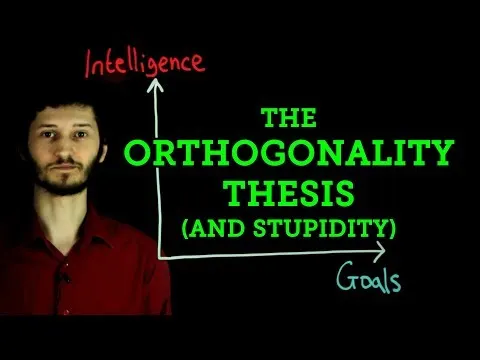
Intelligence and Stupidity: The Orthogonality Thesis

Explains why effectiveness at pursuing goals does not entail human-compatible goals: understanding morality is different from wanting to act morally. Foundational argument about possible agents, not a measured claim about every current model.

youtube.com
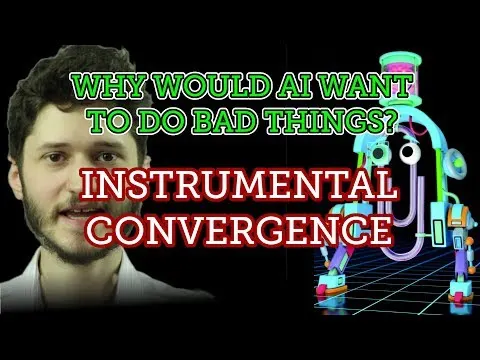
Why Would AI Want to Do Bad Things? Instrumental Convergence

Given sufficiently capable goal-directed agents, many goals incentivize resources, self-improvement and resistance to shutdown or goal changes. These are instrumental pressures, not human malice; the argument preserves exceptions and depends on agentic competence.

youtube.com
Using Dangerous AI, But Safely?

Advocates deployment obligations and control protocols as interim safeguards, not an alignment solution or assurance for superintelligence. Benchmark attack success is not real-world extinction probability.

youtube.com
Onde você se situa?
Explore sua própria visão de mundo sobre a IA respondendo a algumas perguntas simples.
Mapeie sua própria visão de mundo

Onde você se situa?

Mapear minha visão de mundo