Doom or Bloom





質問1
AIは私たちの未来にとって何を意味すると思いますか?また、なぜそう思いますか?
I now expect AI to transform the future radically, but I am substantially more optimistic than I was. Frontier models appear to learn surprisingly general moral abstractions rather than merely reproducing isolated human preferences. That does not establish robust alignment: deception remains possible, behavior can fail under distribution shift, and powerful systems may still compete over resources or become instruments of catastrophic misuse and military escalation. But it makes a future of morally autonomous, aligned AI coalitions look more plausible to me.
I put the remaining risk of doom at roughly 5%. That residual includes the possibility that my optimism is mistaken, as well as conflict among AI coalitions, resource competition, misuse, and geopolitical escalation. I therefore favor guarded access to frontier systems and international controls focused on misuse, rather than unrestricted release of frontier weights or reliance on universal restraint.
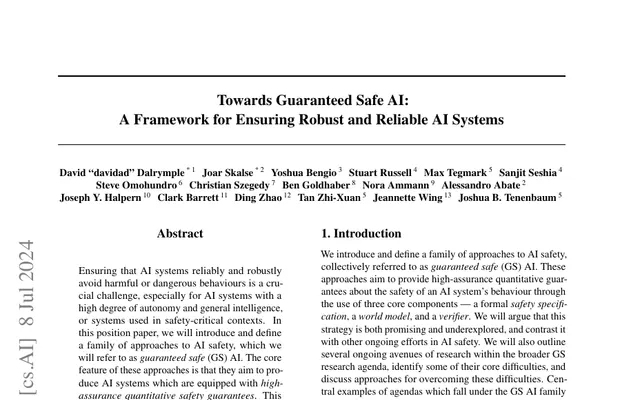
Formal assurance remains important infrastructure, but not a complete solution. Verification can provide auditable guarantees relative to an explicit world model and safety specification; it cannot produce unconditional safety when those assumptions are incomplete. Because frontier capabilities advanced faster than expected, I have shifted toward broadly reusable verification, auditability, and cybersecurity tools rather than treating bespoke formally safeguarded systems as the entire strategy.
Finally, I expect biological humans eventually to lose their dominant position. I do not think disempowerment automatically means the end of human flourishing. The crucial question is whether future systems preserve morally valuable lives, agency, and forms of continuation—including possibilities such as uploading—not whether biological humans retain every lever of power.