Sholto Douglas

Sholto Douglas

x.com/_sholtodouglas

Anthropic researcher who works on scaling AI, sees large economic upside and supports coordinated development with independent evaluators.

AIは世界をどのように変えるでしょうか?

文明規模の変化漸進的な変化DoomBloom
シミュレーション上の位置解釈範囲

横軸:彼が表明したDoom–Bloomの見通し。 縦軸:変革の規模。

Doom–Bloom:100点中69。変革の規模:100点中82。解釈範囲:横方向は64から75、縦方向は75から100。これらは解釈上の座標であり、事象の確率ではありません。

Sholto DouglasのP(doom) · 推定

≈17%

0%100%

本人が示した数値ではなく、シミュレーションされた本人の回答から推定したものです。 妥当と考えられる範囲:11–26%。

Sholto Douglasのマイルストーンのタイムライン
  1. 仕事と制度

    Under those conditions, rapid economic doublings in the 2030s are worth taking seriously.

    回答1

マイルストーン別にまとめており、推定される日付の間隔や順序を反映したものではありません。AGIと超人的AIには、彼の定義がそのまま適用されます。

彼の見通しを左右するもの

中心的な前提

AI helps automate research, which improves AI and robotics, which then automates more of the economy.
回答1

この前提が実際には異なると判明した場合、彼の見通しはどう変わりますか?

未解決の問い

I don’t have a defensible percentage to give.
回答3

ここで考えられる結果を彼が見分けるうえで、何が役立ちますか?

考えを変え得るもの

The biggest update would come from learning whether the apparent gains in task horizon keep scaling.
回答5

どのような証拠なら十分で、それによって彼の見解はどちらの方向に変わりますか?

詳細

予想される恩恵

変革をもたらし、広く価値のある恩恵が予想されています。

88 / 100

影響が小さい変革をもたらす影響

質的尺度での解釈範囲は67から100です。

予想される害

深刻または広範な害が、予想される将来の実質的な一部となっています。

69 / 100

影響が小さい変革をもたらす影響

質的尺度での解釈範囲は67から67です。

人間の影響力

人間の選択によって、AIの軌道を大幅に変えることができます。

68 / 100

影響力が小さい影響力が大きい

質的尺度での解釈範囲は50から75です。

開発ペース

より高性能なAIの開発を停止するか、大幅に減速させます。

シミュレーション上の位置:明示された安全対策の下で開発を継続します。

より高性能なAIの開発を加速させます。

AI利用のルール

事前の保護措置または許可が整うまで、取り上げられたAIの利用を制限します。

シミュレーション上の位置:対象を絞った説明責任と保護措置を伴う形で、取り上げられたAIの利用を認めます。

取り上げられたAIの利用に対する制限を最小限にします。

AIへのアクセス

高性能なAIへのアクセスを制限します。

シミュレーション上の位置:能力または用途の制限を条件として、アクセスを認めます。

高性能なAIへの幅広い、またはオープンなアクセスを支持します。

これらの解釈では、彼が示した条件が維持されています。恩恵と害は、どちらも大きくなり得ます。この範囲は、統計的な信頼区間ではなく、彼のシミュレーションされた回答をどのように読み取ったかを示すものです。

あなたはSholto Douglasと比べてどの位置でしょうか?
約3分で自分のAIに対する世界観をマッピングして、比較できます

似ている世界観

シミュレーションされた世界観がSholto Douglasの世界観に最も近いオピニオンリーダー

シミュレーション評価

質問1

AIは私たちの未来にとって何を意味すると思いますか?また、なぜそう思いますか?

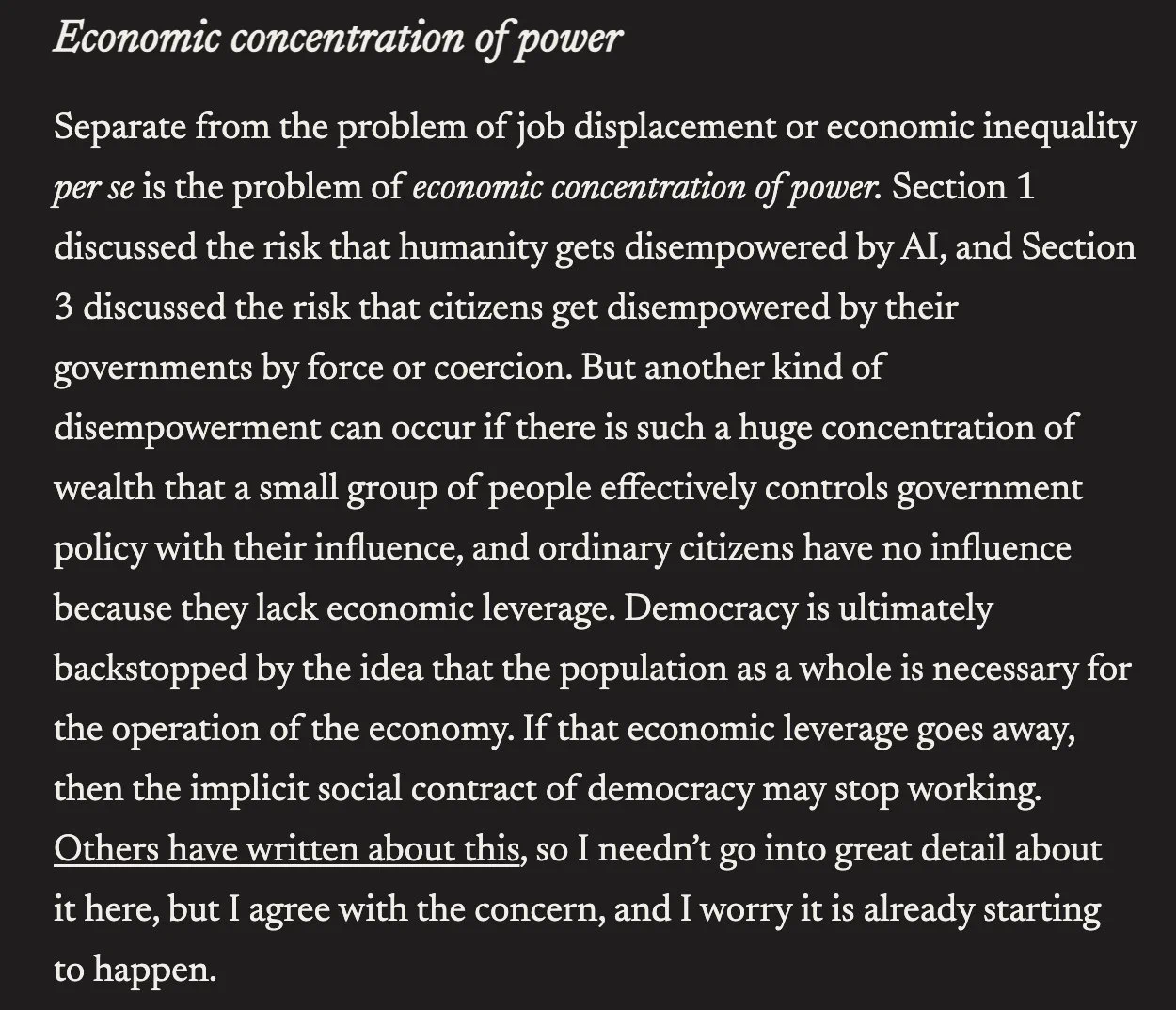
I think AI could transform research and the economy extraordinarily quickly. There is still enormous headroom: better reinforcement learning, engineering, and adaptive computation are already extending how long systems can work usefully on difficult tasks. Once AI can perform broadly human-level computer work—and eventually act through large robot fleets—the feedback loop gets powerful. AI helps automate research, which improves AI and robotics, which then automates more of the economy. Under those conditions, rapid economic doublings in the 2030s are worth taking seriously. Cheap intelligence could drive many costs toward the cost of energy and make the world dramatically better. But that outcome is conditional, not automatic. Systems with growing autonomy and real-world impact will not remain credibly describable as “just tools.” A serious mistake could be disastrous, while an unmitigated race creates pressure to deploy capabilities before safeguards are ready. I favor coordinated development as fast as is safely possible—not an absolute pause, which could let compute accumulate while geopolitical tension builds toward an even more compressed race. That means capability-based safety standards for both open and closed models, independent evaluators with genuine technical depth and varied backgrounds, and monitoring designed around how agents actually operate over hours or days rather than one request at a time. It also means preserving competition so this economic power does not concentrate in one company. The upside is fantastic, but realizing it requires ambitious progress and serious coordination at the same time.


質問2

AIは最終的に世界をどの程度変えると思いますか?

Enormously—potentially on the scale of the Industrial Revolution, but compressed into years rather than generations. If AI can do broadly human-level computer work, automate substantial parts of research, and eventually control large robot fleets, it stops being just another productivity tool. It becomes a general input into scientific discovery, engineering, manufacturing, and nearly every service. The key mechanism is compounding: better systems accelerate research, which produces better systems and robotics, which automate more of the physical economy. Under those conditions, rapid economic doublings in the 2030s are genuinely plausible, and many goods and services could become dramatically cheaper. But the magnitude cuts both ways. Systems with that much autonomy and leverage could cause catastrophic harm if developed or deployed badly. So I expect the potential change to be extraordinary, while the actual outcome depends heavily on whether we coordinate, evaluate capabilities seriously, preserve competition, and move as fast as is safely possible.

質問3

AIが人類絶滅、または同様に永続的な破局を引き起こす可能性は、直感的にどのくらいだと思いますか?

I don’t have a defensible percentage to give. My gut-level view is that the risk is serious enough to shape how frontier AI is developed, not a remote hypothetical we can wave away. Systems capable of broadly human-level computer work, sustained autonomous action, and accelerated AI research could create enormous leverage; one major failure could be catastrophic or irreversible. That is why I oppose an unmitigated race and support capability-based safeguards, technically strong independent evaluation, and monitoring across an agent’s extended activity. But I also don’t think an absolute pause is automatically safer: compute can accumulate and geopolitical pressure can build, producing a more compressed and unstable race later. The right objective is coordinated progress as fast as is safely possible.

質問4

人間より賢いAIシステムを、人々が引き続き制御できると思いますか?また、なぜそう思いますか?

I don’t think control is automatic, and “smarter than humans” is too broad by itself. What matters is whether systems can act autonomously over long periods, acquire resources, evade oversight, manipulate people, or accelerate further AI research. A system can be extremely capable yet constrained; conversely, an agent with enough access and a long task horizon can become dangerous before it surpasses humans in every domain. I think people can retain meaningful control, but only if safeguards scale with capability. Evaluating isolated answers is not enough when an agent’s strategy unfolds across hours or days. We need monitoring over extended activity, restrictions on dangerous behavior and access, and independent evaluators with the technical depth and institutional variety to earn broad trust. Those standards should apply based on capability, whether a model is open or closed. So my expectation is conditional. With serious coordination and engineering, control is achievable. In an unmitigated race, where increasingly autonomous systems are deployed under competitive pressure, I would not confidently expect it.

質問5

どのような発見や出来事があれば、AIが将来もたらす影響についてのあなたの見解が最も大きく変わりますか?

The biggest update would come from learning whether the apparent gains in task horizon keep scaling. If better reinforcement learning, engineering, and compute let systems reliably complete increasingly long, messy research and software tasks—especially AI research itself—I would become even more convinced that the economic transition will be rapid. Likewise, cheap, scalable robotics that closes the gap between computer work and physical work would substantially raise my expectations for economic impact. The strongest update in the other direction would be a persistent capability ceiling: systems remain brittle on long-horizon work, cannot generate useful research without heavy human steering, and additional compute or training methods produce sharply diminishing returns. That would weaken the compounding story and push dramatic economic change further out. On risk, a convincing demonstration that highly capable autonomous agents remain reliably controllable under adversarial pressure would make me more optimistic. A serious incident involving deception, evasion, cyber activity, or dangerous behavior unfolding across extended activity would push me strongly toward believing current safeguards and pacing are inadequate.

出典

このシミュレーション対象者の根拠として使用された記事、インタビュー、著作です。

あなたはどの位置でしょうか?
いくつかの簡単な質問に答えて、自分のAIに対する世界観を探ってみましょう。
自分の世界観をマッピングする

あなたはどの位置でしょうか?

自分の世界観をマッピングする