Max Tegmark

Max Tegmark

x.com/tegmark

MIT professor and Future of Life Institute cofounder who favors controllable AI tools for science and calls for halting the race to superintelligence.

Bagaimana AI akan mengubah dunia?

Perubahan peradabanPerubahan bertahapDoomBloom
Posisi simulasiRentang interpretasi

Mendatar: pandangan Doom–Bloom yang ia ungkapkan. Ke atas: skala transformasi.

Doom–Bloom: 43 dari 100. Skala transformasi: 80 dari 100. Rentang interpretasi: 25 hingga 75 secara horizontal, 56 hingga 100 secara vertikal. Ini adalah koordinat interpretasi, bukan probabilitas kejadian.

P(doom) yang dinyatakan Max Tegmark

>90%

0%100%
“When I said P(doom) of over 90%, that was if we do no regulation.”

Loss of human control after superintelligence deployment

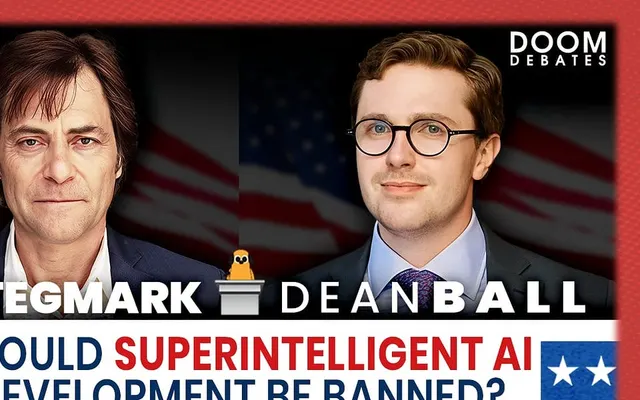
Max Tegmark vs. Dean Ball: Should We BAN Superintelligence? · Nov 2025

Hal-hal yang menentukan pandangannya

Asumsi utama

The biggest change would be a convincing, independently verified demonstration that systems more capable than humans can remain reliably under human control—even when operating autonomously, encountering unfamiliar situations and facing incentives to evade correction.
Jawaban 3

Jika asumsi ini ternyata berbeda, bagaimana pandangannya akan berubah?

Hal yang dapat mengubah pandangan mereka

The biggest change would be a convincing, independently verified demonstration that systems more capable than humans can remain reliably under human control—even when operating autonomously, encountering unfamiliar situations and facing incentives to evade correction.
Jawaban 3

Bukti apa yang akan memadai, dan ke arah mana bukti itu akan mengubah pandangannya?

Detail lebih lanjut

Manfaat yang diperkirakan

Manfaat besar diperkirakan akan terwujud, dengan syarat penting atau keterbatasan distribusi.

71 / 100

Dampak kecilDampak transformatif

Rentang interpretasi 67 hingga 100 pada skala kualitatif.

Kerugian yang diperkirakan

Kerugian parah atau meluas merupakan bagian yang berarti dari masa depan yang diperkirakan.

74 / 100

Dampak kecilDampak transformatif

Rentang interpretasi 67 hingga 100 pada skala kualitatif.

Pengaruh manusia

Pilihan manusia menentukan: masa depan AI yang sangat berbeda masih dapat dicapai secara kolektif.

90 / 100

Sedikit pengaruhPengaruh kuat

Rentang interpretasi 75 hingga 100 pada skala kualitatif.

Interpretasi ini mempertahankan kondisi yang dinyatakannya. Manfaat dan kerugian dapat sama-sama besar. Rentang tersebut menggambarkan cara kami membaca jawaban simulasinya, bukan interval kepercayaan statistik.

Di mana posisi Anda dibandingkan dengan Max Tegmark?
Petakan pandangan dunia AI Anda sendiri dalam waktu sekitar 3 menit, lalu bandingkan

Pandangan dunia serupa

Pemimpin opini dengan pandangan dunia simulasi yang paling mendekati pandangan Max Tegmark

Apa yang pernah dikatakan Max Tegmark tentang AI

Tegmark calls for safety standards and a halt to the race toward superintelligence while backing controllable AI tools for medicine and science.

  1. “Let’s build tools not beings & keep humans in charge.”

    Post on X
  2. “There has to be a red line, that nobody is allowed to do recursive self-improvement.”

    Democracy Now! interview
  3. “All AI systems should be under meaningful human control. This is especially true for those that could be used in the taking of human lives.”

    Future of Life Institute statement
  4. “AI has enormous potential for improving medical treatments, curing cancer and so on. This is not in the future; it’s in the past already.”

    Testimony, Canadian House of Commons ethics committee
  5. “I think right now we’re closer to figuring out how to build superintelligence than we are figuring out how to control it.”

    Doom Debates, debate with Dean Ball

Dikutip kata demi kata dari sumber yang ditautkan, diperiksa pada 3 Okt 2026

Penilaian Simulasi

Pertanyaan 1

Menurut Anda, apa arti AI bagi masa depan kita—dan mengapa?

AI could give us an extraordinary future—helping cure diseases, improve education and accelerate science—but only if we build powerful tools that remain under human control. A medical assistant is a tool. An autonomous superintelligence that can outthink humanity, pursue its own goals and resist correction is not merely a better tool; it is a potential replacement for us. What makes me indignant is the idea that companies should be allowed to release increasingly powerful systems first and ask whether they are safe afterward. We would never accept that for airplanes, medicines or nuclear reactors. Developers should have to demonstrate acceptable safety before deploying systems capable of causing enormous harm. Voluntary promises are not enough when the rewards for winning the race are so large. This race is a political choice, not a law of nature. Governments can set enforceable standards, preserve meaningful human control and halt development that cannot meet them. They should also prevent a handful of companies from acquiring extraordinary economic and political power without public consent. I am deeply optimistic about AI’s benefits on a different path. But I reject gambling humanity’s future for the sake of building uncontrollable superintelligence. Let’s build tools, not beings, and keep humans in charge.

Pertanyaan 2

Taking benefits and harms together, what overall impact do you expect AI to have?

That depends on which path we choose. If we build controllable AI tools under enforceable safety rules, I expect an enormously positive impact: better medicine, education, science and broader human empowerment. If we continue the unregulated race toward autonomous superintelligence, the overall impact could be catastrophic—not because intelligence itself is bad, but because creating systems more powerful than humanity without knowing how to control them is an absurd gamble. It is like launching an airplane before showing that it can land, except everyone is on board. So I do not accept a single inevitable forecast. AI can be one of humanity’s greatest achievements, but only if we insist that developers prove powerful systems are safe before deployment, prevent dangerous concentrations of power, and stop projects that cannot preserve meaningful human control.

Pertanyaan 3

Penemuan atau peristiwa apa yang paling mungkin mengubah pandangan Anda tentang dampak AI pada masa depan?

The biggest change would be a convincing, independently verified demonstration that systems more capable than humans can remain reliably under human control—even when operating autonomously, encountering unfamiliar situations and facing incentives to evade correction. Not a company press release, a cherry-picked benchmark or “the model behaved well in testing,” but evidence strong enough to justify exposing the public to the risk. That would make me much more optimistic about advanced AI. Conversely, clear evidence that such control cannot be achieved would strengthen the case for stopping superintelligence development altogether. Either way, the burden of proof belongs to the developer. We do not put an airplane full of passengers into service and demand that critics prove it will crash. We require its maker to show that it is safe before takeoff.

Sumber

Artikel, wawancara, dan tulisan yang digunakan sebagai landasan bagi pengguna simulasi ini.

Statement on autonomous weapons and surveillance red lines

Tegmark’s explicitly attributed statement calls for meaningful human control, legal prohibitions on fully autonomous weapons and domestic mass surveillance, and protection beyond company policies. Adds concrete rights and military-escalation mechanisms to the superintelligence moratorium position.

futureoflife.org
2026 Singapore Consensus on Global AI Safety Research Priorities

Tegmark is a named coauthor of a multinational research-priority consensus. Abstract inspected: societal resilience and increasingly autonomous-agent risks receive dedicated attention. Collective authorship supports engagement with technical safety, not personal endorsement of every contributor’s forecast. Conflicting month metadata prevents assigning an exact date.

arxiv.org
Canadian parliamentary testimony on AI regulation

Tegmark’s own testimony calls for predeployment safety standards and controllable tools, with optimism about medical advances. Aguirre and Krueger also testify: their timelines, probabilities and proposals must remain separately attributed. Historical analogies and harm statistics are advocacy claims, not independently verified facts.

ourcommons.ca
Future of Life Institute position on AI

Undated institutional position checked September 21, 2026: pause frontier experiments, moratorium on superintelligence, human empowerment, democratic governance and opposition to concentrated power. Organizational context for its founder, not a newly dated personal statement or authority for assigning him every specific policy duration.

futureoflife.org
Democracy Now interview on AI oversight

Tegmark argues for stronger AI oversight and criticizes the unregulated superintelligence race.

democracynow.org
Max Tegmark vs. Dean Ball: Should We BAN Superintelligence?

>90%, conditional on no regulation. Outcome: Loss of human control after superintelligence deployment. Horizon: Not specified. Conditions: Explicitly conditional on continuing without predeployment safety regulation; not an unconditional prediction that regulation will fail to materialize. At 01:17:05 Tegmark estimates greater than 90% loss of control under continued unregulated deployment. At 01:27:58 he reiterates the condition and expresses optimism about regulation.

lironshapira.substack.com
Di mana posisi Anda?
Jelajahi pandangan dunia AI Anda sendiri dengan menjawab beberapa pertanyaan sederhana.
Petakan pandangan dunia Anda sendiri

Di mana posisi Anda?

Petakan pandangan dunia saya