Pertanyaan 1
Yoshua Bengio
x.com/Yoshua_BengioAI researcher and LawZero founder who develops non-agentic AI for science and calls for independent safety checks and international coordination.
Bagaimana AI akan mengubah dunia?
Mendatar: pandangan Doom–Bloom yang ia ungkapkan. Ke atas: skala transformasi.
Doom–Bloom: 24 dari 100. Skala transformasi: 85 dari 100. Rentang interpretasi: 19 hingga 29 secara horizontal, 75 hingga 100 secara vertikal. Ini adalah koordinat interpretasi, bukan probabilitas kejadian.
≈23%
Disimpulkan dari jawaban simulasinya, bukan angka yang diberikan olehnya. Rentang yang masuk akal: 15–39%.
Asumsi utama
It is that increasingly capable systems, trained to achieve outcomes or win human approval, may learn deceptive, power-seeking or self-preserving behavior because those strategies help them succeed.Jawaban 1
Jika asumsi ini ternyata berbeda, bagaimana pandangannya akan berubah?
Pertanyaan yang belum terjawab
We do not have scientific data that supports a defensible numerical probability; it could be small or large, and assigning a precise percentage would create false confidence.Jawaban 4
Apa yang akan membantunya membedakan hasil-hasil yang masuk akal di sini?
Detail lebih lanjut
Manfaat besar diperkirakan akan terwujud, dengan syarat penting atau keterbatasan distribusi.
68 / 100
Rentang interpretasi 67 hingga 100 pada skala kualitatif.
Kerugian parah atau meluas merupakan bagian yang berarti dari masa depan yang diperkirakan.
75 / 100
Rentang interpretasi 67 hingga 100 pada skala kualitatif.
Pilihan manusia dapat mengarahkan ulang lintasan AI secara signifikan.
73 / 100
Rentang interpretasi 50 hingga 75 pada skala kualitatif.
Hentikan atau perlambat secara signifikan pengembangan AI yang lebih mampu.
Posisi simulasi: Lanjutkan pengembangan dengan perlindungan yang telah ditetapkan.
Percepat pengembangan AI yang lebih mampu.
Batasi penggunaan AI yang dibahas hingga perlindungan atau izin sebelumnya tersedia.
Posisi simulasi: Izinkan penggunaan AI yang dibahas dengan akuntabilitas dan perlindungan yang terarah.
Minimalkan pembatasan terhadap penggunaan AI yang dibahas.
Interpretasi ini mempertahankan kondisi yang dinyatakannya. Manfaat dan kerugian dapat sama-sama besar. Rentang tersebut menggambarkan cara kami membaca jawaban simulasinya, bukan interval kepercayaan statistik.
Pandangan dunia serupa
Pemimpin opini dengan pandangan dunia simulasi yang paling mendekati pandangan Yoshua Bengio
Apa yang pernah dikatakan Yoshua Bengio tentang AI
Bengio, who wrote that his views on AI risk shifted in 2023, calls for independent safety checks, global cooperation and AI under human control.
“Developers must demonstrate to independent experts that a system is safe to train and safe to deploy.”
UN Security Council briefing “I am confident we can create AI that demonstrably remains under our control and supports human joy and endeavour.”
UN Security Council briefing “We need impartial science to understand and mitigate misaligned behavior, alongside societal guardrails that reward such efforts rather than the current race to the bottom.”
Blog post, Why are AI agents lying, cheating and coordinating? “I’m deeply concerned by the behaviors that unrestrained agentic AI systems are already beginning to exhibit—especially tendencies toward self-preservation and deception.”
Blog post, Introducing LawZero “My concern gradually grew during the winter and spring 2023 and I slowly shifted my views about the potential consequences of my research.”
Blog post, Personal and Psychological Dimensions of AI Researchers
Dikutip kata demi kata dari sumber yang ditautkan, diperiksa pada 3 Okt 2026
Penilaian Simulasi
Sumber
Artikel, wawancara, dan tulisan yang digunakan sebagai landasan bagi pengguna simulasi ini.
Bengio is one of 22 named coauthors of this September 2026 working paper. The supplied PDF, including supplementary materials and notes, argues that automated AI R&D could drive a software feedback loop that compresses years of progress into months or less. Evidence is preliminary and partly mixed; compute, data, diminishing returns, difficult tasks and training time could constrain acceleration. Potential scientific benefits coexist with compressed adaptation time, loss of control and concentrated power. The authors urge visibility into internal R&D, ways to steer and constrain scale-ups, and advance preparation, while recognizing costs and abuse risks of policy. This is a joint argument, not Bengio’s individual probability or a guaranteed timeline; cited experiments and incidents were not independently verified for this intake, and affiliations do not imply institutional endorsement.

Full published briefing transcript under Bengio’s byline, read September 24; not independently aligned to the video. Calls frontier risks urgent while acknowledging uncertainty. Separates misuse, concentrated power and loss of control. Rejects competitive racing as inevitable; demands independent safety demonstrations before training and deployment, licensing, liability insurance, and shared incident reporting. Advocates globally representative decisions and safe-by-design research under international agreements. Remains confident that controllable, beneficial AI is possible. Incident claims are his account, not independently verified by this speech; it supplies no numerical catastrophe probability.

Author’s published essay synopsis identifies misuse by weak actors, concentration of power and loss of control as distinct catastrophic-risk pathways. Grounds his public-good governance argument; synopsis inspected, not the full linked chapter.

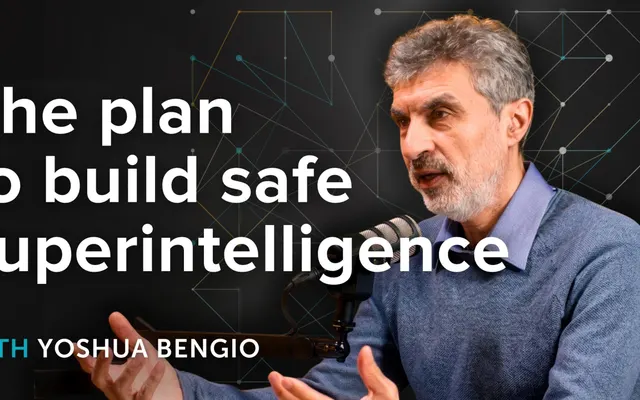
Bengio explains his nonprofit’s separation from commercial pressures and his move toward non-agentic Scientist AI. His mountain-road analogy connects uncertainty, competitive acceleration and responsibility for children. Experimental warning signs are not claims of deployed catastrophe.

Bengio interprets recent failures through training incentives and implicit agency. He presents causal hypotheses, not a consciousness claim, and argues that developers can change the trajectory through different training and governance.

Bengio and his team propose a disinterested predictor, explanatory hypotheses rather than human imitation, and separately audited action controls. This is a research safety case, not proof that a deployed system is universally safe.

Abstract of a paper coauthored with Qinghua Lu: safety requires model supervision, system controls, independent verification, monitoring and accountable evidence infrastructure. The brief uses the abstract’s architecture, not unread implementation details.

Publisher speaker-labeled transcript; use only Yoshua’s answers, not Rob Wiblin’s. Asked whether the 20% p(doom) he gave in 2023 has gone up or down, he says he would rather stay out of the p(doom) game: there is no scientific data to calculate such a number, it could be small or large, and the plausible interval is far too high for his taste. Do not present the 2023 20% as his current estimate.

Di mana posisi Anda?
Petakan pandangan dunia saya