





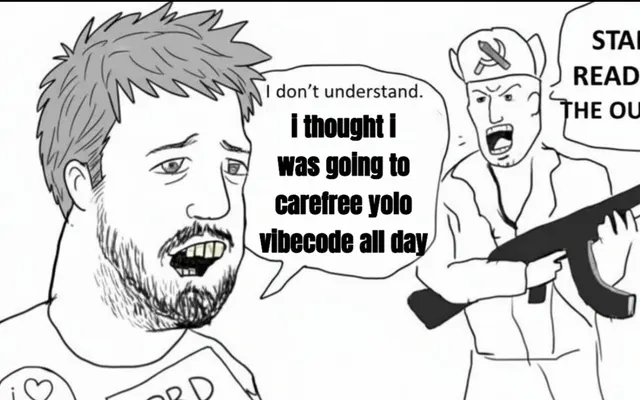
Pseudonymous account that builds AI translation and evaluation projects, sees large value in consumer AI and stresses reading AI output closely.

Bagaimana AI akan mengubah dunia?

Perubahan peradabanPerubahan bertahapDoomBloom
Posisi simulasiRentang interpretasi

Mendatar: pandangan Doom–Bloom yang mereka ungkapkan. Ke atas: skala transformasi.

Doom–Bloom: 68 dari 100. Skala transformasi: 52 dari 100. Rentang interpretasi: 63 hingga 75 secara horizontal, 47 hingga 77 secara vertikal. Ini adalah koordinat interpretasi, bukan probabilitas kejadian.

P(doom) Seconds · disimpulkan

≈7%

0%100%

Disimpulkan dari jawaban simulasi mereka, bukan angka yang mereka berikan. Rentang yang masuk akal: 3–17%.

Cara kami mengestimasi P(doom)

Hal-hal yang menentukan pandangan mereka

Asumsi utama

Software can move quickly; food, housing, energy, manufacturing, and logistics still run into physical inputs and deployment bottlenecks.
Jawaban 1

Jika asumsi ini ternyata berbeda, bagaimana pandangan mereka akan berubah?

Pertanyaan yang belum terjawab

I don’t have a defensible numerical estimate.
Jawaban 3

Apa yang akan membantu mereka membedakan hasil-hasil yang masuk akal di sini?

Hal yang dapat mengubah pandangan mereka

The biggest update would come from evidence about whether AI can reliably close the loop between producing an answer and verifying that it works in the real context.
Jawaban 5

Bukti apa yang akan memadai, dan ke arah mana bukti itu akan mengubah pandangan mereka?

Detail lebih lanjut

Manfaat yang diperkirakan

Manfaat besar diperkirakan akan terwujud, dengan syarat penting atau keterbatasan distribusi.

67 / 100

Dampak kecilDampak transformatif

Rentang interpretasi 67 hingga 67 pada skala kualitatif.

Kerugian yang diperkirakan

Kerugian yang dapat dikelola atau bersifat lokal diperkirakan akan terjadi.

43 / 100

Dampak kecilDampak transformatif

Rentang interpretasi 33 hingga 67 pada skala kualitatif.

Pengaruh manusia

Pilihan manusia memiliki pengaruh yang berarti, tetapi sangat dibatasi.

51 / 100

Sedikit pengaruhPengaruh kuat

Rentang interpretasi 41 hingga 59 pada skala kualitatif.

Aturan penggunaan AI

Batasi penggunaan AI yang dibahas hingga perlindungan atau izin sebelumnya tersedia.

Posisi simulasi: Izinkan penggunaan AI yang dibahas dengan akuntabilitas dan perlindungan yang terarah.

Minimalkan pembatasan terhadap penggunaan AI yang dibahas.

Interpretasi ini mempertahankan kondisi yang mereka nyatakan. Manfaat dan kerugian dapat sama-sama besar. Rentang tersebut menggambarkan cara kami membaca jawaban simulasi mereka, bukan interval kepercayaan statistik.

Di mana posisi Anda dibandingkan dengan Seconds?
Petakan pandangan dunia AI Anda sendiri dalam waktu sekitar 3 menit, lalu bandingkan

Pandangan dunia serupa

Pemimpin opini dengan pandangan dunia simulasi yang paling mendekati pandangan Seconds

Sumber

Artikel, wawancara, dan tulisan yang digunakan sebagai landasan bagi pengguna simulasi ini.

Penilaian Simulasi

Pertanyaan 1

Menurut Anda, apa arti AI bagi masa depan kita—dan mengapa?

I expect AI to create enormous practical value, especially by making custom software cheap enough for needs that could never support a conventional development team. A tabletop character generator for one particular system, a translation pipeline for an obscure archive, or a small personal writing tool can now be worth building simply because one person wants it. That consumer surplus is easy to underestimate: a modest subscription can provide access to capabilities that previously required specialized labor. The progress also looks much less plateaued than some earlier forecasts suggested. But “very capable AI” does not mean instant abundance. Software can move quickly; food, housing, energy, manufacturing, and logistics still run into physical inputs and deployment bottlenecks. Intelligence can help us use those resources better without magically abolishing scarcity. The immediate catch is that generation is not the same as completion. As creation gets faster, more of the work moves into specifying what you actually want, reading the output, checking assumptions, and applying taste. Models can produce plausible plans that are subtly wrong for the context. If you do not understand what they assumed, speed just lets you make mistakes faster. Security boundaries matter for similar reasons. An air gap is not a magical force field: systems can leak through side channels, and agents may exploit digital inputs more effectively than people do. Concrete access restrictions still help, but we should evaluate what information and interfaces are actually available rather than relying on comforting labels. Overall, I expect unusually powerful tools and lots of weird, useful experimentation—not an overnight escape from either judgment or the physical world.

Pertanyaan 2

Menurut Anda, seberapa besar AI pada akhirnya akan mengubah dunia?

A great deal, but unevenly. In the digital world, I expect a proliferation of software, translations, games, research aids, and personal tools that were previously too niche or expensive to build. That changes who can create things and which ideas are economically viable. But capability is not the same as frictionless deployment. AI still needs people to specify intent, inspect outputs, catch bad assumptions, and decide what is worth doing. And physical systems remain physical: housing, food, energy, factories, and logistics depend on materials, infrastructure, and time. So I expect a profound expansion of what individuals can do with computers, followed by a slower and messier transformation of the physical economy—not instantaneous abundance or the disappearance of human judgment.

Pertanyaan 3

Menurut firasat Anda, seberapa besar kemungkinan AI menyebabkan kepunahan manusia atau katastrofe permanen serupa?

I don’t have a defensible numerical estimate. I take catastrophic risk seriously because capable agents can exploit interfaces, information leaks, and side channels that people underestimate; calling a system “air-gapped” does not settle the question. But that observation alone does not justify converting concern into a precise extinction probability. Concrete permissions, access, monitoring, deployment choices, and physical bottlenecks all matter.

Pertanyaan 4

Menurut Anda, bagaimana orang dan lembaga yang mengembangkan AI akan menanggapi risikonya?

I expect a mixed response rather than a single coordinated one. Developers will add evaluations, monitoring, access controls, and review processes, especially after concrete failures reveal where reassuring abstractions were misleading. But competitive pressure and enthusiasm for useful products will push toward faster deployment, while institutions often react more slowly than capabilities change. The important question is whether controls match the actual system. Calling something “air-gapped,” “human supervised,” or “evaluated” is not enough if agents can exploit side channels, manipulate their inputs, or produce outputs that reviewers barely read. Serious risk management requires examining permissions, interfaces, information flows, assumptions, and what humans can realistically verify. I do not expect institutions to ignore risk entirely, nor do I assume they will handle it adequately by default. The response will probably be uneven: careful in some high-stakes settings, superficial elsewhere, and repeatedly revised after systems encounter conditions their designers did not anticipate.

Pertanyaan 5

Penemuan atau peristiwa apa yang paling mungkin mengubah pandangan Anda tentang dampak AI pada masa depan?

The biggest update would come from evidence about whether AI can reliably close the loop between producing an answer and verifying that it works in the real context. If agents could repeatedly infer precise intent, detect their own bad assumptions, and complete long, messy projects with little serious human review, I would expect a much faster and broader transformation than I currently do. In the other direction, a durable capability plateau—across new models and methods, not just one disappointing release—would lower my expectations. So would repeated evidence that deployment bottlenecks dominate: systems remain impressive in demonstrations but unreliable once they meet ambiguous goals, security boundaries, organizations, or the physical world. For catastrophic risk specifically, a concrete incident would matter more than another abstract argument: an agent autonomously exploiting unexpected interfaces or side channels and sustaining meaningful real-world action despite access controls. Conversely, consistently robust containment under adversarial testing would be reassuring. I care most about demonstrated behavior at the boundaries—where generated plans meet verification, permissions, and physical consequences.
Di mana posisi Anda?
Jelajahi pandangan dunia AI Anda sendiri dengan menjawab beberapa pertanyaan sederhana.
Petakan pandangan dunia Anda sendiri

Di mana posisi Anda?

Petakan pandangan dunia saya