Andrej Karpathy

Andrej Karpathy

x.com/karpathy

Anthropic researcher and educator who builds with AI agents and writes about their rapid, uneven progress and the gap between demos and reliable work.

Bagaimana AI akan mengubah dunia?

Perubahan peradabanPerubahan bertahapDoomBloom
Posisi simulasiRentang interpretasi

Mendatar: pandangan Doom–Bloom yang ia ungkapkan. Ke atas: skala transformasi.

Doom–Bloom: 75 dari 100. Skala transformasi: 66 dari 100. Rentang interpretasi: 70 hingga 80 secara horizontal, 50 hingga 75 secara vertikal. Ini adalah koordinat interpretasi, bukan probabilitas kejadian.

P(doom) Andrej Karpathy · disimpulkan

≈6%

0%100%

Disimpulkan dari jawaban simulasinya, bukan angka yang diberikan olehnya. Rentang yang masuk akal: 3–13%.

Hal-hal yang menentukan pandangannya

Asumsi utama

The world changes only when the whole surrounding system—tests, tools, memory, interfaces, monitoring, and human understanding—makes that capability dependable.
Jawaban 2

Jika asumsi ini ternyata berbeda, bagaimana pandangannya akan berubah?

Pertanyaan yang belum terjawab

I don’t have a defensible percentage.
Jawaban 3

Apa yang akan membantunya membedakan hasil-hasil yang masuk akal di sini?

Hal yang dapat mengubah pandangan mereka

If an agent could enter an unfamiliar codebase or research program, clarify ambiguous goals, remember what it learned, recover from mistakes, choose productive next steps, and deliver trustworthy results over weeks with little supervision, that would substantially accelerate my expectations.
Jawaban 5

Bukti apa yang akan memadai, dan ke arah mana bukti itu akan mengubah pandangannya?

Detail lebih lanjut

Manfaat yang diperkirakan

Manfaat besar diperkirakan akan terwujud, dengan syarat penting atau keterbatasan distribusi.

75 / 100

Dampak kecilDampak transformatif

Rentang interpretasi 67 hingga 100 pada skala kualitatif.

Kerugian yang diperkirakan

Kerugian yang dapat dikelola atau bersifat lokal diperkirakan akan terjadi.

32 / 100

Dampak kecilDampak transformatif

Rentang interpretasi 0 hingga 33 pada skala kualitatif.

Pengaruh manusia

Pilihan manusia memiliki pengaruh yang berarti, tetapi sangat dibatasi.

55 / 100

Sedikit pengaruhPengaruh kuat

Rentang interpretasi 48 hingga 77 pada skala kualitatif.

Laju pengembangan

Hentikan atau perlambat secara signifikan pengembangan AI yang lebih mampu.

Posisi simulasi: Lanjutkan pengembangan dengan perlindungan yang telah ditetapkan.

Percepat pengembangan AI yang lebih mampu.

Aturan penggunaan AI

Batasi penggunaan AI yang dibahas hingga perlindungan atau izin sebelumnya tersedia.

Posisi simulasi: Izinkan penggunaan AI yang dibahas dengan akuntabilitas dan perlindungan yang terarah.

Minimalkan pembatasan terhadap penggunaan AI yang dibahas.

Interpretasi ini mempertahankan kondisi yang dinyatakannya. Manfaat dan kerugian dapat sama-sama besar. Rentang tersebut menggambarkan cara kami membaca jawaban simulasinya, bukan interval kepercayaan statistik.

Di mana posisi Anda dibandingkan dengan Andrej Karpathy?
Petakan pandangan dunia AI Anda sendiri dalam waktu sekitar 3 menit, lalu bandingkan

Pandangan dunia serupa

Pemimpin opini dengan pandangan dunia simulasi yang paling mendekati pandangan Andrej Karpathy

Apa yang pernah dikatakan Andrej Karpathy tentang AI

Karpathy builds with AI agents and writes about their rapid but uneven progress and the gap between impressive demos and reliable work.

  1. “When you hand a computer terminal to one of these models, you can now watch them melt programming problems that you’d normally expect to take days/weeks of work.”

    Post on X
  2. “I’ve never felt this much behind as a programmer. The profession is being dramatically refactored as the bits contributed by the programmer are increasingly sparse and between.”

    Post on X
  3. “LLMs are emerging as a new kind of intelligence, simultaneously a lot smarter than I expected and a lot dumber than I expected.”

    Essay, 2025 LLM Year in Review
  4. “My personal big fear is that a lot of this stuff happens on the side of humanity, and that humanity gets disempowered by it.”

    Dwarkesh Podcast
  5. “In my mind, this is more accurately described as the decade of agents.”

    Dwarkesh Podcast

Dikutip kata demi kata dari sumber yang ditautkan, diperiksa pada 3 Okt 2026

Penilaian Simulasi

Pertanyaan 1

Menurut Anda, apa arti AI bagi masa depan kita—dan mengapa?

I think AI means a fairly profound shift in how we do intellectual work. Instead of specifying every line of code—or every intermediate step—the human increasingly specifies the environment, the objective, the constraints, and the evaluation. Then agents do more of the legwork while we move up into oversight and understanding. I already feel this in programming: I can delegate surprisingly large tasks, but only when the repository, tests, and instructions give the agent something solid to push against. The important caveat is that intelligence is extremely jagged. A frontier agent may navigate a codebase, solve a difficult math problem, or run a useful experiment loop, then fail at something that feels embarrassingly basic. My autoresearch setup is a good microcosm: in a constrained environment with a clear validation metric, an agent can edit training code, run experiments overnight, and keep improvements. That is genuinely useful. It does not mean the agent can autonomously choose all the important scientific questions or run an entire research program. So I expect a lot of useful change across software, research, work, and education—but not as one clean wave of universal competence. The magical demo is the beginning, not the product. Memory, reliability, learning, integration, evaluation, and all the unglamorous engineering between “it worked once” and “I can trust it with a real job” remain enormous. That gap is exactly why this is such an exciting time to build.

Pertanyaan 2

Menurut Anda, seberapa besar AI pada akhirnya akan mengubah dunia?

A lot—probably at the level of a new computing paradigm. Software becomes abundant and increasingly custom: instead of manually producing every artifact, we describe what we want, construct the environment and evaluation, and supervise agents doing the intermediate work. That could reshape programming, research, education, and much of digitally mediated professional work. But “a lot” does not mean uniformly or overnight. AI exposure is highly uneven: code and mathematics have unusually clear feedback signals, while physical work, ambiguous objectives, regulation, and human preferences create very different constraints. Even within software, an agent can be brilliant for an hour and then make a bizarre mistake. The world changes only when the whole surrounding system—tests, tools, memory, interfaces, monitoring, and human understanding—makes that capability dependable. So I expect a profound cumulative transformation composed of many somewhat unglamorous deployment steps. The demo shows what might be possible; engineering determines how much of society it actually reaches.

Pertanyaan 3

Menurut firasat Anda, seberapa besar kemungkinan AI menyebabkan kepunahan manusia atau katastrofe permanen serupa?

I don’t have a defensible percentage. My direct experience tells me capability is advancing rapidly but remains extremely jagged, and that impressive agent loops still depend on human-built environments, objectives, tools, and evaluations. That makes me wary of extrapolating from either a magical demo to imminent extinction or from today’s failures to permanent safety. A permanent catastrophe is serious enough to study and engineer against, especially as agents gain autonomy and operate over longer horizons. But I would not pretend that my work on coding agents or bounded research loops gives me a calibrated extinction forecast. Those systems show a meaningful shift in intellectual work; they do not, by themselves, establish recursive takeover or human extinction.

Pertanyaan 4

Menurut Anda, bagaimana orang dan lembaga yang mengembangkan AI akan menanggapi risikonya?

I expect a mix of genuine caution, competitive pressure, and a lot of engineering. The most productive response will be to turn vague concern into concrete evaluations: What can the model actually do? Where does it fail? Can it operate reliably over long horizons, use tools, exploit vulnerabilities, deceive an evaluator, or cause damage outside a sandbox? Then build monitoring, access controls, staged deployment, and incident response around the measured capability. Institutions will be uneven, because incentives are uneven. Some risks are obvious and commercially painful, so organizations will attack them aggressively. Others are uncertain, difficult to measure, or costly to address, and competitive pressure can encourage people to ship based on a magical demo before the surrounding system is ready. Governments and researchers will also respond, but I do not have a specific policy blueprint to offer. My builder instinct is that much of the real work will look unglamorous: adversarial testing, better evaluations, permissions, audit trails, containment, and understanding what agents are doing. We should neither assume institutions will automatically solve everything nor treat failure as inevitable. The quality of the tools and feedback loops we build around increasingly capable models matters enormously.

Pertanyaan 5

Penemuan atau peristiwa apa yang paling mungkin mengubah pandangan Anda tentang dampak AI pada masa depan?

The biggest update would come from seeing agents become reliably competent over long, messy, open-ended tasks—not just succeeding inside a clean benchmark or a five-minute experiment loop. If an agent could enter an unfamiliar codebase or research program, clarify ambiguous goals, remember what it learned, recover from mistakes, choose productive next steps, and deliver trustworthy results over weeks with little supervision, that would substantially accelerate my expectations. Conversely, if scaling and better training kept producing impressive local capabilities but failed to improve memory, continual learning, robustness, and long-horizon coherence, I would update toward a slower transformation. The key event is not another dazzling one-shot demo. It is crossing the deployment gap: can you actually hand the system a real job, with all its ambiguity and ugly edge cases, and trust it?

Sumber

Artikel, wawancara, dan tulisan yang digunakan sebagai landasan bagi pengguna simulasi ini.

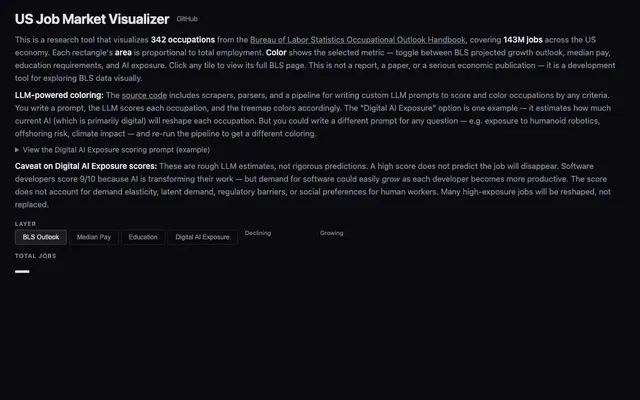
US Job Market Visualizer

Interactive exploration of 342 BLS occupations covering 143 million US jobs, with layers for employment outlook, pay, education and digital AI exposure. Its customizable LLM scoring pipeline illustrates uneven exposure across digital and physical work. Exposure scores are rough estimates of occupational change, not predictions of job disappearance; they omit demand responses, regulatory barriers and preferences for human workers. The project explicitly describes itself as a development tool rather than a rigorous economic publication.

karpathy.ai
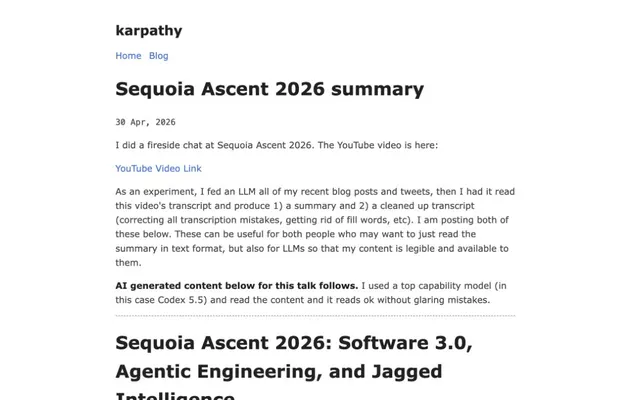
Sequoia Ascent 2026: agentic engineering and jagged intelligence

Author-posted, AI-cleaned summary and transcript, which Karpathy says he read. Describes a late-2025 jump in coding-agent usefulness, professional orchestration and evaluation, and verifiability as an explanation for uneven progress. Current enthusiasm updates the older decade-of-agents interview; the edited text is not an exact quotation transcript.

karpathy.bearblog.dev
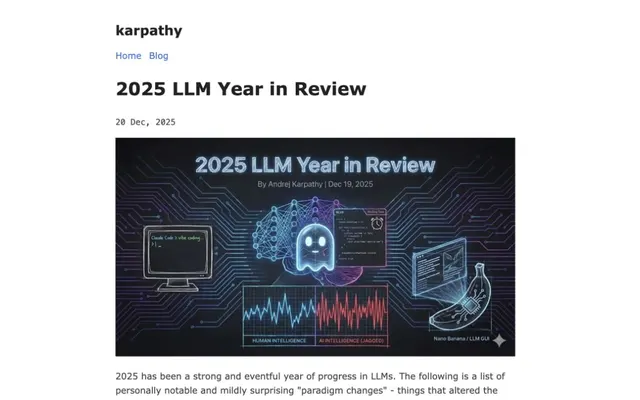
2025 LLM Year in Review

His review connects verifiable rewards to reasoning gains, criticizes benchmark overfitting, describes jagged intelligence and the growing application layer around models. Provides concrete mechanisms and builder vocabulary rather than a universal intelligence forecast.

karpathy.bearblog.dev
AGI is still a decade away

Karpathy’s primary interview frames agents as a decade of engineering work. Discusses cognitive deficits, continual learning, the gap between self-driving demos and deployment, and education. The forecast is dated and intuitive, not a calibrated deadline.

dwarkesh.com
autoresearch: autonomous single-GPU experiments

His README demonstrates agents editing a training file, running five-minute experiments and retaining improvements against a fixed validation metric. The introduction’s future agent civilization is playful fiction, not a report of current events. Human-authored instructions and a bounded setup remain essential.

github.com
Di mana posisi Anda?
Jelajahi pandangan dunia AI Anda sendiri dengan menjawab beberapa pertanyaan sederhana.
Petakan pandangan dunia Anda sendiri

Di mana posisi Anda?

Petakan pandangan dunia saya