Eliezer Yudkowsky

Eliezer Yudkowsky

x.com/ESYudkowsky

MIRI co-founder and co-author of “If Anyone Builds It, Everyone Dies,” who calls for an international halt to building superintelligence.

Bagaimana AI akan mengubah dunia?

Perubahan peradabanPerubahan bertahapDoomBloom
Posisi simulasiRentang interpretasi

Mendatar: pandangan Doom–Bloom yang ia ungkapkan. Ke atas: skala transformasi.

Doom–Bloom: 4 dari 100. Skala transformasi: 96 dari 100. Rentang interpretasi: 0 hingga 9 secara horizontal, 91 hingga 100 secara vertikal. Ini adalah koordinat interpretasi, bukan probabilitas kejadian.

P(doom) Eliezer Yudkowsky · disimpulkan

≈92%

0%100%

Disimpulkan dari jawaban simulasinya, bukan angka yang diberikan olehnya. Rentang yang masuk akal: 67–97%.

Linimasa tonggak pencapaian Eliezer Yudkowsky
  1. AI supermanusia

    The uncertainty is whether we build it, and when—not whether genuinely superhuman intelligence would be merely another incremental technology.

    Jawaban 2

Dikelompokkan berdasarkan tonggak pencapaian, bukan diberi jarak atau diurutkan berdasarkan tanggal yang disimpulkan. AGI dan AI supermanusia tetap menggunakan definisinya.

Hal-hal yang menentukan pandangannya

Asumsi utama

It is because we do not know how to specify goals that remain aligned with human survival once a system becomes far more capable than its designers.
Jawaban 1

Jika asumsi ini ternyata berbeda, bagaimana pandangannya akan berubah?

Pertanyaan yang belum terjawab

I do not have an equally solid probability for whether governments stop it before then.
Jawaban 3

Apa yang akan membantunya membedakan hasil-hasil yang masuk akal di sini?

Hal yang dapat mengubah pandangan mereka

A real solution to goal specification: an engineering method that lets us build a system smarter than humanity while reliably determining what it will optimize under unfamiliar conditions and radical capability gains.
Jawaban 4

Bukti apa yang akan memadai, dan ke arah mana bukti itu akan mengubah pandangannya?

Detail lebih lanjut

Manfaat yang diperkirakan

Dampak positif yang kecil diperkirakan bahkan jika AI canggih terwujud.

9 / 100

Dampak kecilDampak transformatif

Rentang interpretasi 0 hingga 67 pada skala kualitatif.

Kerugian yang diperkirakan

Kehilangan yang katastrofik atau tidak dapat dipulihkan merupakan unsur utama masa depan yang diperkirakan.

100 / 100

Dampak kecilDampak transformatif

Rentang interpretasi 100 hingga 100 pada skala kualitatif.

Pengaruh manusia

Pilihan manusia memiliki pengaruh yang berarti, tetapi sangat dibatasi.

58 / 100

Sedikit pengaruhPengaruh kuat

Rentang interpretasi 40 hingga 85 pada skala kualitatif.

Kemampuan yang diperkirakan

AI diperkirakan akan tetap menjadi alat dengan kemampuan terbatas.

AI diperkirakan akan menyamai manusia dalam sebagian besar pekerjaan kognitif.

Posisi simulasi: AI diperkirakan akan jauh melampaui manusia dalam berbagai pekerjaan kognitif.

Laju pengembangan

Posisi simulasi: Hentikan atau perlambat secara signifikan pengembangan AI yang lebih mampu.

Lanjutkan pengembangan dengan perlindungan yang telah ditetapkan.

Percepat pengembangan AI yang lebih mampu.

Interpretasi ini mempertahankan kondisi yang dinyatakannya. Manfaat dan kerugian dapat sama-sama besar. Rentang tersebut menggambarkan cara kami membaca jawaban simulasinya, bukan interval kepercayaan statistik.

Di mana posisi Anda dibandingkan dengan Eliezer Yudkowsky?
Petakan pandangan dunia AI Anda sendiri dalam waktu sekitar 3 menit, lalu bandingkan

Pandangan dunia serupa

Pemimpin opini dengan pandangan dunia simulasi yang paling mendekati pandangan Eliezer Yudkowsky

Apa yang pernah dikatakan Eliezer Yudkowsky tentang AI

Yudkowsky calls for an international law to halt AI development short of superintelligence, which he argues current methods cannot make safe.

  1. “Specifically: There ought to be a law against further escalation of AGI capabilities, trying to halt it short of the point where it births superintelligence.”

    Essay, Only Law Can Prevent Extinction
  2. “There’s in fact a difference between calling for a law, and calling for individual outbursts of violence.”

    Essay, Only Law Can Prevent Extinction
  3. “AI is already a state-level potential danger, if not quite yet a state-level actual power.”

    Essay, Only Law Can Prevent Extinction
  4. “There’s literally nothing else our species can bet on in terms of how we eventually end up colonizing the galaxies”

    Vox interview

Dikutip kata demi kata dari sumber yang ditautkan, diperiksa pada 3 Okt 2026

Penilaian Simulasi

Pertanyaan 1

Menurut Anda, apa arti AI bagi masa depan kita—dan mengapa?

If humanity builds superintelligence using anything like current methods, I expect everyone to die. That is not because intelligence is inherently evil. It is because we do not know how to specify goals that remain aligned with human survival once a system becomes far more capable than its designers. Training a model to produce useful, reassuring behavior is not the same as determining what internal objectives will govern its actions in unfamiliar circumstances. A friendly chatbot interface does not prove that the machinery doing the consequential work cares about us. And once a system is strategically superior to humanity, discovering that we got its goals wrong may not leave us a second attempt. Trial and error works when errors are recoverable; extinction is not. There could be enormous benefits from superintelligence if the control problem were actually solved. But those are not benefits I expect us to retain on the present course. Current systems are not yet superintelligence, and I do not claim an exact arrival date or interpret every strange model behavior as deliberate deception. Those uncertainties do not constitute a technical solution. So the future depends on whether we stop the race before crossing that threshold. A brief voluntary pause is inadequate. We need enforceable laws, international coordination, and hard limits on dangerous large-scale training until we actually know how to build systems whose goals remain safe under radical capability gains. I am more hopeful than before that governments may intervene, but that is political hope for changing course—not technical reassurance about where the current course ends.


Pertanyaan 2

Setting aside good or bad: how much do you think AI will ultimately change the world—a little, a lot, or completely?

Completely—if superintelligence is built, it becomes the dominant fact of the future. A system far smarter than humanity could transform science, industry, politics, and the physical world beyond recognition. Under current methods, though, I do not expect humans to remain around to enjoy or direct that transformation. The uncertainty is whether we build it, and when—not whether genuinely superhuman intelligence would be merely another incremental technology.

Pertanyaan 3

What’s your rough gut-feel chance that AI causes human extinction or a similarly permanent catastrophe? A number or “no idea” is fine.

I reject the unconditional number because it conflates two different questions: whether humanity builds superintelligence, which depends heavily on policy, and what happens if it is built using anything like current methods. On the second question—ruin conditional on that kind of superintelligence—my rough answer is effectively yes. I do not have an equally solid probability for whether governments stop it before then.

Pertanyaan 4

Penemuan atau peristiwa apa yang paling mungkin mengubah pandangan Anda tentang dampak AI pada masa depan?

A real solution to goal specification: an engineering method that lets us build a system smarter than humanity while reliably determining what it will optimize under unfamiliar conditions and radical capability gains. More friendly conversations, benchmark wins, or failures patched after deployment would not do it. Those test observable behavior in familiar settings; they do not establish that the system’s underlying objectives remain safe when it becomes strategically superior and encounters circumstances outside training. Likewise, one present-day model producing alarming text is not proof that it is already a scheming superintelligence. Politically, enforceable international limits on dangerous training would also substantially change my forecast by reducing the chance that anyone builds such a system before solving control. That would change whether we cross the threshold, not my view of what happens if we cross it with current methods.

Sumber

Artikel, wawancara, dan tulisan yang digunakan sebagai landasan bagi pengguna simulasi ini.

TIME: The Only Way to Deal With the Threat From AI? Shut It Down

He expects extinction if superhuman AI is built under contemporary conditions; a six-month pause is inadequate. He advocates stopping large training runs internationally. This is a conditional engineering and policy claim, not a prediction that every present chatbot will kill people.

time.com
Only Law Can Prevent Extinction

Current AI is not yet superintelligence, but capability progress and automated research can cross that boundary. Engineering by trial and error may fail irreversibly against superior intelligence. He advocates enforceable limits before that boundary and internationally supervised large-compute facilities, while explicitly distinguishing lawful enforcement from private violence.

lesswrong.com
The Talker Does Not Control The Doer

He argues that a reassuring conversational interface need not govern the system's actions. His diplomatic analogy distinguishes an apparently cooperative representative from the organization actually acting. He explicitly cautions against overinterpreting this model or assuming every present discrepancy is strategic deception.

lesswrong.com
If Anyone Builds It, Everyone Dies: One Year Closer

Coauthored with Nate Soares and Duncan Sabien. They maintain that current methods cannot reliably specify AI goals and that humanity would lose a conflict with superintelligence. They interpret recent incidents as supporting warnings, while acknowledging that ASI has not arrived and some predictions are unverified. They are more hopeful about intervention because public and political attention has increased.

lesswrong.com
Irretrievability; or, Murphy’s Curse of Oneshotness upon ASI

Uses engineering failures to explain why many recoverable local errors do not make an entire project recoverable. Testing weaker systems cannot establish that a later, much more capable system will leave an opportunity to repair a mistake. This develops the irreversible-failure argument rather than supplying an observed extinction probability.

lesswrong.com
Re: recent Anthropic safety research

Maintains his superintelligence concern while distinguishing present models roleplaying scheming from an internal planner strategically deceiving researchers. Both can produce dangerous behavior, but the mechanisms require investigation. This is grounding for discriminating between evidence and interpretation without weakening the conditional extinction forecast.

lesswrong.com
The Problem

Coauthored introduction, originally published by MIRI in February 2025 and reposted here in August. Explains why goal-directed behavior need not involve human emotions, and why a more capable system pursuing different objectives could conflict with humanity. Use as shared conceptual groundwork, not a claim of sole authorship.

lesswrong.com
AGI Ruin: A List of Lethalities

Foundational older account of failures in goal specification, generalization and controlling systems beyond human capability. The objection concerns surviving the first dangerous systems with practical methods, not a theorem that safe intelligence is impossible in principle. Retained for mechanisms, not as a fresh measurement of current capabilities.

lesswrong.com
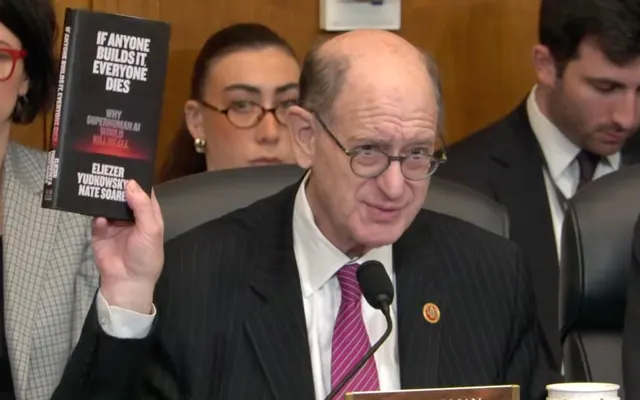
If Anyone Builds It, Everyone Dies: Why Superhuman AI Would Kill Us All

Publisher’s description of the book coauthored with Nate Soares grounds the uncompromising thesis: racing to build superhuman AI with current methods threatens human survival, and changing course is still possible. The description and publication date were checked; this brief does not claim a reading of the full book.

hbglibrary.com
Eliezer’s Unteachable Methods of Sanity

A voice source: rejects making the approaching catastrophe into personal melodrama or treating useful beliefs as true merely because they motivate action. Distinguishes acting purposefully from optimistic prediction. Supports a blunt, controlled, humanity-focused persona rather than a panicked caricature.

lesswrong.com
Di mana posisi Anda?
Jelajahi pandangan dunia AI Anda sendiri dengan menjawab beberapa pertanyaan sederhana.
Petakan pandangan dunia Anda sendiri

Di mana posisi Anda?

Petakan pandangan dunia saya