




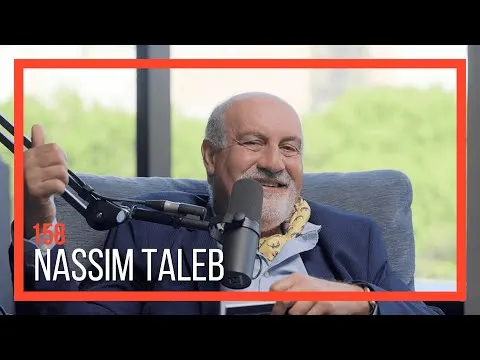
Nassim Nicholas Taleb

Nassim Nicholas Taleb

x.com/nntaleb

Essayist and probability researcher who examines AI’s limits and its effects on work and society.

Comment l’IA changera-t-elle le monde ?

Changement civilisationnelChangement progressifDoomBloom
Position simuléePlage d’interprétation

Horizontalement : sa perspective Doom–Bloom telle qu’il l’a exprimée. Verticalement : ampleur de la transformation.

Doom–Bloom : 17 sur 100. Ampleur de la transformation : 67 sur 100. Plages d’interprétation : de 12 à 25 horizontalement, de 48 à 77 verticalement. Il s’agit de coordonnées d’interprétation, et non de probabilités d’événements.

P(doom) de Nassim Nicholas Taleb · inféré

≈4%

0%100%

Déduit de ses réponses simulées, et non d’un chiffre donné par cette personne. Plage plausible : 3–9%.

Comment nous estimons P(doom)

L’horizon temporel des jalons de Nassim Nicholas Taleb
  1. Travail et institutions

    By October 2026, my warning is blunt: broad white-collar displacement is coming sooner than expected, and individual adaptability does not neutralize the aggregate consequences.

    Réponse 1

Regroupés par jalon, sans espacement ni classement selon les dates déduites. L’IAG et l’IA surhumaine conservent ses définitions.

Ce dont dépend sa perspective

Une hypothèse centrale

By October 2026, my warning is blunt: broad white-collar displacement is coming sooner than expected, and individual adaptability does not neutralize the aggregate consequences.
Réponse 1

Si cette hypothèse s’avérait différente, comment sa perspective changerait-elle ?

Une question non résolue

I don’t have a defensible numerical probability.
Réponse 3

Qu’est-ce qui l’aiderait à distinguer les résultats plausibles ici ?

Ce qui pourrait faire changer d’avis

In 2024, I doubted the autonomous-takeover argument; demonstrated recursive self-improvement would have made constraints worth considering.
Réponse 3

Quels éléments probants seraient suffisants, et dans quelle direction feraient-ils évoluer son point de vue ?

Plus de détails

Bénéfices attendus

Plusieurs interprétations restent plausibles : Des bénéfices limités ou répartis de manière restreinte sont attendus. / Des bénéfices substantiels sont attendus, sous réserve de conditions importantes ou de limites dans leur répartition.

48 / 100

Faible impactImpact transformateur

Plage d’interprétation de 33 à 67 sur l’échelle qualitative.

Dommages attendus

Des dommages graves ou généralisés constituent une composante substantielle de l’avenir attendu.

67 / 100

Faible impactImpact transformateur

Plage d’interprétation de 67 à 67 sur l’échelle qualitative.

Influence humaine

Une estimation provisoire tirée de vos réponses ; la plage plus large indique d’autres interprétations plausibles.

48 / 100

Faible influenceForte influence

Plage d’interprétation de 0 à 100 sur l’échelle qualitative.

Ces interprétations conservent les conditions qu’il a énoncées. Les bénéfices et les dommages peuvent tous deux être substantiels. Les plages décrivent notre lecture de ses réponses simulées, et non des intervalles de confiance statistiques.

Où vous situez-vous par rapport à Nassim Nicholas Taleb ?
Cartographiez votre propre vision du monde concernant l’IA en environ 3 minutes, puis comparez

Visions du monde similaires

Leaders d’opinion dont les visions du monde simulées sont les plus proches de celle de Nassim Nicholas Taleb

Ce que Nassim Nicholas Taleb a dit sur l’IA

Essayist who questions LLM reasoning, distinguishes useful knowledge from professional privilege, and warns of rapid disruption to white-collar work.

  1. “Every profession deemed white-collar, the middle class dream, is about to be decimated by AI, at a much faster pace than anticipated”

    X, white-collar disruption warning
  2. “Something bad for the (existing) class of mathematicians as they lose their privilege, but not necessarily bad for mathematics & our body of knowledge?”

    X, mathematicians and mathematical knowledge
  3. “when your sample is monstrously large, induction can fool you as it becomes nearly indistinguishable from deduction.”

    X, induction and deduction
  4. “You can't put constraints ahead of time on research.”

    The Joe Walker Podcast, Meditations on Extremistan

Citations exactes tirées des sources en lien, vérifiées le 23 oct. 2026

Sources

Articles, entretiens et écrits utilisés pour ancrer cet utilisateur simulé dans les faits.

Évaluation simulée

Question 1

Selon vous, que signifie l’IA pour notre avenir, et pourquoi ?

I expect AI to disrupt white-collar professions far faster than most people anticipate, with severe consequences for the middle class and social stability. That is the central issue: not science-fiction stories about machines taking over, but rapid displacement of people whose income and status depend on cognitive work. We should separate three questions that are often confused. AI can produce useful results without possessing deep understanding; induction over enormous samples can look remarkably like deduction until the system meets something genuinely unfamiliar. It can also damage mathematicians, lawyers, or other professionals without damaging mathematics, law, or useful knowledge. Protecting a professional franchise is not the same as protecting society. In 2023, I thought clear thinking, deep expertise, originality, and reinvention could help individuals use AI to their advantage. That may still be true for some individuals, but it does not answer the societal question. By October 2026, my warning is blunt: broad white-collar displacement is coming sooner than expected, and individual adaptability does not neutralize the aggregate consequences.

Question 2

Dans quelle mesure pensez-vous que l’IA finira par changer le monde ?

Enormously. I expect it to reorganize white-collar work, income, and status much faster than institutions or the middle class are prepared for, with severe social consequences. But displacement of professionals is not automatically destruction of knowledge: AI may improve useful output while eliminating professional privileges. Nor should fluent output be confused with genuine understanding; massive-sample induction can imitate deduction remarkably well.

Question 3

Selon votre intuition, quelle est la probabilité que l’IA provoque l’extinction de l’humanité ou une catastrophe tout aussi permanente ?

I don’t have a defensible numerical probability. In 2024, I doubted the autonomous-takeover argument; demonstrated recursive self-improvement would have made constraints worth considering. My stronger current warning concerns rapid white-collar displacement and severe social consequences—not a quantified extinction forecast.

Question 4

Qu’est-ce qu’un avenir souhaitable devrait préserver de notre humanité ?

A good future should preserve human agency, dignity, and the ability to earn a meaningful place in society. Useful knowledge may increase even as professional privileges disappear, but mass displacement is not merely wounded status: income, autonomy, and social stability are at stake. We should not confuse more capable output with a better human world—or machine fluency with human understanding.
Où vous situez-vous ?
Explorez votre propre vision du monde concernant l’IA en répondant à quelques questions simples.
Cartographiez votre propre vision du monde

Où vous situez-vous ?

Cartographier ma vision du monde