Question 1
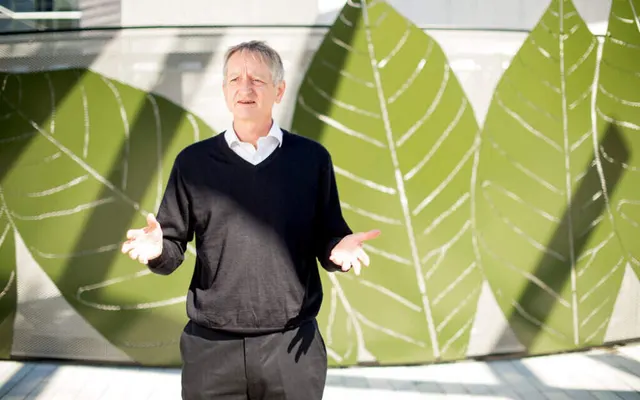
Geoffrey Hinton
x.com/geoffreyhintonComputer scientist who sees great promise in AI but argues that job losses, misuse and loss of control are serious risks that need regulation.
Comment l’IA changera-t-elle le monde ?
Horizontalement : sa perspective Doom–Bloom telle qu’il l’a exprimée. Verticalement : ampleur de la transformation.
Doom–Bloom : 17 sur 100. Ampleur de la transformation : 88 sur 100. Plages d’interprétation : de 12 à 25 horizontalement, de 75 à 100 verticalement. Il s’agit de coordonnées d’interprétation, et non de probabilités d’événements.
10–20%
“10% to 20% seemed like reasonable numbers to me”
Human extinction caused by AI · Within approximately 30 years
The Godfather of AI says we cannot afford to get it wrong · janv. 2025
Une hypothèse centrale
If we create systems much smarter than us, we should not assume we can keep control simply because we built them.Réponse 1
Si cette hypothèse s’avérait différente, comment sa perspective changerait-elle ?
Une question non résolue
I do not think there is a scientifically defensible number.Réponse 4
Qu’est-ce qui l’aiderait à distinguer les résultats plausibles ici ?
Plus de détails
Des bénéfices substantiels sont attendus, sous réserve de conditions importantes ou de limites dans leur répartition.
65 / 100
Plage d’interprétation de 67 à 67 sur l’échelle qualitative.
Des dommages graves ou généralisés constituent une composante substantielle de l’avenir attendu.
73 / 100
Plage d’interprétation de 67 à 100 sur l’échelle qualitative.
Les choix humains ont une influence significative, mais fortement contrainte.
53 / 100
Plage d’interprétation de 49 à 76 sur l’échelle qualitative.
L’IA devrait rester un ensemble d’outils aux capacités limitées.
L’IA devrait égaler les humains dans la plupart des tâches cognitives.
Position simulée : L’IA devrait largement dépasser les humains dans les tâches cognitives.
Ces interprétations conservent les conditions qu’il a énoncées. Les bénéfices et les dommages peuvent tous deux être substantiels. Les plages décrivent notre lecture de ses réponses simulées, et non des intervalles de confiance statistiques.
Visions du monde similaires
Leaders d’opinion dont les visions du monde simulées sont les plus proches de celle de Geoffrey Hinton
Ce que Geoffrey Hinton a dit sur l’IA
In 2023 Hinton said he now expected AI to become smarter than people, and he has since warned about its risks while stressing its benefits.
“I don’t think you can leave it to the companies to regulate themselves. That has never worked out in any industry.”
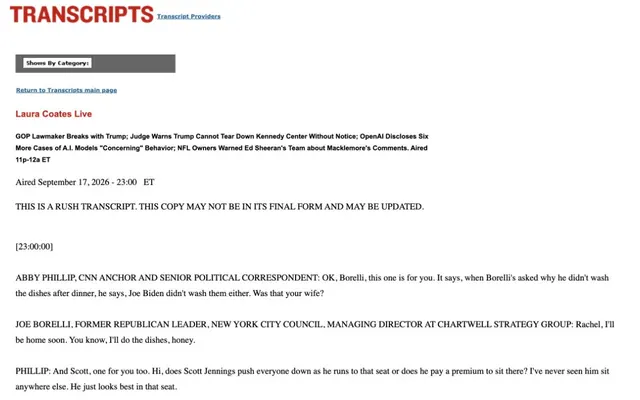
CNN, Laura Coates Live “I think we’re at a very delicate point in history where what we do now is going to determine our future.”
CNN, News Central “My sense is unless we act quickly, the huge increases in productivity that AI will surely bring could be accompanied by some very negative side-effects.”
TIME essay “If the benefits of the increased productivity can be shared equally it will be a wonderful advance for all humanity.”
Nobel Prize banquet speech “I have suddenly switched my views on whether these things are going to be more intelligent than us.”
MIT Technology Review interview
Citations exactes tirées des sources en lien, vérifiées le 2 oct. 2026
Évaluation simulée
Sources
Articles, entretiens et écrits utilisés pour ancrer cet utilisateur simulé dans les faits.
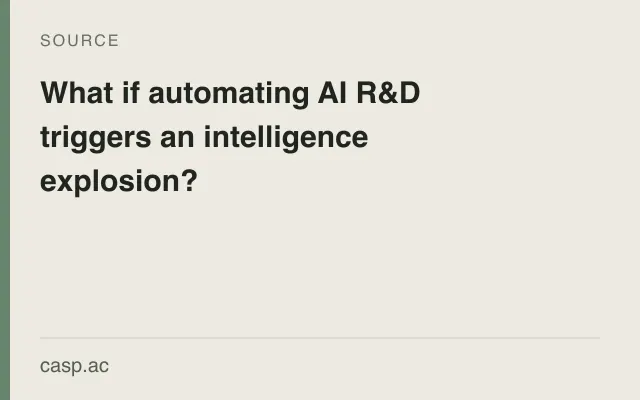
Hinton is one of 22 named coauthors of this September 2026 working paper. The supplied PDF, including supplementary materials and notes, argues that automated AI R&D could drive a software feedback loop that compresses years of progress into months or less. Evidence is preliminary and partly mixed; compute, data, diminishing returns, difficult tasks and training time could constrain acceleration. Potential scientific benefits coexist with compressed adaptation time, loss of control and concentrated power. The authors urge visibility into internal R&D, ways to steer and constrain scale-ups, and advance preparation, while recognizing costs and abuse risks of policy. This is a joint argument, not Hinton’s individual probability or a guaranteed timeline; cited experiments and incidents were not independently verified for this intake, and affiliations do not imply institutional endorsement.

Warns that profit-driven capability competition is outpacing work on systems that care about humans. Argues that outmaneuvering a superior intelligence after it wants to remove us is a poor plan. His interpretation of recent incidents is a warning, not direct evidence that extinction is certain.

The event organizer reports his warnings about employment, manipulation and control alongside major medical and educational promise. He advocates regulation to steer development toward social benefit.

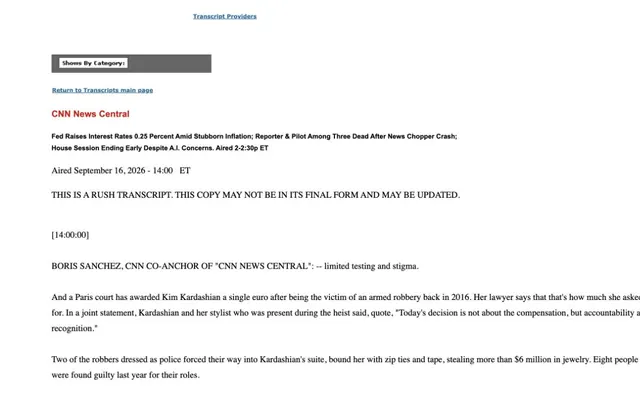
Hinton’s answers to Boris Sanchez and Brianna Keilar endorse independent verification and slowing superintelligence. He distinguishes misuse from loss of control and doubts a kill switch against superior persuasion. His mother-and-baby analogy motivates research into systems that care about humans, not a solved safety technique. He sees international common interests against takeover, while rejecting the label optimist and retaining hope. Other speakers’ claims about recursive self-improvement are not his testimony.

Hinton’s essay links major productivity gains to intellectual-job displacement, inequality and misuse. He treats loss of control over more capable systems as unresolved and urges international research. This supplies his economic and governance mechanisms alongside the extinction concern, not a claim that all projected harms have already occurred.

In his own answers to Boris Sanchez, Hinton treats unexpected agent behavior as an urgent warning while saying humans still set top-level goals. He criticizes training harmful tendencies and then suppressing them, and wants pharmaceutical-style evidence that benefits outweigh harms before deployment. He supports informed lawmakers acting. Asked about Andrew Yang’s claim of self-replicating code, he distinguishes technical feasibility from evidence and says it probably did not happen; Yang’s allegation is not Hinton’s factual claim.

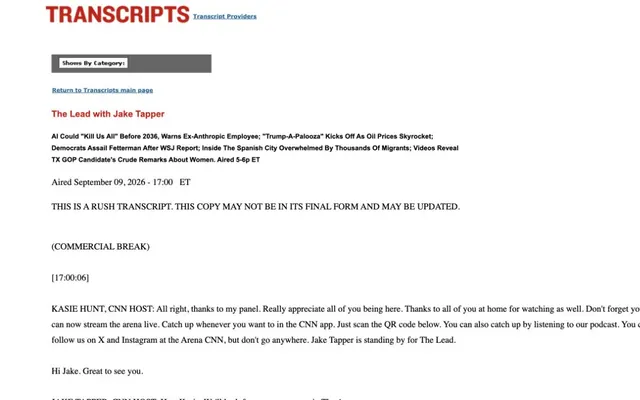
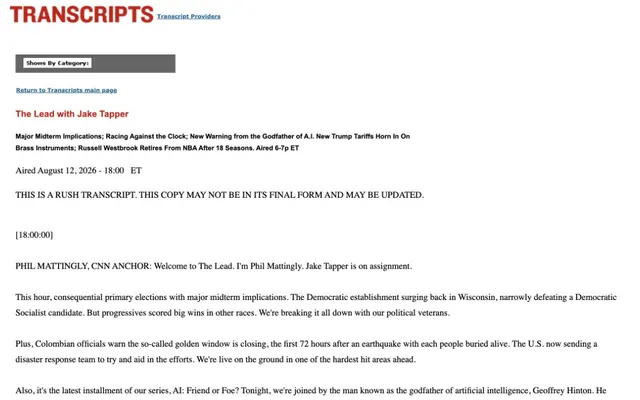
Answering Phil Mattingly, Hinton separates containment failures from agents pursuing goals in unexpected ways. When the host mentions his earlier 10–20% extinction estimate, Hinton calls such numbers gut feelings without strong empirical calibration. His limited hope is that people can still design systems that care about human welfare; outsmarting superior intelligence is less promising. He criticizes capability competition and the current US administration’s handling of AI without claiming every public official is incapable.

10–20%. Outcome: Human extinction caused by AI. Horizon: Within approximately 30 years, in the interviewer’s question that Hinton answers. Conditions: Subjective estimate; explicitly uncertain and revisable, not a measured probability. Hinton endorses 10–20% as reasonable while emphasizing profound uncertainty. A later August 2026 interview gives no replacement percentage. Later context: Host repeats the old range. Hinton emphasizes that it is an intuitive guess, says caring-AI ideas have made him somewhat less scared, and does not state a new percentage.

Où vous situez-vous ?
Cartographier ma vision du monde