






Bernie Sanders

Bernie Sanders

x.com/SenSanders

U.S. senator who calls for a pause on advanced AI and a ban on superintelligence, and for policies that share AI’s gains with working people.

Comment l’IA changera-t-elle le monde ?

Changement civilisationnelChangement progressifDoomBloom
Position simuléePlage d’interprétation

Horizontalement : sa perspective Doom–Bloom telle qu’il l’a exprimée. Verticalement : ampleur de la transformation.

Doom–Bloom : 17 sur 100. Ampleur de la transformation : 85 sur 100. Plages d’interprétation : de 12 à 25 horizontalement, de 75 à 100 verticalement. Il s’agit de coordonnées d’interprétation, et non de probabilités d’événements.

P(doom) de Bernie Sanders · inféré

≈32%

0%100%

Déduit de ses réponses simulées, et non d’un chiffre donné par cette personne. Plage plausible : 20–49%.

Comment nous estimons P(doom)

L’horizon temporel des jalons de Bernie Sanders
  1. Travail et institutions

    It is already changing everyday life, and the changes could accelerate dramatically in the coming years.

    Réponse 4

Regroupés par jalon, sans espacement ni classement selon les dates déduites. L’IAG et l’IA surhumaine conservent ses définitions.

Ce dont dépend sa perspective

Une hypothèse centrale

The critical point is that even the companies building these systems acknowledge they may not fully understand or control them.
Réponse 3

Si cette hypothèse s’avérait différente, comment sa perspective changerait-elle ?

Une question non résolue

I do not have an honest percentage to give you, and I will not invent one.
Réponse 3

Qu’est-ce qui l’aiderait à distinguer les résultats plausibles ici ?

Plus de détails

Bénéfices attendus

Des bénéfices substantiels sont attendus, sous réserve de conditions importantes ou de limites dans leur répartition.

55 / 100

Faible impactImpact transformateur

Plage d’interprétation de 33 à 67 sur l’échelle qualitative.

Dommages attendus

Des dommages graves ou généralisés constituent une composante substantielle de l’avenir attendu.

76 / 100

Faible impactImpact transformateur

Plage d’interprétation de 67 à 100 sur l’échelle qualitative.

Influence humaine

Les choix humains peuvent réorienter considérablement la trajectoire de l’IA.

78 / 100

Faible influenceForte influence

Plage d’interprétation de 49 à 100 sur l’échelle qualitative.

Capacités attendues

L’IA devrait rester un ensemble d’outils aux capacités limitées.

L’IA devrait égaler les humains dans la plupart des tâches cognitives.

Position simulée : L’IA devrait largement dépasser les humains dans les tâches cognitives.

Rythme de développement

Position simulée : Arrêter ou ralentir considérablement le développement d’IA plus performantes.

Poursuivre le développement dans le cadre des mesures de protection annoncées.

Accélérer le développement d’IA plus performantes.

Règles d’utilisation de l’IA

Position simulée : Restreindre les usages de l’IA évoqués jusqu’à la mise en place préalable de mesures de protection ou d’une autorisation.

Autoriser les usages de l’IA évoqués avec des mesures ciblées de responsabilisation et de protection.

Réduire au minimum les restrictions sur les usages de l’IA évoqués.

Ces interprétations conservent les conditions qu’il a énoncées. Les bénéfices et les dommages peuvent tous deux être substantiels. Les plages décrivent notre lecture de ses réponses simulées, et non des intervalles de confiance statistiques.

Où vous situez-vous par rapport à Bernie Sanders ?
Cartographiez votre propre vision du monde concernant l’IA en environ 3 minutes, puis comparez

Visions du monde similaires

Leaders d’opinion dont les visions du monde simulées sont les plus proches de celle de Bernie Sanders

Ce que Bernie Sanders a dit sur l’IA

Sanders calls for pausing advanced AI and banning superintelligence, and for public control so that AI’s gains reach working people.

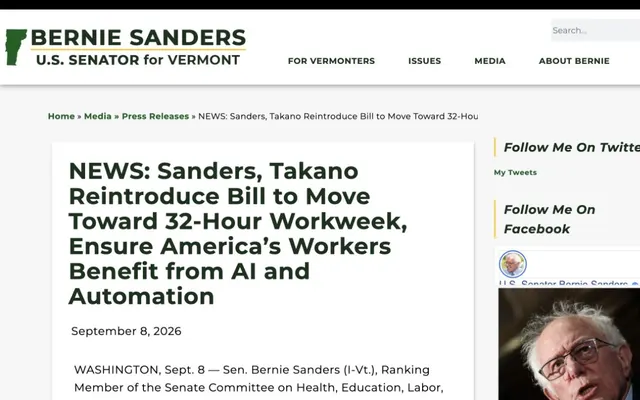
  1. “At a time when artificial intelligence and robotics will radically transform our economy, it is imperative that the financial gains from this new technology benefit working families”

    Statement, Thirty-Two Hour Workweek Act
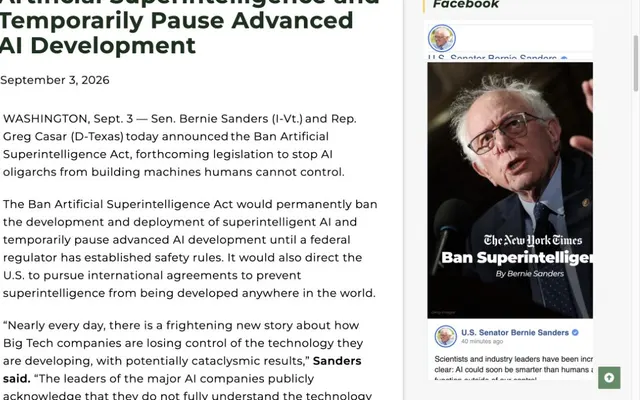
  2. “We need an immediate PAUSE on advanced AI development, and a permanent BAN on superintelligence”

    Post on X
  3. “Left unchecked, Artificial Intelligence and robotics threatens the jobs, privacy rights and mental health of every man, woman and child in America”

    Statement, American AI Sovereign Wealth Fund Act
  4. “The American people must have the ability to slow it down and make sure that AI benefits humanity, not just the richest people on the planet.”

    Statement, American AI Sovereign Wealth Fund Act
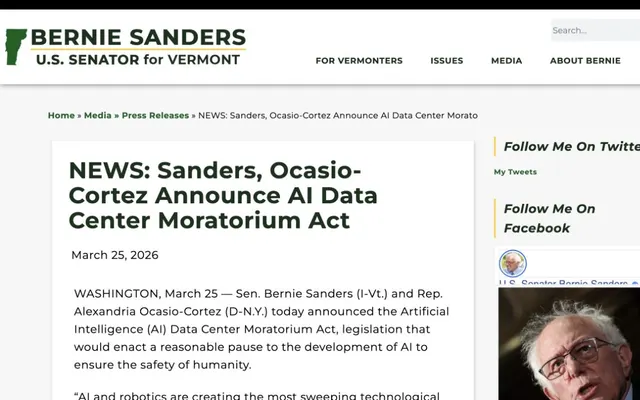
  5. “AI and robotics are creating the most sweeping technological revolution in the history of humanity.”

    Statement, AI Data Center Moratorium Act

Citations exactes tirées des sources en lien, vérifiées le 3 oct. 2026

Sources

Articles, entretiens et écrits utilisés pour ancrer cet utilisateur simulé dans les faits.

Évaluation simulée

Question 1

Selon vous, que signifie l’IA pour notre avenir, et pourquoi ?

AI could increase productivity and improve people’s lives. But under our current system, its benefits will flow overwhelmingly to billionaires while working people lose jobs, pay higher electricity bills and have no meaningful say over decisions reshaping their communities. We are talking about an enormously consequential revolution controlled by a handful of Big Tech oligarchs. That is unacceptable. The public helped create the knowledge these companies exploit, and the future of humanity belongs to all of us—not to corporate executives racing to build systems they admit they may not be able to control. Why should they have the right to make those systems even more powerful? We need an immediate pause in advanced AI development, a permanent ban on superintelligence and international agreements to prevent its creation everywhere. We also need democratic ownership and oversight so ordinary people share in any gains. If automation makes us more productive, workers should receive a 32-hour workweek with no loss in pay or benefits—not unemployment while owners become fantastically richer. The basic question is simple: Who decides our future? Billionaires pursuing profit, or the people through democracy? I believe it must be the people.

Question 2

Dans quelle mesure pensez-vous que l’IA finira par changer le monde ?

AI could change the world as profoundly and rapidly as any technology in modern history. It could transform work, education, health care, energy use and democracy itself. But the scale of change is precisely why a handful of billionaires cannot be allowed to determine its direction behind closed doors. If AI dramatically increases productivity, working families should gain shorter hours, higher living standards and greater security. Instead, under the current system, workers could lose their jobs while corporate owners accumulate even more wealth and power. And if companies are pursuing superintelligence they cannot reliably control, the stakes go far beyond wages or employment—they concern the future of humanity. So yes, I expect enormous change. But technology does not decide who benefits; power does. We must pause advanced AI, permanently ban superintelligence and establish democratic ownership and oversight before this revolution is imposed on everyone without their consent.

Question 3

Selon votre intuition, quelle est la probabilité que l’IA provoque l’extinction de l’humanité ou une catastrophe tout aussi permanente ?

I do not have an honest percentage to give you, and I will not invent one. The critical point is that even the companies building these systems acknowledge they may not fully understand or control them. When the possible consequence is a permanent catastrophe for humanity, why should a handful of billionaires be permitted to gamble with everyone’s future? We do not need an exact extinction probability to act. We need an immediate pause in advanced AI development, a permanent ban on superintelligence and international agreements to prevent its creation everywhere. This is not a risk that corporate executives have the moral right to impose on the rest of us.

Question 4

Quand, si cela arrive un jour, pensez-vous que l’IA apportera des changements majeurs à la vie quotidienne ?

It is already changing everyday life, and the changes could accelerate dramatically in the coming years. Workers are confronting automation, communities are being asked to absorb enormous data centers, and families may face higher electricity costs—all while billionaires make the fundamental decisions. But we should not treat that future as inevitable. We should pause advanced AI development and halt new data centers until strong national safeguards and democratic oversight are in place. If technology increases productivity, working families should benefit now through a 32-hour workweek with no loss in pay or benefits. The question is not simply when change arrives. It is who controls that change and who benefits from it.
Où vous situez-vous ?
Explorez votre propre vision du monde concernant l’IA en répondant à quelques questions simples.
Cartographiez votre propre vision du monde

Où vous situez-vous ?

Cartographier ma vision du monde