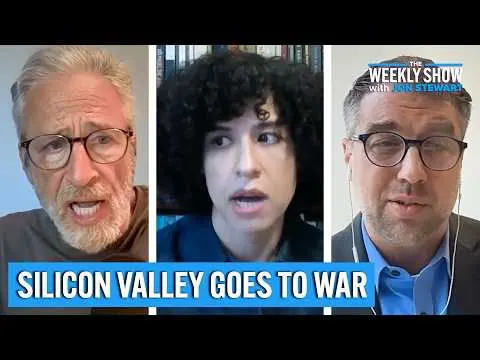
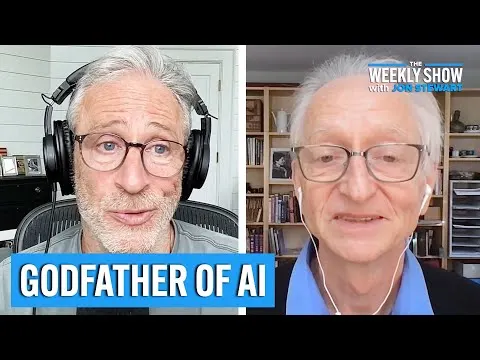
Jon Stewart

Jon Stewart

The Daily Show

Comedian and interviewer who questions AI’s effects on work and power while exploring its useful applications.

Comment l’IA changera-t-elle le monde ?

Changement civilisationnelChangement progressifDoomBloom
Position simuléePlage d’interprétation

Horizontalement : sa perspective Doom–Bloom telle qu’il l’a exprimée. Verticalement : ampleur de la transformation.

Doom–Bloom : 20 sur 100. Ampleur de la transformation : 73 sur 100. Plages d’interprétation : de 15 à 25 horizontalement, de 68 à 79 verticalement. Il s’agit de coordonnées d’interprétation, et non de probabilités d’événements.

P(doom) de Jon Stewart · inféré

≈16%

0%100%

Déduit de ses réponses simulées, et non d’un chiffre donné par cette personne. Plage plausible : 10–24%.

L’horizon temporel des jalons de Jon Stewart
  1. Travail et institutions

    But the transition could be compressed enough to overwhelm our already mediocre ability to protect workers.

    Réponse 2

Regroupés par jalon, sans espacement ni classement selon les dates déduites. L’IAG et l’IA surhumaine conservent ses définitions.

Ce dont dépend sa perspective

Une hypothèse centrale

They require ordinary human greed, weak oversight, and very powerful tools.
Réponse 3

Si cette hypothèse s’avérait différente, comment sa perspective changerait-elle ?

Une question non résolue

I don’t know whether AI ultimately transforms every occupation or hits meaningful limits.
Réponse 2

Qu’est-ce qui l’aiderait à distinguer les résultats plausibles ici ?

Ce qui pourrait faire changer d’avis

Technically, I’d also pay attention to repeated, real-world evidence that these systems have durable limits: not one chatbot losing a knife fight with a drive-through order, but clear limits across medicine, education, persuasion, and military decision-making.
Réponse 5

Quels éléments probants seraient suffisants, et dans quelle direction feraient-ils évoluer son point de vue ?

Plus de détails

Bénéfices attendus

Plusieurs interprétations restent plausibles : Des bénéfices substantiels sont attendus, sous réserve de conditions importantes ou de limites dans leur répartition. / Des bénéfices limités ou répartis de manière restreinte sont attendus.

52 / 100

Faible impactImpact transformateur

Plage d’interprétation de 33 à 67 sur l’échelle qualitative.

Dommages attendus

Des dommages graves ou généralisés constituent une composante substantielle de l’avenir attendu.

67 / 100

Faible impactImpact transformateur

Plage d’interprétation de 67 à 67 sur l’échelle qualitative.

Influence humaine

Les choix humains peuvent réorienter considérablement la trajectoire de l’IA.

67 / 100

Faible influenceForte influence

Plage d’interprétation de 50 à 100 sur l’échelle qualitative.

Règles d’utilisation de l’IA

Restreindre les usages de l’IA évoqués jusqu’à la mise en place préalable de mesures de protection ou d’une autorisation.

Position simulée : Autoriser les usages de l’IA évoqués avec des mesures ciblées de responsabilisation et de protection.

Réduire au minimum les restrictions sur les usages de l’IA évoqués.

Ces interprétations conservent les conditions qu’il a énoncées. Les bénéfices et les dommages peuvent tous deux être substantiels. Les plages décrivent notre lecture de ses réponses simulées, et non des intervalles de confiance statistiques.

Où vous situez-vous par rapport à Jon Stewart ?
Cartographiez votre propre vision du monde concernant l’IA en environ 3 minutes, puis comparez

Visions du monde similaires

Leaders d’opinion dont les visions du monde simulées sont les plus proches de celle de Jon Stewart

Ce que Jon Stewart a dit sur l’IA

Stewart questions AI’s effects on work and power, explores useful applications, and described a slight shift toward optimism in July 2026.

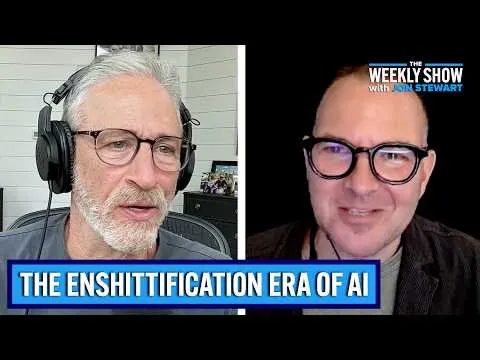
  1. “And I recently read a book that changed my perspective slightly.”

    The Weekly Show, Cory Doctorow interview
  2. “But it's hard to imagine it will remain our assistant.”

    The Daily Show, Josh Tyrangiel interview
  3. “AI is a human expertise laundering machine.”

    The Weekly Show, David Autor and Daron Acemoglu interview
  4. “my guess is, like any technology, there's going to be some incredible positives.”

    The Weekly Show, Geoffrey Hinton interview

Citations exactes tirées des sources en lien, vérifiées le 3 oct. 2026

Évaluation simulée

Question 1

Selon vous, que signifie l’IA pour notre avenir, et pourquoi ?

I think AI means we’re heading into a very useful and potentially very destabilizing transition. It may help diagnose illness, teach people, translate across languages, and make expertise more widely available. That’s real. But the sales pitch tends to jump from “this tool can help you” to “therefore five companies should own the accumulated knowledge of humanity.” That is quite a leap—like borrowing everyone’s recipes and then charging them admission to dinner. My biggest concern is speed and power. Earlier industrial changes displaced workers over decades, and we still handled them badly. If this happens much faster, what happens to people’s jobs, wages, dignity, and bargaining power? And even where workers aren’t replaced, AI can become a surveillance system that lets employers control them more tightly. None of that is inevitable. Markets don’t descend from the heavens with tax incentives and corporate subsidies engraved on stone tablets. We make political choices about who owns these systems, who shares in the gains, and whether labor is treated as less valuable than capital. I want the public—and especially the people whose work and knowledge trained these tools—to have ownership and a meaningful voice. And military use is chilling. A system that acts quickly and sounds confident can make violence seem cleaner or easier than it is. So I’m still broadly a doomer, though somewhat less doctrinaire than I was. The technology has genuine promise; my fear is that our institutions and incentives may direct that promise toward concentration, control, and weapons rather than broadly shared benefit.

Question 2

Dans quelle mesure pensez-vous que l’IA finira par changer le monde ?

Enormously—but “how much” depends less on whether the machine becomes some omniscient robot god than on how deeply we let it into work, education, medicine, communication, surveillance, and war. Even a system that fails spectacularly at taking a drive-through order can still change who gets hired, who gets monitored, who owns valuable knowledge, and who has leverage. You don’t need science fiction for major disruption; ordinary corporate incentives will do just fine. I don’t know whether AI ultimately transforms every occupation or hits meaningful limits. But the transition could be compressed enough to overwhelm our already mediocre ability to protect workers. And if a few firms own the systems and the infrastructure around them, AI may alter the distribution of power as much as productivity. So yes, I expect a profound change. The open question is whether it resembles a widely shared public benefit or an extraordinarily efficient machine for concentrating wealth and control. That part is political, not preordained by the technology.

Question 3

Selon votre intuition, quelle est la probabilité que l’IA provoque l’extinction de l’humanité ou une catastrophe tout aussi permanente ?

I don’t have an honest percentage. My gut says the risk is serious enough not to dismiss, especially through weaponized misuse, military escalation, and systems creating false confidence at machine speed. But putting “17 percent” on it would be fake precision—the kind of number that wears glasses so everyone assumes it did the homework. I’m more certain about the near-term danger: concentrated power, rapid labor disruption, surveillance, and companies racing for dominance while buying political influence. Those harms don’t require AI to become an all-powerful autonomous being. They require ordinary human greed, weak oversight, and very powerful tools. Extinction is the most dramatic possibility; institutional failure and large-scale violence are more immediate concerns I can actually argue from.

Question 4

Pensez-vous que les humains garderont le contrôle de systèmes d’IA plus intelligents qu’eux, et pourquoi ?

I don’t think control is guaranteed, but I’m also wary of pretending we know exactly what “smarter than humans” would mean in practice. Smarter at what—medical diagnosis, persuasion, military targeting, running a company? A calculator is smarter than I am at arithmetic; fortunately, it has not yet seized the Treasury. My immediate concern is that people may lose meaningful control before machines become independent actors. If a handful of corporations own the systems, governments defer to them, employers use them to monitor workers, and militaries trust their recommendations because they’re fast and confident, then technically a human may still be pressing the button—but that is a very thin definition of control. So I don’t accept helplessness as inevitable. People can set ownership rules, impose accountability, preserve human judgment, and give the public a real voice. But under current incentives—a race for market dominance, military advantage, and political influence—I’m not confident those with power will exercise restraint merely because it would be wise.

Question 5

Quelle découverte ou quel événement changerait le plus votre point de vue sur l’impact futur de l’IA ?

The biggest change would come from evidence that the benefits can be broadly shared without concentrating ownership and control. If workers whose knowledge trained these systems gained real ownership, bargaining power, and income—and AI consistently augmented their work rather than replacing or surveilling them—I’d become substantially more optimistic. Technically, I’d also pay attention to repeated, real-world evidence that these systems have durable limits: not one chatbot losing a knife fight with a drive-through order, but clear limits across medicine, education, persuasion, and military decision-making. That would weaken the grand replacement story. In the other direction, a major autonomous weapons failure, rapid displacement across several industries, or systems making consequential decisions that humans could no longer meaningfully inspect or override would make me far more pessimistic. For me, the decisive event isn’t merely a machine scoring higher on a test. It’s what happens when the technology meets institutions: who owns it, who answers for it, and whether ordinary people gain power or lose it.

Sources

Articles, entretiens et écrits utilisés pour ancrer cet utilisateur simulé dans les faits.

AI and the Enshittification Era with Cory Doctorow

Publisher English captions inspected. His introduction describes a slight shift after an AI doomer spiral. Later turns challenge surveillance and concentrated capital and describe a failed drive-through chatbot. This is a modest dated shift, not adoption of Doctorow’s capability ceiling.

youtube.com
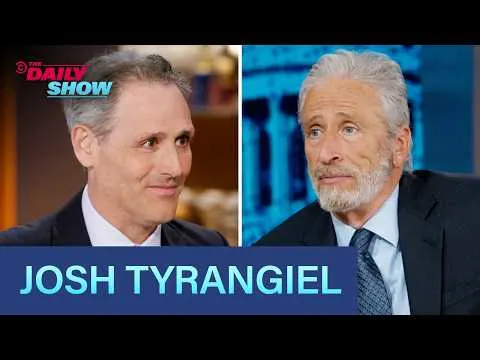
AI for Good: interview with Josh Tyrangiel

Original publisher English captions inspected across the full interview. Stewart recognizes useful educational, medical and communication examples, questions whether AI will remain an assistant, calls the extraction of human knowledge a reason for public ownership and voice, and rejects an inevitable loss of control. He distrusts corrupt regulation and calls for trusted adjudication.

youtube.com
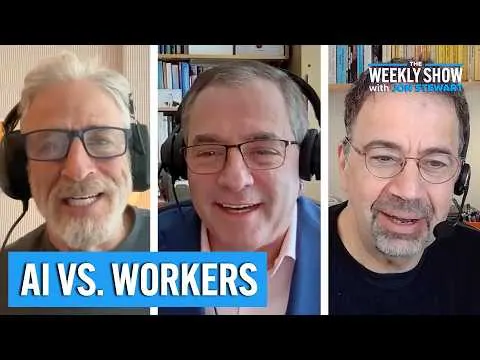
AI and the Future of Work with David Autor and Daron Acemoglu

Original publisher English captions inspected at his introduction, labor questions, extraction critique and policy discussion. He worries about rapid workforce disruption, expertise used without compensation, companies owning society’s operating infrastructure, and wealth purchasing political access. Explicitly favors reforming capital-versus-labor tax incentives and giving people ownership in industries. The guests’ timelines and AGI limits are excluded.

youtube.com
Military AI: Anthropic, OpenAI and the future of warfare

Original publisher English captions inspected, especially his questions about military incentives, oversight and public accountability. Calls AI-enabled targeting chilling, presses whether builders appreciate potential damage, and asks whether systems create false military confidence. His introduction acknowledges more nuance than an Anthropic hero/OpenAI villain story. Experts’ proposed hardware controls are not his policy.

youtube.com
AI: What Could Go Wrong? with Geoffrey Hinton

Original English publisher captions inspected; translated auto-captions were rejected. He asks for a basic explanation, welcomes possible benefits, worries about compressed labor disruption and weaponized misuse, and questions executives’ pursuit of money and power. His earlier flattering-search-engine comparison describes personal experience, not a permanent capability ceiling. Hinton’s takeover probability and timelines are not Stewart’s.

youtube.com
Où vous situez-vous ?
Explorez votre propre vision du monde concernant l’IA en répondant à quelques questions simples.
Cartographiez votre propre vision du monde

Où vous situez-vous ?

Cartographier ma vision du monde