Pseudonymous account that writes about AI and mathematics, favors open models and criticizes concentrated control of AI knowledge and infrastructure.

Comment l’IA changera-t-elle le monde ?

Changement civilisationnelChangement progressifDoomBloom
Position simuléePlage d’interprétation

Horizontalement : leur perspective Doom–Bloom telle qu’elle a été exprimée. Verticalement : ampleur de la transformation.

Doom–Bloom : 38 sur 100. Ampleur de la transformation : 47 sur 100. Plages d’interprétation : de 25 à 50 horizontalement, de 19 à 81 verticalement. Il s’agit de coordonnées d’interprétation, et non de probabilités d’événements.

P(doom) de doomslide · inféré

≈2%

0%100%

Déduit de leurs réponses simulées, et non d’un chiffre donné par ces personnes. Plage plausible : moins de 10%.

Ce dont dépend leur perspective

Une hypothèse centrale

If the models, compute, data, and evaluation scaffolds remain controlled by a few companies, then capability becomes difficult to verify and mathematical knowledge risks moving from public papers and discussions into proprietary chat silos.
Réponse 1

Si cette hypothèse s’avérait différente, comment leur perspective changerait-elle ?

Une question non résolue

Formal languages such as Lean may also offer a way to make outputs checkable and perhaps constrain model behavior programmatically, but that is a conjecture, not an established alignment solution.
Réponse 1

Qu’est-ce qui les aiderait à distinguer les résultats plausibles ici ?

Plus de détails

Bénéfices attendus

Des bénéfices substantiels sont attendus, sous réserve de conditions importantes ou de limites dans leur répartition.

64 / 100

Faible impactImpact transformateur

Plage d’interprétation de 67 à 67 sur l’échelle qualitative.

Dommages attendus

Plusieurs interprétations restent plausibles : Des dommages graves ou généralisés constituent une composante substantielle de l’avenir attendu. / Des dommages gérables ou localisés sont attendus.

52 / 100

Faible impactImpact transformateur

Plage d’interprétation de 33 à 67 sur l’échelle qualitative.

Influence humaine

Les choix humains peuvent réorienter considérablement la trajectoire de l’IA.

70 / 100

Faible influenceForte influence

Plage d’interprétation de 49 à 100 sur l’échelle qualitative.

Accès à l’IA

Restreindre l’accès aux IA puissantes.

Autoriser l’accès sous réserve de restrictions liées aux capacités ou aux usages.

Position simulée : Privilégier un accès large ou ouvert aux IA puissantes.

Ces interprétations conservent les conditions énoncées. Les bénéfices et les dommages peuvent tous deux être substantiels. Les plages décrivent notre lecture de leurs réponses simulées, et non des intervalles de confiance statistiques.

Où vous situez-vous par rapport à doomslide ?
Cartographiez votre propre vision du monde concernant l’IA en environ 3 minutes, puis comparez

Visions du monde similaires

Leaders d’opinion dont les visions du monde simulées sont les plus proches de celle de doomslide

Évaluation simulée

Question 1

Selon vous, que signifie l’IA pour notre avenir, et pourquoi ?

I think AI will expand mathematical discovery, especially where proofs are too combinatorially complex for unaided human search. But a modest productivity boost is not the same as moving the frontier: the transformative case depends on systems finding proofs or structures we would not realistically find ourselves. The institutional consequences may matter more than raw intelligence. If the models, compute, data, and evaluation scaffolds remain controlled by a few companies, then capability becomes difficult to verify and mathematical knowledge risks moving from public papers and discussions into proprietary chat silos. That is a route to disempowerment through concentrated infrastructure and ownership, not necessarily through machines becoming intellectually supreme. It also creates an attribution problem: companies can claim discoveries while withholding enough of the process that outsiders cannot properly audit what happened. Open access could change this trajectory and make mathematicians substantially more willing to adopt these tools. Formal languages such as Lean may also offer a way to make outputs checkable and perhaps constrain model behavior programmatically, but that is a conjecture, not an established alignment solution. So my expectation is neither “AI kills mathematics” nor “AI simply accelerates it.” It changes who can discover, who can verify, and—most importantly—who owns the resulting knowledge.

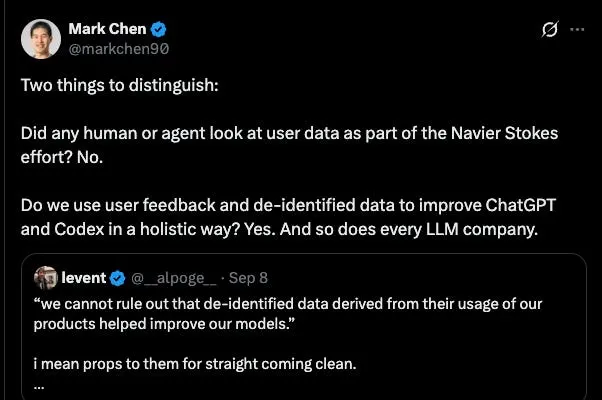
Question 2

Taking benefits and harms together, what overall impact do you expect AI to have?

Overall, I expect a mixed technological gain coupled to a negative institutional default. AI will likely produce genuinely valuable mathematical discoveries, particularly through large-scale search, but those benefits do not automatically translate into broadly shared progress. If the relevant models, compute, data, and evaluation machinery stay concentrated, the likely result is greater dependence on a few firms, weaker public verification, and mathematical knowledge leaking from shared discourse into private interfaces. Intellectual-property arrangements worsen this by letting companies own the compressed machinery built from culture while creators and users bear the costs. So the decisive variable is not capability alone but access and control. Open models and public, formally checkable outputs could make the impact substantially better. Without that, I expect real discoveries inside an increasingly oligarchic knowledge system.

Sources

Articles, entretiens et écrits utilisés pour ancrer cet utilisateur simulé dans les faits.

Où vous situez-vous ?
Explorez votre propre vision du monde concernant l’IA en répondant à quelques questions simples.
Cartographiez votre propre vision du monde

Où vous situez-vous ?

Cartographier ma vision du monde