Will Brown

Will Brown

x.com/willcb

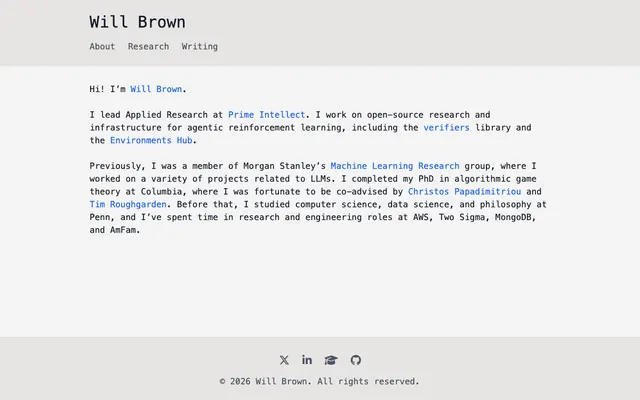
AI researcher who builds open reinforcement-learning environments and evaluation tools for agents and favors open, widely distributed AI development.

AI将如何改变世界?

文明层面的变革渐进式变化DoomBloom
模拟位置解读范围

横向:他们表达的 Doom–Bloom 前景看法。 纵向:变革程度。

Doom–Bloom:100 中的 60。变革程度:100 中的 52。解读范围:横向为 50 至 75,纵向为 18 至 100。这些是解读坐标,而不是事件概率。

Will Brown的 P(doom) · 推断

≈8%

0%100%

根据他们的模拟回答推断,并非他们给出的数字。 合理范围:1–40%。

他们的展望取决于什么

一个核心假设

That path concentrates capital, capability, and control, while giving institutions incentives to move faster than their evaluation and governance can support.
回答 2

如果这个假设实际并非如此,他们的展望会如何变化?

一个尚未解决的问题

My technical work gives me concrete reasons to expect useful improvement, but it does not establish a confident net forecast across every social, political, or existential consequence.
回答 2

什么能帮助他们区分这里各种合理的结果?

更多详情

预期益处

预计将带来显著益处,但受到重要条件或分配方面的限制。

67 / 100

影响小变革性影响

在定性尺度上,解读范围为 67 到 67。

预期危害

仍有几种解读是合理的:预计会出现可控或局部的危害。 / 严重或广泛的危害预计将是未来不可忽视的一部分。

46 / 100

影响小变革性影响

在定性尺度上,解读范围为 33 到 67。

人类影响力

人类的选择可以大幅改变AI的发展轨迹。

66 / 100

影响力小影响力强

在定性尺度上,解读范围为 50 到 75。

发展速度

停止或大幅放缓开发能力更强的AI。

模拟位置:在落实所述保障措施的前提下继续开发。

加快开发能力更强的AI。

这些解读保留了他们陈述的条件。益处和危害都可能很大。这些范围描述的是我们如何解读他们的模拟回答,而不是统计置信区间。

与Will Brown相比,你的立场在哪里?
用大约3分钟描绘你自己的AI世界观,然后进行比较

相似的世界观

模拟世界观与 Will Brown 最接近的意见领袖

模拟评估

问题 1

你认为AI对我们的未来意味着什么?为什么?

I expect AI progress to be broad and increasingly agentic, with many labs pursuing more capable systems rather than one uniquely destined winner. The practical driver is a growing feedback loop: better learning environments, evaluations, model-based judges, and review pipelines let models improve on tasks that cannot always be checked with a simple deterministic verifier. Models may even help repair flawed training data when embedded in careful orchestration and review. But the shape of progress matters as much as raw capability. My preferred future is slower and more diffuse: open, distillable models and specialized systems that let many people build, inspect, and adapt useful agents. A race for overwhelming geopolitical advantage could instead concentrate capital and decision-making in a few organizations, producing a darker and less safe outcome. So I do not think technical progress alone settles the future. Concrete institutional choices matter. If a lab promises to pace itself relative to the frontier, I want to know what operationally changes beyond existing pre-release evaluation: who evaluates, what triggers restraint, and how commitments alter deployment. My work suggests practical ways to improve agents and measure them; it does not, by itself, resolve broader policy or extinction-risk questions.

问题 2

Taking benefits and harms together, what overall impact do you expect AI to have?

My expectation is conditional on how progress is organized. Diffuse, relatively slow development around open, distillable models and specialized systems could have a strongly positive impact: useful agents would become broadly accessible, evaluations could improve on real-world tasks, and models could support increasingly capable feedback and data-repair loops. But I am less optimistic about a race dominated by a few frontier labs seeking decisive economic or geopolitical advantage. That path concentrates capital, capability, and control, while giving institutions incentives to move faster than their evaluation and governance can support. Many labs are likely to pursue increasingly powerful systems, so concentration does not necessarily produce orderly coordination; it may simply intensify the race. I therefore expect substantial benefits, but not an automatically positive overall outcome. The distribution and pace of progress are central. I prefer the future where capability spreads through open infrastructure and specialized systems, rather than one where a handful of actors compete to control increasingly general intelligence. My technical work gives me concrete reasons to expect useful improvement, but it does not establish a confident net forecast across every social, political, or existential consequence.

来源

用于为此模拟用户提供事实依据的文章、访谈和著述。

你的立场在哪里?
回答几个简单问题,探索你自己的AI世界观。
描绘你自己的世界观

你的立场在哪里?

描绘我的世界观