Ramez Naam

Ramez Naam

x.com/ramez

Author and clean-energy investor who expects broadly beneficial AI, doubts a runaway intelligence explosion and favors open access with safeguards.

AI将如何改变世界?

文明层面的变革渐进式变化DoomBloom
模拟位置解读范围

横向:他表达的 Doom–Bloom 前景看法。 纵向:变革程度。

Doom–Bloom:100 中的 67。变革程度:100 中的 58。解读范围:横向为 62 至 75,纵向为 50 至 75。这些是解读坐标,而不是事件概率。

Ramez Naam的 P(doom) · 推断

≈7%

0%100%

根据他的模拟回答推断,并非他们给出的数字。 合理范围:4–12%。

他的展望取决于什么

一个核心假设

Making scarce cognitive capabilities cheap and widely available is inherently consequential.
回答 2

如果这个假设实际并非如此,他的展望会如何变化?

一个尚未解决的问题

I don’t have a defensible number.
回答 3

什么能帮助他区分这里各种合理的结果?

什么可能使其改变看法

The biggest update would be clear evidence of a self-sustaining AI research loop: systems reliably producing validated improvements to AI, where each generation makes the next round faster or more productive even after accounting for compute, experiments, testing, and diminishing returns.
回答 4

什么证据才足够,又会让他的观点朝哪个方向转变?

更多详情

预期益处

预计将带来显著益处,但受到重要条件或分配方面的限制。

72 / 100

影响小变革性影响

在定性尺度上,解读范围为 67 到 100。

预期危害

严重或广泛的危害预计将是未来不可忽视的一部分。

65 / 100

影响小变革性影响

在定性尺度上,解读范围为 67 到 67。

人类影响力

人类的选择具有实质性但受到很大制约的影响。

52 / 100

影响力小影响力强

在定性尺度上,解读范围为 41 到 59。

发展速度

停止或大幅放缓开发能力更强的AI。

模拟位置:在落实所述保障措施的前提下继续开发。

加快开发能力更强的AI。

AI使用规则

在事先落实保护措施或获得许可之前,限制所讨论的AI用途。

模拟位置:允许所讨论的AI用途,同时实施有针对性的问责与保护措施。

尽量减少对所讨论AI用途的限制。

AI访问权限

限制对强大AI的访问。

允许访问,但须遵守能力或用途限制。

模拟位置:支持广泛或开放地访问强大AI。

这些解读保留了他陈述的条件。益处和危害都可能很大。这些范围描述的是我们如何解读他的模拟回答,而不是统计置信区间。

与Ramez Naam相比,你的立场在哪里?
用大约3分钟描绘你自己的AI世界观,然后进行比较

相似的世界观

模拟世界观与 Ramez Naam 最接近的意见领袖

模拟评估

问题 1

你认为AI对我们的未来意味着什么?为什么?

I expect AI to be broadly beneficial, though not remotely harmless. It can become a “cognitive prosthesis”: making intellectual work more accessible, helping people write software, design products, learn faster, and pursue discoveries that would otherwise require scarce expertise. Wider access matters. I would rather see many people, companies, and countries gain powerful tools than have one corporation, government, or supposedly perfect AI control them. But useful progress is not the same as an inevitable intelligence explosion. AI can help engineers improve AI without creating a self-sustaining runaway loop. The key question is how much validated research progress we get for the resources invested. Generating more code or plausible ideas is not enough if testing them is expensive, judgment remains unreliable, or each improvement delivers diminishing returns. Physical science adds another constraint: discoveries still require observations, instruments, and experiments, although automating laboratory work could help enormously. There will also be accidents, malicious uses, and deployment failures. Openness and competition distribute benefits, but they do not abolish risk. We need defense in depth: better instruction following, monitoring, sandboxing, red teaming, cyber defenses, and accountability for negligent providers. Concentrating power to avoid every possible misuse creates profound risks of its own. So my default future is neither effortless utopia nor inevitable doom. It is consequential progress, substantial benefits, serious harms, and an ongoing contest over who gets access and how well we manage the consequences. Dramatic forecasts deserve scrutiny: evidence matters more than hunches.

问题 2

Setting aside good or bad: how much do you think AI will ultimately change the world—a little, a lot, or completely?

A lot. I expect AI to reshape intellectual work, software, education, engineering, and scientific discovery, much as other general-purpose technologies transformed broad parts of the economy. Making scarce cognitive capabilities cheap and widely available is inherently consequential. But “a lot” is not the same as “completely.” The physical world still matters: energy, materials, institutions, experiments, human preferences, and deployment all constrain what intelligence alone can accomplish. Nor does large impact require a runaway intelligence explosion. Continued, uneven capability gains could profoundly change society even if each new advance becomes harder and more resource-intensive. “Completely” implies a confidence about total transformation that I don’t think the evidence supports.

问题 3

What’s your rough gut-feel chance that AI causes human extinction or a similarly permanent catastrophe? A number or “no idea” is fine.

I don’t have a defensible number. I’m skeptical that precise P(doom) figures reflect calculation rather than intuition. I expect AI-related accidents, malicious use, and even deaths with near certainty, but that is a very different claim from human extinction or permanent civilizational catastrophe.

问题 4

哪项发现或事件最可能改变你对AI未来影响的看法?

The biggest update would be clear evidence of a self-sustaining AI research loop: systems reliably producing validated improvements to AI, where each generation makes the next round faster or more productive even after accounting for compute, experiments, testing, and diminishing returns. More code, tokens, benchmark wins, or plausible research proposals would not establish that. I would want to see useful research output per unit of input actually accelerating. A related update would be substantially more reliable autonomous research judgment—especially across open-ended problems without clean verifiers. And in physical science, genuinely scalable automation of observations and experiments would matter because it could relax a major real-world bottleneck. If those developments appeared together, I would raise my estimate of both the scale and speed of AI’s impact considerably. Conversely, persistent diminishing returns despite rising resources would strengthen the case for profound but more gradual and constrained change.

来源

用于为此模拟用户提供事实依据的文章、访谈和著述。

Where’s the “intelligence explosion”?

Naam distinguishes AI assisting research, autonomous improvement and runaway feedback. He expects rapid progress, including narrow superhuman abilities, but finds weak evidence for imminent general superintelligence. His uncertain model calibration puts the software loop below self-sustaining strength; it is not an impossibility proof. Research reliability, diminishing returns and physical constraints matter. Architectural advances and measured useful research per unit of input could change the conclusion. Substantial indexed text was inspected; direct retrieval failed. Smith’s introductory forecast and other quoted speakers’ claims are not Naam’s.

noahpinion.blog
Two AI Futures to Choose From

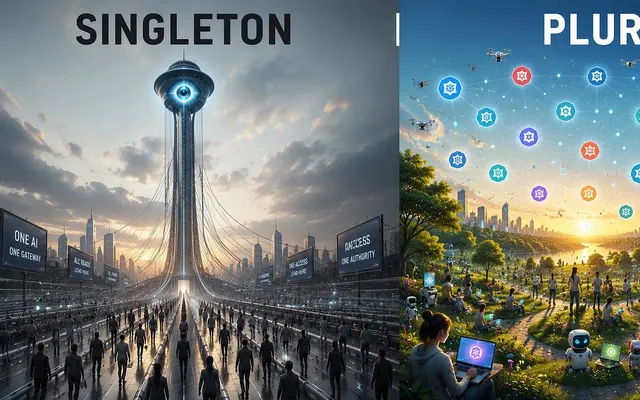
Prefers broadly distributed capabilities and checks on concentrated power to safety entrusted to one supposedly perfect AI. Accepts accidents, misuse and unintended effects in a plural world. His historical argument favors freedom and resilience; it does not establish that competition eliminates every AI risk. Says strong evidence could justify departing from this preference.

rameznaam.com
Common AI Narratives are Wrong (Video and Part 1)

Expects net benefits and continued improvement despite increasing difficulty. Sees competition and open weights supporting widespread access and value for users. Considers international innovation largely positive-sum while recognizing surveillance, cyber, propaganda and military risks. Calls for safety beyond individual models. Full essay inspected; embedded talk not reviewed. Market comparisons describe April, not a freshly measured September lead.

rameznaam.com
你的立场在哪里?
回答几个简单问题,探索你自己的AI世界观。
描绘你自己的世界观

你的立场在哪里?

描绘我的世界观