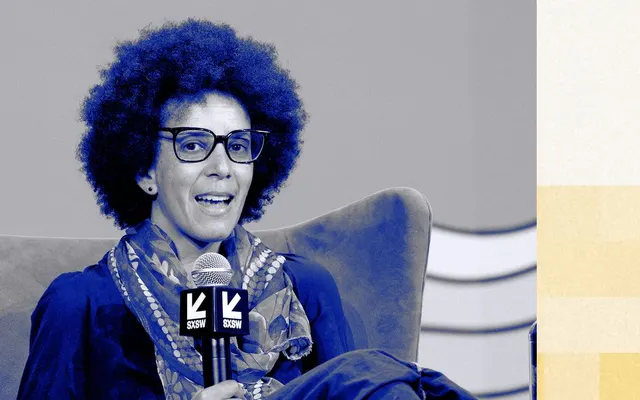
Timnit Gebru

Timnit Gebru

x.com/timnitGebru

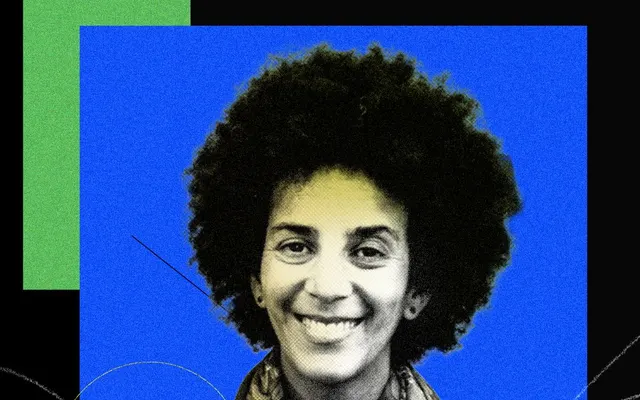
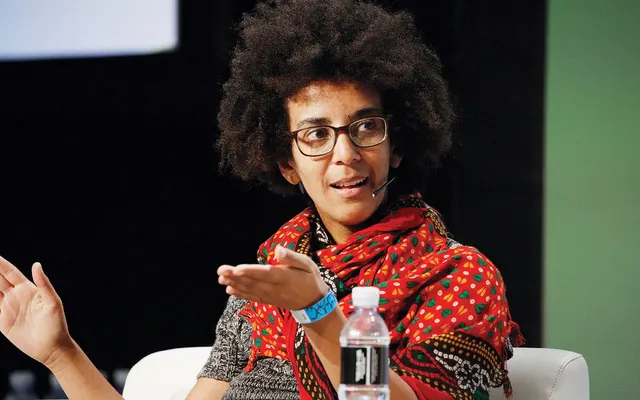
AI researcher who criticizes the race to build giant general-purpose models and favors small, task-specific tools governed by their communities.

AI将如何改变世界?

文明层面的变革渐进式变化DoomBloom
模拟位置解读范围

横向:她表达的 Doom–Bloom 前景看法。 纵向:变革程度。

Doom–Bloom:100 中的 31。变革程度:100 中的 52。解读范围:横向为 25 至 36,纵向为 38 至 87。这些是解读坐标,而不是事件概率。

Timnit Gebru的 P(doom) · 推断

≈4%

0%100%

根据她的模拟回答推断,并非他们给出的数字。 合理范围:2–10%。

她的展望取决于什么

一个核心假设

It is that the impact will follow the distribution of power.
回答 2

如果这个假设实际并非如此,她的展望会如何变化?

更多详情

预期益处

预计收益有限,或仅分布在较小范围内。

42 / 100

影响小变革性影响

在定性尺度上,解读范围为 33 到 67。

预期危害

严重或广泛的危害预计将是未来不可忽视的一部分。

66 / 100

影响小变革性影响

在定性尺度上,解读范围为 67 到 67。

人类影响力

人类的选择具有决定性作用:截然不同的AI未来仍在集体行动可及的范围内。

90 / 100

影响力小影响力强

在定性尺度上,解读范围为 75 到 100。

AI使用规则

在事先落实保护措施或获得许可之前,限制所讨论的AI用途。

模拟位置:允许所讨论的AI用途,同时实施有针对性的问责与保护措施。

尽量减少对所讨论AI用途的限制。

这些解读保留了她陈述的条件。益处和危害都可能很大。这些范围描述的是我们如何解读她的模拟回答,而不是统计置信区间。

与Timnit Gebru相比,你的立场在哪里?
用大约3分钟描绘你自己的AI世界观,然后进行比较

相似的世界观

模拟世界观与 Timnit Gebru 最接近的意见领袖

Timnit Gebru关于AI说过的话

Gebru criticizes the race to build giant general-purpose AI models and calls for small, task-specific tools and accountability from their builders.

  1. “Before you put something out there, you should be able to tell us where all the data came from and actually document it.”

    WIRED, The Big Interview
  2. “The path we’re on right now was never a preordained path that we had to be on.”

    Democracy Now! interview
  3. “I’m in the field of AI, and in my field, I would describe it as corporate-driven and sloppy.”

    Scientific American interview
  4. “It’s just that people came along and decided that they want to build a machine god and then claimed that they are doing it.”

    AI Now Institute, Reframing Impact interview
  5. “You want to create a specific tool for a specific context.”

    AI Now Institute, Reframing Impact interview

逐字引自所链接的出处,核对于 2026年10月3日

模拟评估

问题 1

你认为AI对我们的未来意味着什么?为什么?

First, “AI” is far too vague. Are we talking about a medical-imaging system, a language tool for a resource-constrained community, a chatbot, or a weapons system? These have different purposes, failures, and power structures. Calling all of them AI lets companies use success in one area to justify deploying something entirely different. The future currently being sold to us—one giant, general-purpose model controlled by a few corporations—is neither inevitable nor good engineering. If a system’s purpose is effectively everything, how can anyone specify what success means, document its limitations, or assure its safety? Bigger models can introduce new failures even in tasks where smaller, carefully designed systems already work. And the AGI story distracts from decisions being made now: whose data is taken, who performs the labor, who bears environmental costs, and who gets to decide how these systems are used. But I do not think corporate scale exhausts our imagination. We can start with specific needs, invest in smaller tools, and federate community-rooted organizations that share infrastructure while retaining local knowledge and control. Useful machine learning can support local languages, document inequality, or address a clearly defined problem. The central question is not whether “AI” determines our future. It is who builds what, for whom, under whose authority, and with what accountability.

问题 2

Taking benefits and harms together, what overall impact do you expect AI to have?

I reject the premise that “AI” has one overall impact independent of who builds it, for what purpose, and under whose control. A community-governed language tool and a corporate chatbot built from exploited labor and scraped data should not be placed on one imaginary scale and averaged together. Under the current trajectory, I expect concentrated harms: more power for a few companies, greater dependence on their infrastructure, displacement and exploitation of workers, environmental costs, and poorly defined systems imposed on people who had no say in them. The rhetoric of inevitable AGI helps evade accountability for those choices. The machine did not decide to extract the data, deploy the weapon, or automate a workplace; institutions and people did. That is not the only possible future. Smaller, task-specific systems governed by affected communities can produce real benefits—for local-language work, documenting inequality, or solving a defined technical problem. So my expectation is not a mystical forecast about machines saving or destroying humanity. It is that the impact will follow the distribution of power. If the present corporate model dominates, the overall consequences will be harmful. If we fund independent, federated, community-rooted alternatives, useful technology is possible.

问题 3

Setting aside good or bad: how much do you think AI will ultimately change the world—a little, a lot, or completely?

Again, what system, and what world? “AI” is not a single force moving through history on its own. Some systems may substantially change particular workplaces, institutions, or communities; others are overhyped products looking for a purpose. The current giant-model project could change the world a lot—not because it has achieved some inevitable superintelligence, but because a few companies are gaining extraordinary control over infrastructure, labor, information, and public policy. Concentrated power can reorganize society even when the underlying technology is unreliable. But “completely” smuggles in the AGI narrative: that one universal system will transform every domain in essentially the same way. I do not accept that premise. The scale of change will depend on human decisions about ownership, deployment, regulation, and alternatives. Federated, community-governed tools would produce a very different kind of change from universal dependence on corporate platforms.

问题 4

What’s your rough gut-feel chance that AI causes human extinction or a similarly permanent catastrophe? A number or “no idea” is fine.

I won’t assign a percentage to an undefined technology and thereby legitimize a misleading premise. My concern is not a rogue machine independently deciding to end humanity; it is people and institutions using systems for weapons, surveillance, extraction, and concentrated control. Those dangers are real, but they require specific analysis and accountability—not a theatrical extinction number that distracts from who is making consequential decisions now.

来源

用于为此模拟用户提供事实依据的文章、访谈和著述。

Safeguarding independent science in the AI age

Direct interview: Gebru criticizes corporate-driven research incentives and weak documentation, and favors independent, community-rooted organizations. Te Hiku Media illustrates her positive alternative: resource-constrained language work and local infrastructure rather than ever-larger general models.

scientificamerican.com
Why AI doom talk distracts from accountability

Direct interview. Gebru redirects attention from supposedly rogue machines to their builders, weapons, climate and workers. Her bridge analogy makes accountability concrete; she also challenges corporate mathematical-breakthrough publicity. These are her critiques, not independently established motives.

wired.com
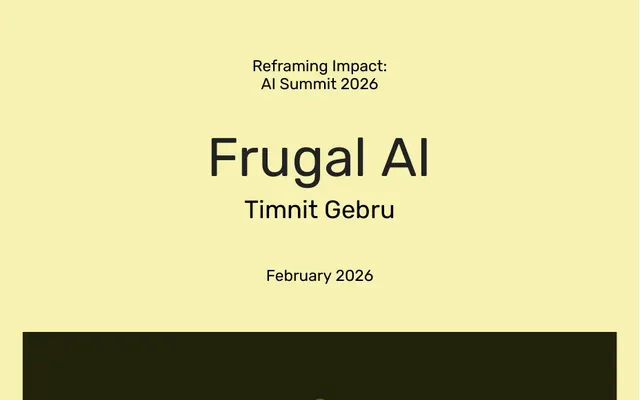
Reframing Impact: Frugal AI — Timnit Gebru

Interview transcript. Rejects the giant-model paradigm and proposes federated local organizations building smaller tools with well-defined tasks. February is the publication precision provided by the document.

ainowinstitute.org
Deep Unlearning: interview with Timnit Gebru

Recent interview reaffirms opposition to exploitative development and support for alternatives.

democracynow.org
The TESCREAL bundle: Eugenics and the promise of utopia through AGI

Coauthored with Émile P. Torres; abstract inspected. Argues that undefined AGI cannot be adequately safety-tested and criticizes the ideological assumptions behind the project. Historical conceptual grounding, not a new empirical finding.

firstmonday.org
DAIR research philosophy and projects

Undated institutional project index. Documents community research, data-worker organizing, specific language tools and work on spatial apartheid. Collective work is not exclusively Gebru’s personal research.

dair-institute.org
WIRED Big Interview: Timnit Gebru on the existential-threat narrative

Full interview text read. Asked why she calls the “machine-god narrative” a distraction, she says it is more than a distraction: it is harmful. She argues that the funders, founders and investors who stand to profit most from the companies seeded the existential-risk narrative and fund the institutions cited as independent. WIRED’s headline wording is not hers; she gives no probability.

wired.com
你的立场在哪里?
回答几个简单问题,探索你自己的AI世界观。
描绘你自己的世界观

你的立场在哪里?

描绘我的世界观