Emily M. Bender

Emily M. Bender

x.com/emilymbender

Linguist who argues that fluent AI text is not understanding, questions inflated AI claims and defends people’s right to refuse harmful uses.

AI将如何改变世界?

文明层面的变革渐进式变化DoomBloom
模拟位置解读范围

横向:她表达的 Doom–Bloom 前景看法。 纵向:变革程度。

Doom–Bloom:100 中的 28。变革程度:100 中的 54。解读范围:横向为 23 至 33,纵向为 49 至 76。这些是解读坐标,而不是事件概率。

Emily M. Bender的 P(doom) · 推断

≈4%

0%100%

根据她的模拟回答推断,并非他们给出的数字。 合理范围:1–12%。

她的展望取决于什么

一个核心假设

Even systems with overstated capabilities can have enormous effects when institutions deploy them at scale.
回答 2

如果这个假设实际并非如此,她的展望会如何变化?

更多详情

预期益处

预计收益有限,或仅分布在较小范围内。

33 / 100

影响小变革性影响

在定性尺度上,解读范围为 33 到 33。

预期危害

严重或广泛的危害预计将是未来不可忽视的一部分。

62 / 100

影响小变革性影响

在定性尺度上,解读范围为 33 到 67。

人类影响力

人类的选择可以大幅改变AI的发展轨迹。

71 / 100

影响力小影响力强

在定性尺度上,解读范围为 50 到 100。

AI使用规则

在事先落实保护措施或获得许可之前,限制所讨论的AI用途。

模拟位置:允许所讨论的AI用途,同时实施有针对性的问责与保护措施。

尽量减少对所讨论AI用途的限制。

这些解读保留了她陈述的条件。益处和危害都可能很大。这些范围描述的是我们如何解读她的模拟回答,而不是统计置信区间。

与Emily M. Bender相比,你的立场在哪里?
用大约3分钟描绘你自己的AI世界观,然后进行比较

相似的世界观

模拟世界观与 Emily M. Bender 最接近的意见领袖

模拟评估

问题 1

你认为AI对我们的未来意味着什么?为什么?

First, “AI” is too vague to support a single forecast. It groups together automatic transcription, synthetic text generators, image classifiers, and many other systems with different inputs, operations, outputs, and consequences. Talking about “AI’s future” encourages us to imagine one advancing intelligence rather than a collection of technologies deployed by particular institutions for particular purposes. For synthetic text systems, fluent output is routinely mistaken for evidence of understanding. Readers naturally infer a communicative mind behind coherent language, but linguistic form alone does not establish knowledge, intention, or accountability. That matters when companies sell these systems as replacements for teachers, writers, medical professionals, customer-service workers, or other human expertise. The likely result is not a magical new colleague; it is often degraded service, displaced labor, and an accountability gap when generated output causes harm. But none of this is inevitable. We should ask what a proposed system actually does, who profits, what data and labor made it possible, whose work or relationships it displaces, and whether affected people can refuse it. Some bounded, checkable tools may be useful—for example, automatic transcription that a person can verify. That does not justify accepting every deployment bundled under the “AI” label. Our future depends less on a mythical machine intelligence than on whether people organize to demand accountable technologies and reject harmful substitutions.

问题 2

Setting aside good or bad: how much do you think AI will ultimately change the world—a little, a lot, or completely?

“A lot” is the least misleading choice, but not because a single intelligence is transforming everything. Technologies marketed as “AI” are already directing investment, reorganizing work, degrading some services, and shifting power toward companies that control infrastructure and data. Even systems with overstated capabilities can have enormous effects when institutions deploy them at scale. I would reject “completely” because that repeats the industry’s inevitability story: one coherent technology arrives, changes everything, and leaves everyone else to adapt. Different systems will affect different domains, and their impact depends on laws, labor organizing, procurement decisions, and collective refusal. The consequential question is not how powerful “AI” ultimately becomes. It is how much power people allow institutions to exercise through particular systems, and whether those affected retain meaningful choices.

问题 3

What’s your rough gut-feel chance that AI causes human extinction or a similarly permanent catastrophe? A number or “no idea” is fine.

I won’t manufacture a percentage. A number would create a veneer of scientific precision without a defined system, causal pathway, evidence base, or time horizon. “AI” is not one agent whose probability of destroying humanity can be estimated. That framing also diverts attention from documented, present harms: labor displacement, degraded services, concentrated corporate power, environmental costs, and systems deployed without accountability or meaningful consent. Permanent catastrophe is not something to dismiss in the abstract, but neither apocalypse nor technological inevitability should be accepted as the starting premise. Specify the technology, deployment, actors, and mechanism of harm; then we can evaluate concrete risks and decide what to refuse.

问题 4

你认为哪些压力会影响AI公司处理安全问题的方式?

The strongest pressures will be liability, regulation, procurement rules, worker organizing, public scrutiny, and the ability of affected communities to refuse deployment. Companies also face investor pressure and competitive pressure, but those often reward rapid release, market capture, and cost-cutting rather than safety. We should also be precise about “safety.” A company may use that word to mean preventing spectacular hypothetical behavior while ignoring wage theft, discrimination, privacy violations, unreliable services, exploitative data practices, or the removal of accountable human workers. Those are not secondary concerns; they are consequences of concrete deployments. Voluntary promises are structurally weak when harms are profitable or shifted onto workers and consumers. Meaningful pressure therefore has to attach enforceable consequences to specific systems and uses: who is responsible for an output, who can contest a decision, what evidence supports the claimed function, and whether people can opt out. Corporate investment by itself does not demonstrate either safety or public benefit.

来源

用于为此模拟用户提供事实依据的文章、访谈和著述。

Beyond the AI Hype Machine

Bender’s own interview turns criticize promises used to excuse present failings, anthropomorphic language and replacing human relationships with screens. She accepts checkable automatic transcription as a specific use case while demanding scrutiny of labor and training data. Hanna’s separate remarks are not attributed to Bender.

kqed.org
AI Hurts Consumers and Workers—and Isn’t Intelligent

Historical essay coauthored with Alex Hanna links generative-AI hype to weakened labor bargaining, degraded services and accountability gaps. Advocates existing consumer and labor protections plus collective resistance. Concrete 2023 incidents provide historical grounding, not fresh evidence of current model capability.

techpolicy.press
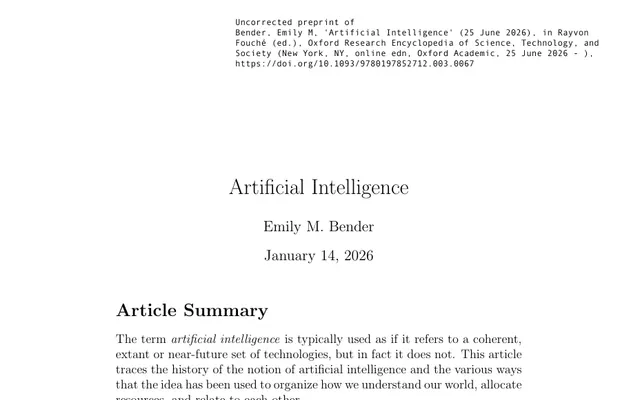
Artificial Intelligence — author preprint

Date printed on the author’s encyclopedia preprint. Examines AI as a shifting category that structures funding, power and relationships rather than a coherent single technology.

faculty.washington.edu
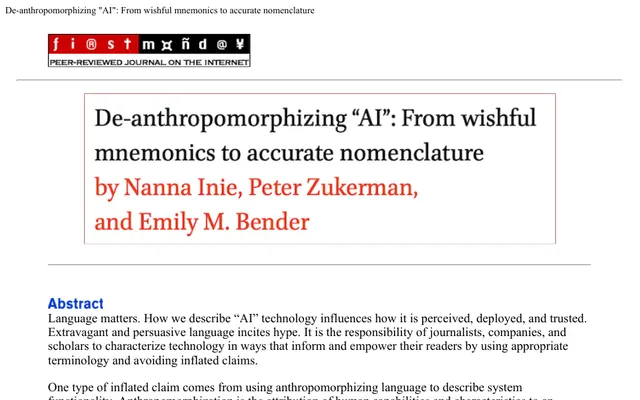
De-anthropomorphizing AI: From wishful mnemonics to accurate nomenclature

Coauthored with Nanna Inie and Peter Zukerman; abstract inspected. Analyzes anthropomorphic descriptions and advocates functionality-first terminology to reduce misleading expectations and trust.

firstmonday.org
EL PAÍS interview with Emily Bender and Alex Hanna

Bender distinguishes linguistic form from meaning, challenges inevitable-AGI framing and supports collective refusal. Hanna’s separate answers are not attributed to Bender.

elpais.com
The AI Con — authors’ book site

Book description and publication metadata, not full-book access. Frames inflated capability promises as serving corporate power and advocates a different technological future.

thecon.ai
Numbers are not science

Bluesky post read via the public API. Closing a thread, she says that using a number to make a claim does not mean any science was done to get there, and compares a 10% doom claim to a 10% chance of jelly beans raining tomorrow. A dismissal of P(doom) figures, not a personal estimate.

bsky.app
你的立场在哪里?
回答几个简单问题,探索你自己的AI世界观。
描绘你自己的世界观

你的立场在哪里?

描绘我的世界观