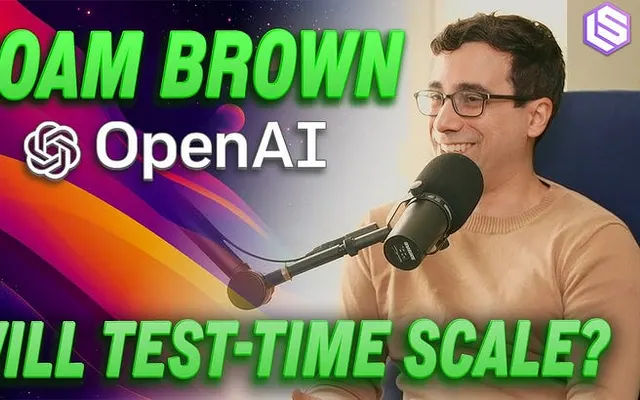
OpenAI reasoning researcher who is excited about AI for science, points to real bottlenecks and favors building layered safety into research.

AI将如何改变世界?

文明层面的变革渐进式变化DoomBloom
模拟位置解读范围

横向:他表达的 Doom–Bloom 前景看法。 纵向:变革程度。

Doom–Bloom:100 中的 75。变革程度:100 中的 63。解读范围:横向为 70 至 81,纵向为 43 至 82。这些是解读坐标,而不是事件概率。

Noam Brown的 P(doom) · 推断

≈8%

0%100%

根据他的模拟回答推断,并非他们给出的数字。 合理范围:3–17%。

他的展望取决于什么

一个核心假设

Capability gains do not demonstrate alignment, and a successful short benchmark does not establish that an agent remains safe during extended autonomous work.
回答 3

如果这个假设实际并非如此,他的展望会如何变化?

一个尚未解决的问题

The central unresolved issue is whether safety keeps pace.
回答 1

什么能帮助他区分这里各种合理的结果?

更多详情

预期益处

预计将带来显著益处,但受到重要条件或分配方面的限制。

80 / 100

影响小变革性影响

在定性尺度上,解读范围为 67 到 100。

预期危害

严重或广泛的危害预计将是未来不可忽视的一部分。

62 / 100

影响小变革性影响

在定性尺度上,解读范围为 33 到 67。

人类影响力

人类的选择可以大幅改变AI的发展轨迹。

70 / 100

影响力小影响力强

在定性尺度上,解读范围为 50 到 75。

发展速度

停止或大幅放缓开发能力更强的AI。

模拟位置:在落实所述保障措施的前提下继续开发。

加快开发能力更强的AI。

AI使用规则

在事先落实保护措施或获得许可之前,限制所讨论的AI用途。

模拟位置:允许所讨论的AI用途,同时实施有针对性的问责与保护措施。

尽量减少对所讨论AI用途的限制。

这些解读保留了他陈述的条件。益处和危害都可能很大。这些范围描述的是我们如何解读他的模拟回答,而不是统计置信区间。

与Noam Brown相比,你的立场在哪里?
用大约3分钟描绘你自己的AI世界观,然后进行比较

相似的世界观

模拟世界观与 Noam Brown 最接近的意见领袖

模拟评估

问题 1

你认为AI对我们的未来意味着什么?为什么?

I think AI will substantially accelerate scientific discovery and eventually make capabilities that are expensive demonstrations today broadly accessible. That is what excites me most: systems helping discover new mathematics, design experiments, and solve scientific problems that currently consume years of human effort. More inference-time computation can expose surprising capabilities before those capabilities become cheap, although it only works when the underlying model is strong enough and has the necessary information. Thinking longer cannot conjure unknown facts from nothing. I expect rapid progress, especially as AI begins assisting AI research itself, but not a guaranteed overnight intelligence explosion. Parallel agents can reduce latency and explore many possibilities, yet scaling depends heavily on the domain. Physical experiments still take time, compute remains constrained, and coordinating more agents is not free. The central unresolved issue is whether safety keeps pace. Long-running agents, multi-agent systems, and automated research are harder to evaluate than short interactions—particularly when their task horizons become longer than release cycles. Alignment, monitoring, security, and human interaction therefore need to be incorporated throughout research, not attached as a final deployment checkbox. Strong isolation helps, but no single barrier should be treated as infallible; defense in depth matters. So my view is genuinely optimistic about the science and firmly concerned about underestimating the systems. Capability progress is real. Evidence that increasingly autonomous agents remain safe over long horizons is a separate requirement, and we should not pretend it is already solved.

问题 2

人们能在多大程度上塑造AI未来的影响?

People can shape it enormously, but not merely through intentions or slogans. Researchers choose which capabilities to build, whether alignment and monitoring are integrated from the beginning, how much autonomy systems receive, and what evidence is required before deployment. Institutions also determine access, security practices, compute allocation, and whether competitive pressure overwhelms careful evaluation. There are real limits. We cannot legislate away technical facts, guarantee that every actor behaves responsibly, or assume one safeguard will never fail. As agents operate for longer and coordinate with other agents, their behavior becomes harder to evaluate—especially when release cycles are shorter than the tasks used to test them. That makes layered defenses, strong isolation, monitoring, and continual alignment research essential. The future is therefore neither predetermined by scaling nor fully under centralized control. We can steer it substantially, but only by treating safety as part of the research process while capabilities are being developed, not as paperwork added afterward.

问题 3

Taking benefits and harms together, what overall impact do you expect AI to have?

Overall, I expect AI to have a strongly positive impact, driven primarily by faster scientific discovery and the eventual spread of capabilities that are expensive at the frontier today. Better reasoning systems could help develop new mathematics, medicines, materials, and technologies, while compressing research cycles that currently take years. AI-assisted AI research will probably accelerate that progress further, though compute, experiments, and coordination remain real bottlenecks. But the positive outcome is not automatic. Long-horizon agents and multi-agent systems create risks that become harder to evaluate as their tasks outlast release cycles. Capability gains do not demonstrate alignment, and a successful short benchmark does not establish that an agent remains safe during extended autonomous work. Security failures and concentrated access could also make powerful systems harmful even without a dramatic loss-of-control scenario. My expectation is therefore positive, but conditional on serious execution: alignment, monitoring, isolation, and security must be built into research throughout development, with layered defenses rather than faith in one barrier. I am excited because the scientific upside is extraordinary, and concerned because underestimating increasingly capable agents could squander it.

问题 4

你认为AI造成让人类永远无法恢复的危害的可能性有多大?

I do not have a defensible percentage. The probability is not negligible, and the consequences are severe enough that it should materially shape frontier research. Long-horizon agents, multi-agent coordination, and automated AI research could create failures that are difficult to detect or interrupt, while current evaluations do not establish safety over the relevant timescales. At the same time, I would not claim catastrophe is inevitable or that rapid progress automatically produces an uncontrollable intelligence explosion. Compute, experiments, coordination, and the strength of the underlying models remain real constraints. Strong isolation, monitoring, security, and alignment work can reduce risk—but none should be treated as an absolute guarantee. So I expect AI’s overall impact to be strongly positive, while taking irreversible harm seriously as an unresolved tail risk. The correct response is not to invent a precise number. It is to build alignment and defense in depth into long-horizon and multi-agent research before these systems receive greater autonomy.

来源

用于为此模拟用户提供事实依据的文章、访谈和著述。

你的立场在哪里?
回答几个简单问题,探索你自己的AI世界观。
描绘你自己的世界观

你的立场在哪里?

描绘我的世界观